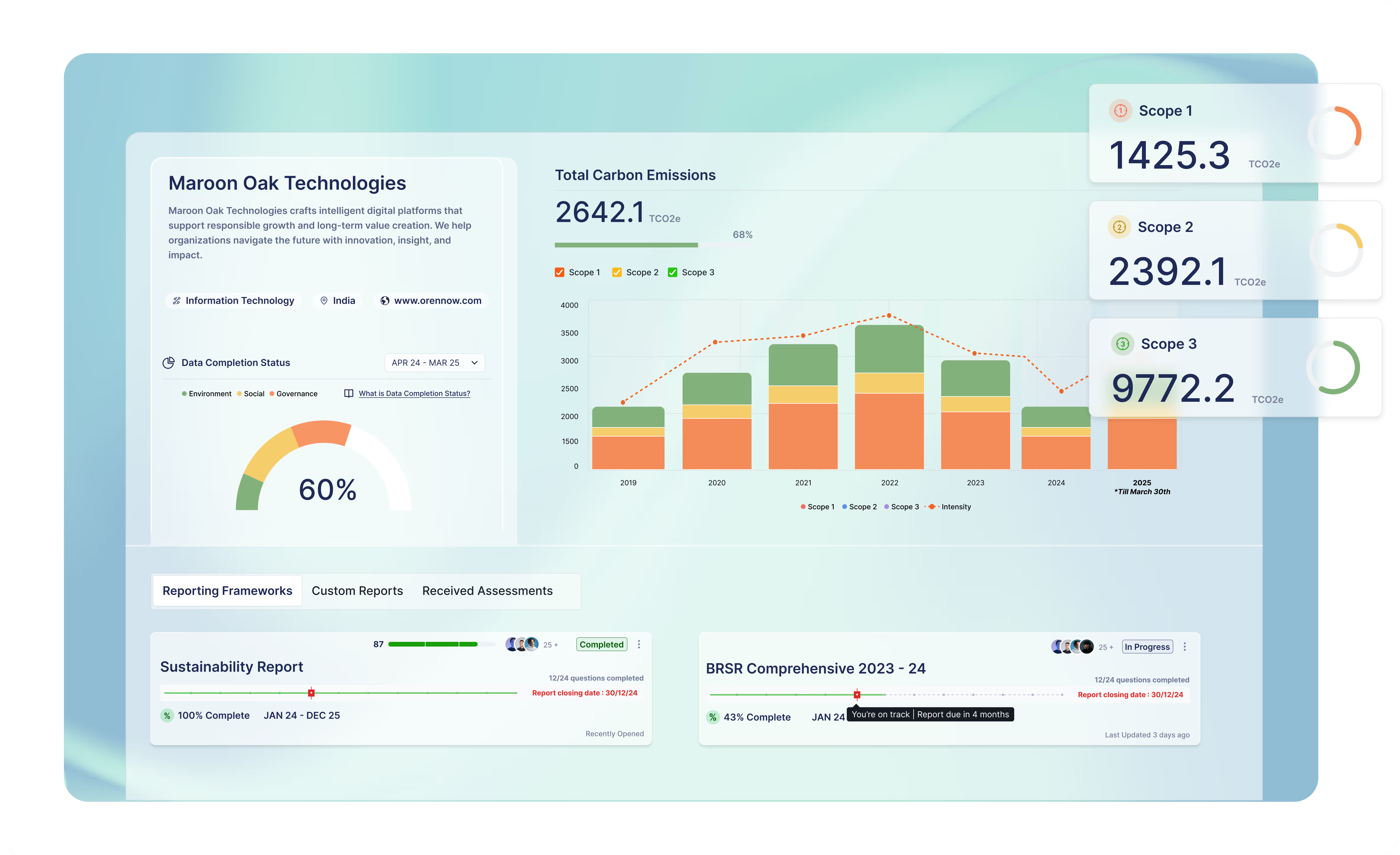
Scope 1, 2 & 3 Emissions: Definitions, Examples & How to Report
Scope 1, 2, & 3 emissions explained for business with examples, key differences, carbon emissions reporting essentials, and a look at the future outlook for companies.
Financial risk associated with climate is no longer a distant concern in boardrooms; it is now a core issue for investors and regulatory bodies.
Task Force on Climate-related Financial Disclosures (TCFD) offers an internationally recognised framework allowing organisations to identify, organise, and report their exposure to climate-related risks through structured TCFD reporting. This model is based on four core fundamental pillars, which include: governance, strategy, risk management and metrics & targets.
However, a grasp of the structure is just the beginning. To translate it into credible, consistent, investor-grade disclosure, the right process, the right data, and the right guidance are required. And Oren helps organisations move from one stage to the next, with ease.




























The Task Force on Climate-related Financial Disclosures (TCFD) was created in December 2015 by the Financial Stability Board (FSB) at the specific request of G20 Finance Ministers and Central Bank Governors. It was established to address a basic failure in global financial markets: investors had no reliable, comparable data on which to appropriately price climate-related risk.
In 2017, the TCFD released its landmark Final Report with 11 voluntary recommendations structured around four disclosure themes: Governance, Strategy, Risk Management, and Metrics & Targets. The aim was clear — to arm investors, lenders, and insurers with organised information to enable them to make informed decisions in a world constrained by climate.
The adoption has also been swift. As of November 2022, more than 4,000 organisations in 101 jurisdictions had supported the framework, which represents a total market capitalisation amounting to USD 27 trillion.
What initially started as voluntary reporting has continued to shift towards the regulatory space, with the UK, EU, Japan, Singapore, and Canada, among others, either requiring or formally incorporating TCFD-aligned disclosures.
TCFD disclosure is no longer simply a reporting exercise; it has become a signal of strategic credibility. Here is why it matters:
Not sure where to begin with TCFD or how to structure your climate-related financial disclosures? Our experts can walk you through the entire process and help you build a TCFD sustainability reporting approach.
The TCFD's recommendations are structured around four interconnected pillars, each addressing a different dimension of how climate risk flows through an organisation.
| Pillar | What It Covers |
|---|---|
| Governance | Board and management oversight of climate-related risks and opportunities.
|
| Strategy | Actual and potential impacts of climate risks on
|
| Risk Management | How the organisation
|
| Metrics & Targets | The data and goals used to track and manage climate-related performance, including Scope 1, 2, and 3 emissions. |
The TCFD classifies climate-related financial risks into two categories:
The TCFD sets out 11 recommended disclosures spread across its four pillars, not as a rigid checklist, but as a structured roadmap for meaningful, investor-grade TCFD reporting.
Every organisation's emissions profile is different. Connect with us, and we will help you identify the right metrics, set meaningful targets, and build a personalised TCFD reporting solution.
Most organisations know they need to act on TCFD. The challenge is knowing where to start and how to move through the process without losing momentum or creating duplication across teams. Oren simplifies that journey from the very first step.
Oren assists organisations to determine and quantify climate-related risks and opportunities throughout operations and supply chains, to have a clear and evidence-based base before any disclosure work begins.
After that, we guide teams through structured climate scenario analysis, including a 2°C or lower pathway, to test the resilience of your business strategy in the face of various possible future conditions and surface risks that are not part of the normal risk register.
Oren supports the integration of climate considerations directly into board-level governance and management accountability structures, so TCFD is embedded into how decisions are made, not treated as a separate reporting exercise.
Oren maps climate-related data to the corresponding TCFD recommendations and disclosures intelligently using our TCFD software, eliminating the need to manually work on them and enhancing the accuracy of all four pillars.
At last, Oren generates structured, TCFD-compliant reports through a robust TCFD reporting platform that clearly communicates climate strategy, performance, and targets to investors and stakeholders, with alignment to IFRS S1 and S2 built in from the outset. Our IFRS S1 and S2 services ensure organisations meet both climate and sustainability disclosure standards seamlessly, fully supported by an IFRS S1 and S2 solution designed for long-term compliance.
Metrics and targets are where TCFD disclosure moves from narrative to accountability. They are the quantitative proof that an organisation's climate strategy is grounded in real data, not just good intentions.
The cornerstone of TCFD metrics:
Emissions normalised against a business metric such as revenue, production output, or employee headcount, enabling meaningful year-on-year comparison and clearer communication with investors.
Including net-zero commitments or science-based targets, with clearly disclosed timelines, base years, and progress milestones.
The proportion of capital expenditure directed towards low-carbon assets, technologies, or transition activities, signalling that financial decisions are aligned with climate commitments.
Not sure where your reporting gaps are? Our experts will help you get to investor-grade TCFD reporting with confidence.
Avoiding TCFD is not a neutral choice; it carries real and growing consequences.

“Oren is very professional, and they deliver their services and commitments in a time-bound manner. The products they have developed are absolutely topnotch and it caters to all our requirements.”


“Oren's technology and expert advisory helped us overcome data management hurdles and navigate stakeholder engagement, materiality assessment and quantifying environmental impact to publish our first BRSR report.”


“Oren immensely helped us with our Scope 1 and Scope 2 reporting. Overall, the team is well updated and very supportive - and they were always just a call away. I definitely recommend Oren to anyone who is looking for assistance in their ESG journey.”


“Oren's expertise has been instrumental in driving our ESG achievements, consistently guiding us with professionalism, reliability, and timely execution. Their outstanding products not only surpassed expectations but also fully complied with Metrochem API Industries' ESG standards.”

“Oren is very professional, and they deliver their services and commitments in a time-bound manner. The products they have developed are absolutely topnotch and it caters to all our requirements.”
“Oren's technology and expert advisory helped us overcome data management hurdles and navigate stakeholder engagement, materiality assessment and quantifying environmental impact to publish our first BRSR report.”
“Oren immensely helped us with our Scope 1 and Scope 2 reporting. Overall, the team is well updated and very supportive - and they were always just a call away. I definitely recommend Oren to anyone who is looking for assistance in their ESG journey.”
“Oren's expertise has been instrumental in driving our ESG achievements, consistently guiding us with professionalism, reliability, and timely execution. Their outstanding products not only surpassed expectations but also fully complied with Metrochem API Industries' ESG standards.”
The Task Force on Climate-related Financial Disclosures (TCFD) is an organization established in 2015 by the Financial Stability Board (FSB) to develop recommendations for more effective climate-related disclosures. Its goal is to promote informed investment, credit, and insurance underwriting decisions by enhancing transparency on climate-related risks and opportunities.
The TCFD recommendations provide a framework for companies to disclose climate-related financial information. They are structured around four thematic areas: Governance: Disclose the organization’s governance around climate-related risks and opportunities. Strategy: Disclose the actual and potential impacts of climate-related risks and opportunities on the organization’s businesses, strategy, and financial planning. Risk Management: Disclose how the organization identifies, assesses, and manages climate-related risks. Metrics and Targets: Disclose the metrics and targets used to assess and manage relevant climate-related risks and opportunities.
The TCFD recommendations are applicable to organizations across sectors and jurisdictions. They are particularly relevant for companies with public debt or equity, as well as asset managers and owners. While adoption is voluntary, many organizations choose to implement the recommendations to enhance transparency and meet investor expectations.
Disclosure under the TCFD recommendations is currently voluntary. However, some countries are moving towards mandating such disclosures. For example, the UK government has announced plans to make TCFD-aligned disclosures mandatory for certain companies by 2025.
Implementing the TCFD recommendations can provide several benefits, including: Enhanced Transparency: Improved disclosure of climate-related risks and opportunities. Better Risk Management: Structured assessment and management of climate-related risks. Informed Decision-Making: Provision of decision-useful information to investors and stakeholders. Reputation Enhancement: Demonstration of commitment to sustainability and responsible business practices.
Organizations can begin by reviewing the TCFD recommendations and assessing their current disclosure practices against them. Engaging with stakeholders, conducting scenario analysis, and integrating climate-related considerations into governance and risk management processes are key steps. Utilizing resources such as the TCFD Knowledge Hub can provide additional guidance.
Yes, the TCFD emphasizes the importance of scenario analysis in assessing the potential impacts of climate-related risks and opportunities. It provides guidance to help organizations consider different climate-related scenarios, including a 2°C or lower scenario, to understand the resilience of their strategies under various potential future states.
Yes, the TCFD has developed supplemental guidance for specific sectors, particularly those with significant exposure to climate-related risks and opportunities. These sectors include energy, transportation, materials and buildings, and agriculture, food, and forest products. The supplemental guidance offers additional context and suggestions tailored to these industries.
Scope 1, 2, & 3 emissions explained for business with examples, key differences, carbon emissions reporting essentials, and a look at the future outlook for companies.

How to Choose the Right ESG framework guide for businesses. Compare GRI, SASB, TCFD, & CDP to align reporting with industry standards & meet sustainability goals.
The Global Reporting Initiative (GRI) Standards are a critical framework for sustainability reporting, widely used by organisations to communicate their economic, environmental, and social impacts. This blog explores the GRI’s importance, particularly in India, where ESG reporting is gaining prominence. It highlights how the GRI Standards help companies align with global guidelines like the UN SDGs and the OECD Guidelines. With Universal, Sector, and Topic Standards, the GRI framework offers a flexible yet comprehensive approach to sustainability reporting. Tools like Oren’s platform simplify ESG reporting, aiding businesses in meeting global standards and contributing to sustainability goals.

A materiality assessment is a key tool for identifying and prioritizing the most relevant Environmental, Social, and Governance (ESG) issues that affect a company's operations and stakeholders. By focusing on significant issues, companies can align their sustainability strategies with stakeholder expectations, ensuring compliance with ESG reporting standards like GRI and BRSR. Conducting an effective assessment involves engaging both internal and external stakeholders, identifying critical ESG issues, prioritizing them through a matrix, and using the results to inform strategy. Materiality assessments enhance transparency, improve decision-making, and foster long-term sustainable growth.