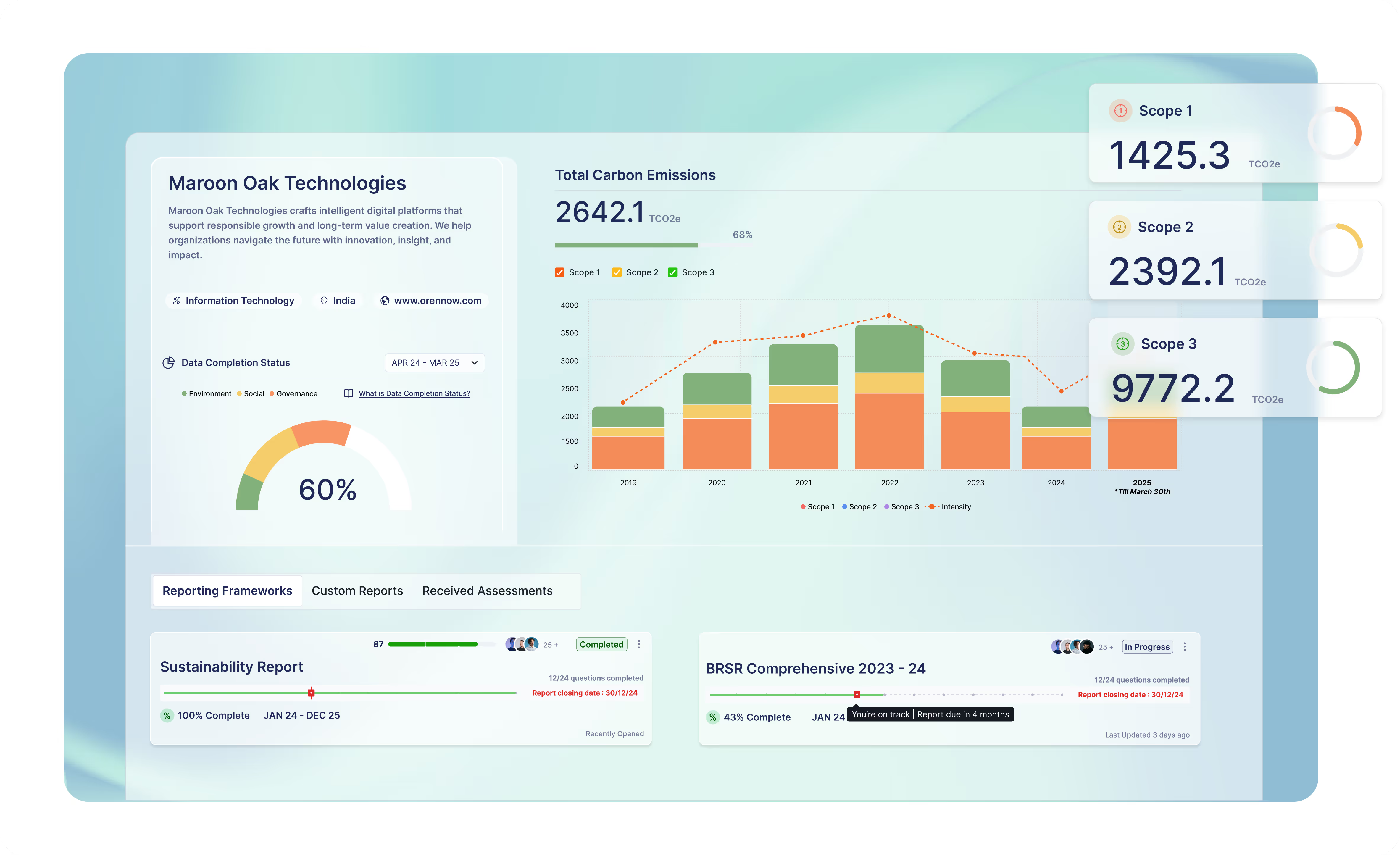
Comprehensive Guide to ESG Data Management & Reporting Software
Compare ESG data management software and platforms: what they do, the key selection criteria, and how to choose the right ESG reporting tool for your business.
An ESG strategy is the structured framework through which an organisation identifies, manages, and reports on its environmental, social, and governance responsibilities in a manner that relates directly to business performance and long-term value generation. It forms a fundamental aspect of how organisations build resilience, gain stakeholder trust, and access capital.
But building a credible ESG strategy takes more than good intentions. It requires the right structure, the right data, and the right expertise. Oren helps organisations design and implement it, end-to-end.






























Investors factor ESG into decisions
Assets actively divesting from weak ESG
CSRD fine cap on global turnover
SEBI fine for BRSR non-compliance
An ESG strategy is a structured framework that defines how an organisation integrates environmental, social, and governance priorities into its core business decisions, operations, and long-term planning. It shapes how a company manages everything from carbon emissions and supply chain responsibility to board governance, in a quantifiable, uniform manner.
The pressure to act is growing. As regulatory frameworks such as CSRD, BRSR, TCFD, and GRI continue to raise disclosure expectations, an ESG corporate strategy has become central to how organisations demonstrate credibility to global capital markets. Institutional investors are enquiring about ESG performance more than ever, as 89% of investors now consider ESG a factor in investment.
A strong ESG strategy creates impact beyond sustainability reporting, making it critical for businesses:
A well-structured ESG strategy is built across three interconnected pillars, each addressing a distinct dimension of how a business creates or destroys long-term value.
How an organisation deals with the natural world.
How the organisation treats its people and communities.
The structures that make ESG credible and investable.
The pillars support each other: environmental commitments need governance structures to hold them accountable; social outcomes depend on operational decisions rooted in the environmental pillar; and governance provides the whole structure with credibility among investors, regulators, and the communities where organisations are based.
Ready to build your ESG strategy?
Every organisation's sustainability journey looks different. Tell us where you are, and Oren's ESG strategy advisory team will help you build a clear, structured path forward.
Building an ESG strategy is structured, and so is its reporting. It follows a five-stage framework.
Determine the existing level of ESG performance regarding all three pillars and compare it with peers and applicable standards, including GRI, BRSR, and CSRD.
Determine strategic priorities and long-term ESG objectives based on an effective materiality assessment and stakeholder feedback.
Integrate ESG priorities into business practices, governance systems, and supply chain management via action plans.
Monitor progress with a set of KPIs aligned to regulatory and investor expectations.
Report on performance transparently using organised disclosure that complies with BRSR, CSRD, TCFD, and GRI reporting requirements.
After the framework come the steps for building an effective ESG strategy — moving from awareness to measurable, reportable outcomes.
Assess existing ESG performance, data maturity, and reporting practices to create a clear starting point.
Determine and rank the ESG issues that are most pertinent to the business, its industry, and its stakeholders.
Assess the financial materiality and regulatory exposure of operations and value chain by mapping climate, social, and governance risks.
Build a time-bound, practical plan with specific targets, duties, and milestones geared towards BRSR, CSRD, and GRI models.
Integrate ESG priorities into governance systems, business operations, and supplier engagement initiatives.
Organisations that consider reporting as an initial phase tend to publish disclosures that are superficial, inconsistent, and not credible to investors. An organised ESG approach makes each piece of data in a report traceable to a strategic business choice.
| Aspect | ESG Strategy | ESG Reporting |
|---|---|---|
| Purpose | Forward-looking plan and goal-setting. | Backward-looking performance disclosure. |
| Focus | Priorities, targets, and integration. | Progress, outcomes, and compliance. |
| Driven by | Business decisions and risk management. | Frameworks — BRSR, CSRD, GRI, TCFD. |
| Audience | Internal leadership and advisors. | Investors, regulators, and stakeholders. |
| Comes first? | Yes — strategy precedes reporting. | No — follows once the strategy is in place. |
Oren's ESG strategy advisory methodology is built to move your organisation beyond intent into structured, measurable, and disclosure-ready sustainability performance. Here is how we work.
We start by reviewing your current ESG performance, data infrastructure, and reporting maturity across all three pillars — Environmental, Social, and Governance — so we know exactly where you stand.
With a systematic materiality analysis, we recognise and rank the ESG issues that matter most to your business and to your stakeholders, forming the basis of your ESG corporate strategy.
We evaluate climate, social, and governance risks in financial materiality along your value chain and incorporate them into your enterprise risk structures — turning ESG strategy solutions into genuine business intelligence.
We align your strategy with BRSR, CSRD, GRI, TCFD, and DJSI requirements so you can comply with current demands and stay ahead of changing regulator expectations.
We collaborate with your teams during the entire implementation process — from governance structuring and supplier engagement to ESG communication at the board level and investor reporting.
Not sure where your ESG strategy should begin?
Connect with us, and we'll help you identify the right priorities, align with the right frameworks, and build a personalised ESG strategy that works for your business.
Companies that operate without a structured ESG strategy are increasingly exposed to regulators, investors, and the public. The risks are no longer theoretical.
Non-compliance with BRSR can trigger SEBI fines starting at INR 1 lakh per day; CSRD violations carry fines of up to 5% of global annual turnover.
Institutional investors managing over $25 trillion in assets are actively divesting from companies without credible ESG programmes.
Poor ESG scores lead to unfavourable credit terms, restricted access to green finance, and exclusion from ESG-screened investment portfolios.
Businesses without ESG alignment risk being dropped from supplier networks and excluded from public sector procurement.
Your ESG strategy starts with the right conversation.
Every organisation's sustainability journey looks different. Tell us where you are, and Oren's ESG strategy advisory team will help you build a clear, structured path forward.
Building an ESG strategy is only half the work; executing it consistently, tracking performance, and staying ahead of regulatory change is where most organisations struggle. The Oren Sustainability Hub is built to close that gap.
Every organisation's sustainability context is different. We develop tailored ESG strategy solutions that reflect your industry, regulatory environment, and stakeholder expectations — not a generic template.
From governance restructuring to supply chain engagement and emissions tracking, our team works alongside yours to embed ESG priorities into day-to-day operations — not just annual reports.
Oren's platform gives you live visibility into your ESG KPIs across Environmental, Social, and Governance dimensions, so you can course-correct quickly and report with confidence.
We align your strategy and disclosures to BRSR, CSRD, GRI, TCFD, and DJSI from the outset, so you're not rebuilding your reporting approach every time a new regulation lands.

“Oren is very professional, and they deliver their services and commitments in a time-bound manner. The products they have developed are absolutely topnotch and it caters to all our requirements.”


“Oren's technology and expert advisory helped us overcome data management hurdles and navigate stakeholder engagement, materiality assessment and quantifying environmental impact to publish our first BRSR report.”


“Oren immensely helped us with our Scope 1 and Scope 2 reporting. Overall, the team is well updated and very supportive - and they were always just a call away. I definitely recommend Oren to anyone who is looking for assistance in their ESG journey.”


“Oren's expertise has been instrumental in driving our ESG achievements, consistently guiding us with professionalism, reliability, and timely execution. Their outstanding products not only surpassed expectations but also fully complied with Metrochem API Industries' ESG standards.”

“Oren is very professional, and they deliver their services and commitments in a time-bound manner. The products they have developed are absolutely topnotch and it caters to all our requirements.”
“Oren's technology and expert advisory helped us overcome data management hurdles and navigate stakeholder engagement, materiality assessment and quantifying environmental impact to publish our first BRSR report.”
“Oren immensely helped us with our Scope 1 and Scope 2 reporting. Overall, the team is well updated and very supportive - and they were always just a call away. I definitely recommend Oren to anyone who is looking for assistance in their ESG journey.”
“Oren's expertise has been instrumental in driving our ESG achievements, consistently guiding us with professionalism, reliability, and timely execution. Their outstanding products not only surpassed expectations but also fully complied with Metrochem API Industries' ESG standards.”
ESG strategy is the forward-looking plan that sets goals, priorities, and targets. ESG reporting discloses performance against those goals. Strategy must come first for reporting to be credible.
A successful ESG corporate strategy covers three pillars: Environmental (emissions, energy, biodiversity), Social (labour practices, diversity, human rights), and Governance (board accountability, anti-corruption, executive pay alignment).
An assessment and strategy based on materiality usually lasts three to six months, determined by the availability of data, complexity of the organisation, and the number of frameworks to be considered.
Oren provides end-to-end ESG strategy consulting that includes baseline assessment and materiality design through to framework alignment, implementation support, performance tracking, and disclosure-ready reporting.
Compare ESG data management software and platforms: what they do, the key selection criteria, and how to choose the right ESG reporting tool for your business.

A clear guide to MSCI ESG ratings, methodology, MSCI ESG data, how ratings are formed, the India Index, and actions companies can prioritise for businesses and investors.

ESG reporting is a vital practice that allows companies to disclose their environmental, social, and governance (ESG) performance. This transparency is increasingly important for investors, regulators, and stakeholders. The environmental aspect focuses on reducing carbon footprints, social impact addresses labor practices and community engagement, while governance deals with leadership and corporate policies. ESG reporting is essential for building investor confidence, ensuring regulatory compliance, improving market positioning, and securing access to capital. However, challenges like knowledge gaps and diverse reporting standards remain. As ESG reporting trends toward becoming mandatory, businesses that adopt effective reporting practices will gain a strategic edge in sustainability and long-term growth.

SEBI has made significant strides in integrating Environmental, Social, and Governance (ESG) factors into the Indian securities market, particularly through the introduction of the Business Responsibility and Sustainability Reporting (BRSR) framework. The BRSR is mandatory for the top 1,000 companies from FY 2022-23, with assurance requirements phased in from FY 2023-24. SEBI has also enabled ESG rating providers to register under CRA norms, encouraging transparency and reducing greenwashing risks. To further promote ESG adoption, SEBI has released a list of companies voluntarily reporting their sustainability performance, offering a roadmap for others to follow. By aligning with these initiatives, Indian companies can meet regulatory standards and attract responsible investors focused on sustainability.