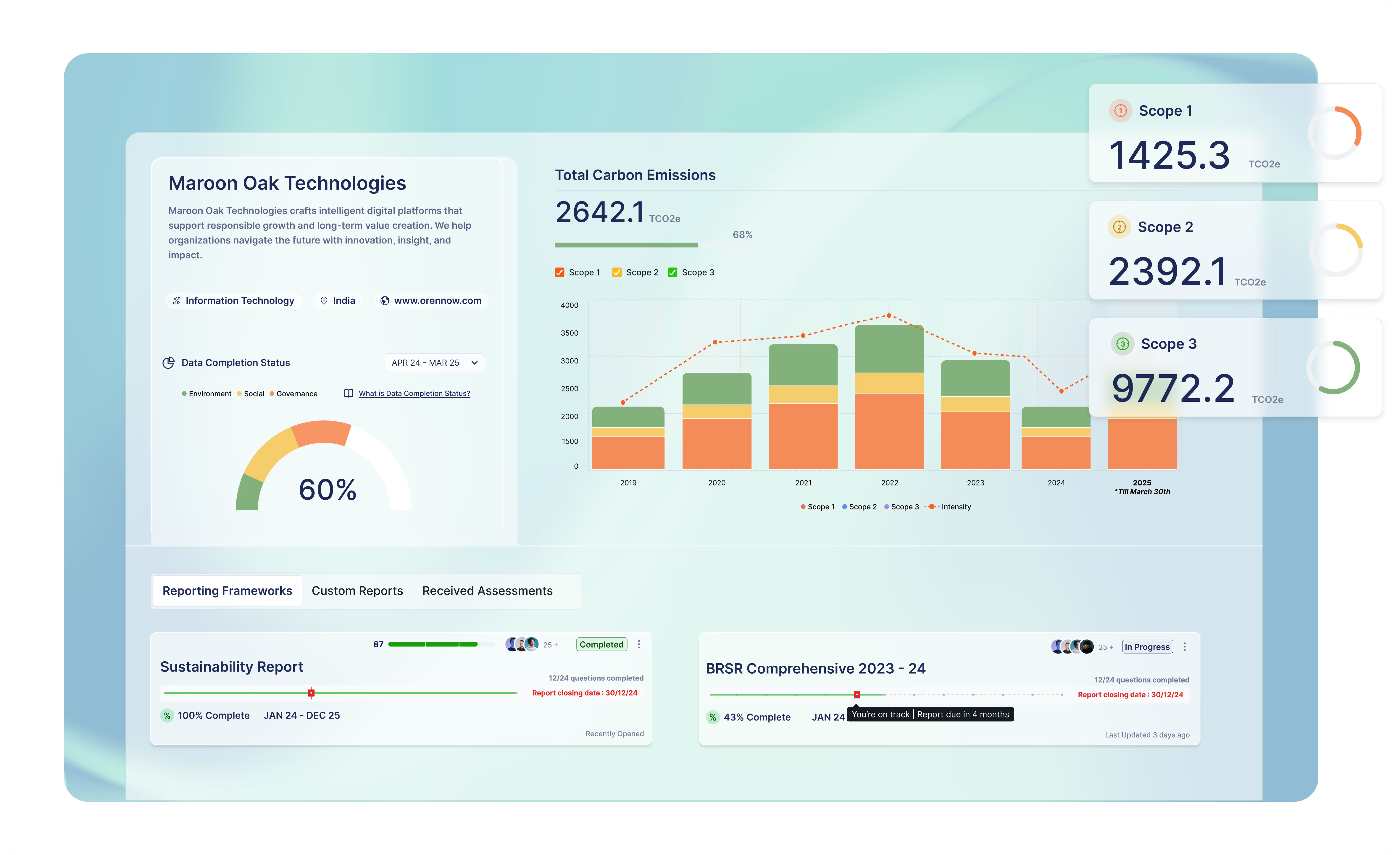
Understanding Carbon Footprint and Its Calculation
Understand carbon footprint and its calculation. Learn Scope 1 to 3 basics, choose actions that support sustainability, and advance carbon footprint goals for businesses.
CDP, formerly known as the Carbon Disclosure Project, is a globally recognised non-profit organisation that helps companies, cities, and governments measure, disclose, and manage their environmental impact. For organisations with global investors, lenders, or supply chain customers requesting disclosure, a strong CDP response directly shapes procurement decisions, capital access, and ESG credibility. Falling short, whether on accuracy or deadlines, carries real consequences.
With Oren's expertise, the CDP submission becomes straightforward. We make the process smooth and effective. Data collection, validation, and timely submission are our responsibility as we guide the organisation through every step.



























The CDP began in 2000 as an initiative to encourage companies to disclose carbon emissions to institutional investors. Over time, it has grown into the world's most comprehensive environmental disclosure platform covering climate, water and forest-related risk across global operations.
CDP operates through an integrated corporate questionnaire structured around three core areas:
CDP scores are widely used by institutional investors and corporations to guide decisions on capital allocation, procurement, and partnerships. As a result, disclosure plays a critical role in shaping business outcomes.
CDP's corporate questionnaire covers three core disclosure streams. Covering distinct environmental risk areas, they give investors and buyers insights into the business's environmental accountability.
| Parameter | Climate Change | Water Security | Forests |
|---|---|---|---|
| Coverage | Covers GHG emissions across Scopes 1, 2, and 3, reduction targets, climate governance, and climate-related risks and opportunities. | Addresses water sourcing, usage, operational exposure and long-term stewardship strategies across the business's value chain. | Deals with deforestation risk and supply chain exposure across key commodities including cattle, timber, soy, and palm oil. |
| Outcome | Disclose to hundreds of Capital Market Signatories, benchmark against global peers, and demonstrate the organisation's commitment to long-term sustainability. | Know where the water comes from and where it goes. Benchmark progress, identify opportunities, and build long-term operational resilience. | Measure the deforestation footprint, develop elimination plans, and benchmark against sector peers on ethical supply chain commitments. |
Depending on the business operation and the disclosure requests received, an organisation may need to respond to one, two or all three streams. Oren assesses the exposure and ensures each questionnaire is completed accurately and on time.
CDP evaluates each disclosure response across four scoring levels. Scores reflect the quality and depth of disclosure.
A / A-
Requires: Ambitious strategies, verified progress, and sector-leading action. Must meet essential criteria for all levels.
Signals: Best-practice environmental performance — the highest standard recognised by investors and buyers.
B / B-
Requires: Evidence of action and processes to manage environmental issues.
Signals: Active environmental management and operational commitment.
C / C-
Requires: Demonstrated understanding of how environmental issues relate to business activities and impacts.
Signals: Recognition of environmental risk, but action yet to take place.
D / D-
Requires: Complete and accurate questionnaire responses. Points allocated based on data volume and importance to data users.
Signals: Foundational reporting — willingness to disclose but limited depth beyond completeness.
The CDP disclosure process reflects a company's commitment to environmental transparency.
To complete CDP disclosure, companies must submit relevant questionnaire modules and report Scope 1, 2, and 3 emissions along with calculation methodologies. Disclosures also include governance structures, sustainability integration, and climate-related risks and opportunities. All responses must be accurate, comprehensive, and submitted annually within the defined timeline.
CDP disclosure applies to publicly listed companies, exporters, and organisations engaged in global supply chains. It is often requested by investors and customers, especially through CDP Capital Markets and Supply Chain programs.
Participation is increasingly essential, as CDP scores influence investment decisions, procurement eligibility, and overall business credibility.
Oren guides organisations through every stage to ensure accurate reporting, measurable improvement in environmental performance and strong scores.
Existing environmental data is reviewed against CDP disclosure requirements. Gaps are identified early to ensure nothing is overlooked before the process begins.
Relevant data across climate, water, and forests is gathered and structured to meet CDP framework standards accurately.
Actionable strategies are built around the organisation's disclosure profile. It positions responses to reflect leadership across all applicable CDP categories.
Every requirement is checked before the final submission is made. Accuracy, completeness, and compliance with CDP expectations are ensured throughout.
CDP disclosure performance is strengthened across all scored categories. It helps organisations demonstrate transparency to investors, customers, and global stakeholders.
Ready to strengthen your CDP disclosure?
Let's build an accurate, audit-ready response together.
Failing to disclose or scoring poorly on the CDP leads to real consequences across financial, commercial, and reputational fronts.
Absence from CDP exhibits a lack of transparency, eroding trust among investors, customers, and partners who rely on disclosed data to make informed decisions.
Institutional investors increasingly screen portfolios using CDP scores. A missing or weak disclosure raises immediate red flags around environmental risk management.
International buyers operating CDP Supply Chain programs may deprioritise or drop suppliers who fail to meet disclosure expectations, directly affecting contracts and revenue.
Without a CDP score, organisations have no visibility into their own environmental performance relative to industry peers and global standards.
Worried about your CDP readiness or score trajectory?
Our team can help you identify gaps and plan a stronger disclosure.
Oren Sustainability Hub brings together the tools, expertise, and strategic guidance needed to make CDP reporting accurate, efficient, and impactful.
Environmental data across climate, water, and forests is consolidated in one place. This reduces errors and ensures consistency across all CDP modules.
Reporting is continuously mapped against evolving CDP framework requirements. This keeps organisations ahead of regulatory and disclosure standard changes.
CDP responses are aligned with broader global ESG expectations. This ensures disclosure efforts contribute meaningfully to the organisation's overall sustainability positioning.
Responses are reviewed and refined to reflect the strongest possible performance across all scored CDP categories. This moves organisations up the D to A scoring ladder.
From the first data point collected to the final submission made, Oren manages the entire process with precision, ensuring nothing falls through the gaps.
Disclosed data is structured to meet the expectations of investors, customers, and global stakeholders, turning compliance into a credibility asset.

“Oren is very professional, and they deliver their services and commitments in a time-bound manner. The products they have developed are absolutely topnotch and it caters to all our requirements.”


“Oren's technology and expert advisory helped us overcome data management hurdles and navigate stakeholder engagement, materiality assessment and quantifying environmental impact to publish our first BRSR report.”


“Oren immensely helped us with our Scope 1 and Scope 2 reporting. Overall, the team is well updated and very supportive - and they were always just a call away. I definitely recommend Oren to anyone who is looking for assistance in their ESG journey.”


“Oren's expertise has been instrumental in driving our ESG achievements, consistently guiding us with professionalism, reliability, and timely execution. Their outstanding products not only surpassed expectations but also fully complied with Metrochem API Industries' ESG standards.”

“Oren is very professional, and they deliver their services and commitments in a time-bound manner. The products they have developed are absolutely topnotch and it caters to all our requirements.”
“Oren's technology and expert advisory helped us overcome data management hurdles and navigate stakeholder engagement, materiality assessment and quantifying environmental impact to publish our first BRSR report.”
“Oren immensely helped us with our Scope 1 and Scope 2 reporting. Overall, the team is well updated and very supportive - and they were always just a call away. I definitely recommend Oren to anyone who is looking for assistance in their ESG journey.”
“Oren's expertise has been instrumental in driving our ESG achievements, consistently guiding us with professionalism, reliability, and timely execution. Their outstanding products not only surpassed expectations but also fully complied with Metrochem API Industries' ESG standards.”
Companies receive a disclosure request, register on the CDP portal, complete the relevant questionnaire, undergo internal review and submit before the annual deadline. Then, CDP scores the response and publishes the results to request investors and buyers.
Companies choose the right CDP questionnaire — Climate, Water or Forests — by determining the key environmental issue for the business. They may also choose based on investor request or via CDP’s industry classification system.
The CDP Climate questionnaire focuses on emissions, energy and transition risks, while Water addresses usage and supply risks. The Forests questionnaire focuses on deforestation-linked commodities, supply chain impacts, and associated environmental risks.
Requested CDP submissions are from investors or customers holding formal authority to request data through CDP’s platform. Voluntary CDP submissions are self-initiated by the company itself to improve transparency, show leadership or prepare for future regulation.
Companies can improve their CDP scores by improving data quality and accuracy, optimising the value chain, engaging internal teams, and improving reporting practices.
CDP disclosure requires environmental data across emissions, climate-related risks and opportunities, energy consumption, targets, governance structure, water usage and risks. It may also require supply chain exposure to deforestation, if relevant.
Common mistakes in CDP reporting include incomplete questionnaire responses, missing or unverified emissions data, inability to meet essential criteria at each scoring level, late submissions and misalignment between stated targets and reported progress.
Oren works end-to-end with organisations, from data collection and gap analysis to questionnaire completion, internal review, and timely submission. Each step is managed to ensure responses are accurate, audit-ready, and aligned with CDP’s scoring methodology.
Understand carbon footprint and its calculation. Learn Scope 1 to 3 basics, choose actions that support sustainability, and advance carbon footprint goals for businesses.

Achieving net-zero emissions is a global priority driven by the need to combat climate change. Decarbonisation plays a crucial role in this journey by reducing greenhouse gas (GHG) emissions through sustainable practices and innovation. Businesses must focus on accurate data collection, sustainable supply chains, setting measurable goals, and adopting renewable energy and circular economy practices. Platforms like Oren's Sustainability Hub can streamline these efforts. By aligning with international standards like GRI and SBTi, companies not only comply with regulations but also unlock new business opportunities, positioning themselves as leaders in the sustainability movement.

Understanding the terms "Net Zero," "Carbon Neutral," and "Carbon Positive" is crucial in the global fight against climate change, especially for sustainability reporting. Net Zero means balancing the greenhouse gases emitted with the amount removed, focusing on eliminating emissions and using offsets like afforestation. Carbon Neutrality involves offsetting emissions through methods like purchasing carbon credits. Carbon Positivity refers to adding more emissions than are removed, often misused in greenwashing. Companies aiming for sustainability adopt renewable energy, reduce consumption, and invest in carbon-offsetting projects to align with ESG reporting standards like GRI and TCFD.
The Science Based Targets Initiative (SBTi), a collaboration between international organizations like the UN Global Compact and WWF, sets guidelines for companies to reduce greenhouse gas emissions in line with the Paris Climate Agreement. Over 4,000 companies globally have committed to science-based emissions reduction targets, which cover Scope 1, 2, and 3 emissions across the value chain. Companies can set science-based targets by selecting a baseline year, measuring emissions, and calculating reductions using methods like the Absolute Contraction Approach (ACA) or the Sectoral Decarbonisation Approach (SDA). SBTi is crucial for decarbonization, ensuring businesses align their operations with climate goals. Oren helps companies on their decarbonization journey, from emissions quantification to setting long-term reduction targets.