Biodiversity Reporting in India: Are Companies Ready for TNFD Disclosures?

Biodiversity Reporting in India: Are Companies Ready for TNFD Disclosures?
Biodiversity is moving to the centre of ESG conversations. Companies are no longer expected to report only on carbon. They are now being asked to disclose how their operations depend on and impact nature.
This shift is being driven by frameworks like the Taskforce on Nature-related Financial Disclosures. They bring structure to biodiversity disclosure and connect it directly to financial risk and strategy.
In India, the transition is already underway. With the Securities and Exchange Board of India mandating BRSR for the top 1,000 listed companies, the foundation for nature-related reporting is in place. Recent guidance also shows strong alignment between BRSR and TNFD, indicating that Indian companies may be closer to readiness than they realise.
But readiness is not uniform. Many organisations still lack the data, systems, and internal alignment needed for robust TNFD disclosures. So, let us learn the details.
What Biodiversity Reporting Is and Why It Is Becoming Critical for ESG Disclosures
Biodiversity reporting refers to how companies measure, manage, and disclose their impact on ecosystems, species, and natural resources. It goes beyond climate. It looks at how business activities affect forests, water systems, land use, and biodiversity loss.
This is becoming critical because nature-related risks are now financial risks. According to the World Economic Forum, more than half of global GDP is moderately or highly dependent on nature.
As a result, investors and regulators are responding. They want visibility into how companies depend on nature, and how they manage that risk. Thus, biodiversity disclosure is moving from voluntary storytelling to structured, decision-useful reporting. For companies, it is becoming a core part of ESG disclosures.
Role of Biodiversity Disclosure in Corporate Sustainability Reporting
It is worth noting that biodiversity disclosure adds depth to ESG reporting. It connects environmental impact with business strategy as well as risk management.
It helps companies:
Identify dependencies on natural resources (water, land, ecosystems)
Assess risks from biodiversity loss (supply chain disruption, regulatory action)
Demonstrate accountability to stakeholders
Frameworks like the Global Reporting Initiative already require disclosures on biodiversity impacts, protected areas, and habitat restoration.
What is changing now is the expectation of financial relevance. Biodiversity is no longer reported as a side metric. It is being integrated into governance, strategy, and risk disclosures. This shift is what is driving the rise of structured frameworks like TNFD.
Overview of TNFD Biodiversity and Nature-Related Financial Disclosures

The TNFD (Taskforce on Nature-related Financial Disclosures) came into the picture in June 2021 to help companies assess and disclose nature-related risks.
Its final recommendations, which came later in 2023, provide a structured framework across four pillars:
Governance
Strategy
Risk and impact management
Metrics and targets
At the core of TNFD is the LEAP approach:
Locate interfaces with nature
Evaluate dependencies and impacts
Assess nature-related risks and opportunities
Prepare responses to nature-related risks and disclosures on your material nature-related issues
TNFD is designed to mirror the structure of climate reporting frameworks like TCFD, making it easier for companies to integrate nature into existing ESG systems.
Globally, over 500 organisations managing USD 17.7 trillion in assets have committed to aligning with TNFD.
This signals a clear direction: biodiversity reporting is becoming a financial disclosure expectation.
How TNFD Disclosures Are Shaping Biodiversity Reporting for Companies
The following are the main ways in which TNFD disclosures are impacting
1. From qualitative to measurable
Companies are expected to quantify impacts on ecosystems, not just describe initiatives.
2. From CSR to risk management
Nature-related risks are being integrated into enterprise risk frameworks, alongside financial and climate risks.
3. From siloed to integrated reporting
Biodiversity is now linked with strategy, supply chains, and long-term value creation.
This shift aligns biodiversity reporting with investor expectations. It also ensures comparability across companies and industries.
State of Biodiversity Reporting in India and Corporate Preparedness
India is in a relatively strong position when compared to many other markets.
The Securities and Exchange Board of India (SEBI) introduced the Business Responsibility and Sustainability Reporting (BRSR) framework. This made ESG disclosures mandatory for the top 1,000 listed companies from FY 2022–23.
Recent guidance released by Confederation of Indian Industry, India Business & Biodiversity Initiative, and TNFD shows a high level of alignment between BRSR and TNFD.
Key insight:
Most of TNFD’s 14 recommended disclosures already overlap with BRSR requirements
Core indicators in BRSR align with TNFD metrics
Both frameworks include ecosystem impact and stakeholder engagement
This means Indian companies are not starting from scratch.
However, readiness is uneven. Many firms still:
Lack of granular biodiversity data
Do not map dependencies on ecosystems
Treat biodiversity as a compliance item rather than a strategic risk
So while the regulatory foundation exists, execution maturity varies widely.
Corporate Biodiversity Reporting Checklist for Organisations
To prepare for TNFD biodiversity disclosures, companies should focus on fundamentals:
Map nature dependencies and impacts across operations and supply chains
Identify high-risk locations (ecologically sensitive areas, water-stressed regions)
Integrate biodiversity into risk frameworks
Align disclosures with BRSR, GRI, and TNFD
Set measurable targets (restoration, conservation, resource use)
Establish data systems for tracking biodiversity metrics
Engage stakeholders including local communities and suppliers
Document policies and governance structures
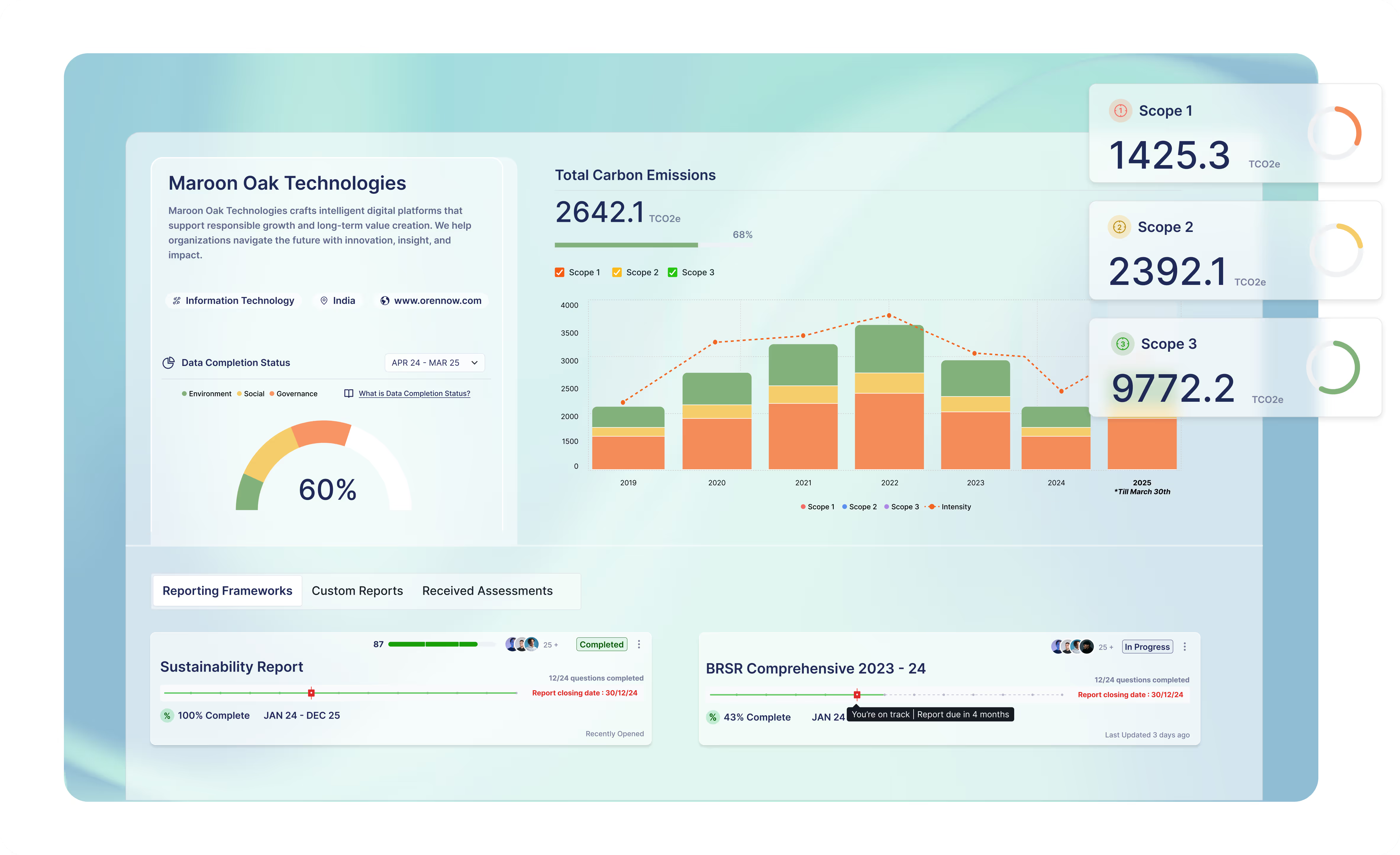
As biodiversity reporting becomes more data-intensive, organisations are also moving toward structured, system-driven approaches. At Oren, we support this shift by enabling data mapping to the TNFD indicator and centralising documentation. Thus, we help teams build consistent, audit-ready disclosures aligned with global frameworks.
Challenges Companies Face in Implementing Biodiversity Reporting
Despite progress, companies face real barriers:
Data gaps: Biodiversity data is complex, location-specific, and harder to quantify than carbon emissions.
Lack of standardisation: While TNFD provides guidance, methodologies are still evolving.
Limited internal expertise: Most ESG teams are still building capability in nature-related risk assessment.
Supply chain complexity: Impacts often occur deep within supply chains, making visibility difficult.
Integration challenges: Linking biodiversity with financial risk and strategy requires cross-functional alignment.
These challenges explain why many companies are still in the early stages of biodiversity disclosure.
Key Takeaways on Biodiversity Reporting and TNFD Disclosures
Biodiversity reporting is more than voluntary today. It is now becoming important for financial decision-making. To support this shift, TNFD provides a clear framework to help companies identify and report nature-related risks. In India, the BRSR framework is already closely aligned with TNFD requirements, which puts many companies in a good position. However, while the initial groundwork is there, gaps in data and execution still remain. Companies that act early can turn this into an advantage by building stronger investor trust and managing risks more effectively.
Frequently Asked Questions (FAQs)
Q1. What is biodiversity reporting?
It is the process of measuring and disclosing how a company impacts and depends on ecosystems, species as well as natural resources.
Q2. Why is biodiversity disclosure important for companies?
It helps identify risks and improve transparency. Biodiversity disclosure also helps meet investor and regulatory expectations around sustainability.
Q3. What are TNFD disclosures?
They are structured recommendations to help companies report nature-related risks, impacts, and opportunities.
Q4. How does TNFD biodiversity reporting work?
It uses the LEAP approach to identify, assess, and disclose nature-related risks within governance and strategy frameworks.
Q5. Are Indian companies required to report biodiversity risks?
Not explicitly under TNFD yet. But under BRSR, many related disclosures are already mandatory for top-listed companies.
Q6. What should be included in a corporate biodiversity reporting checklist?
Key elements include risk mapping, data systems, measurable targets, governance, and alignment with TNFD and BRSR.
Q7. How can companies prepare for TNFD disclosures?
Start with mapping dependencies and improve data quality. Integrate biodiversity into risk frameworks and align with existing reporting standards. Aligning with frameworks like BRSR and TNFD is key. Organisations can benefit from structured platforms such as the Oren Sustainability Hub to streamline data collection, map disclosures to TNFD indicators, and build consistent, audit-ready reports.

About the author
Kushagra
Senior ESG & Sustainability Advisor
Kushagra is a Senior ESG & Sustainability Advisor at Oren with 8+ years across CSR and sustainability consulting, specialising in GHG accounting, ESG strategy, and regulatory reporting across India, the UAE, and the Middle East.