Sector Specific Decarbonisation Solutions

The global push for a low-carbon future is definitely stronger than ever, driven by global decarbonization targets and climate commitments worldwide.

  • Investors are paying close attention
  • Governments are tightening rules
  • Consumers are putting up more challenging demands

Under these conditions, having a decarbonisation strategy should not be considered as just another good-to-have trait. Because it has become an absolute need for companies such as yours, especially when partnering with a reliable decarbonization company offering end-to-end decarbonisation solutions.

Creating a decarbonisation strategy can help companies stay ahead of risks and strengthen their brand among customers, regulators, and investors. Oren delivers industry-aligned decarbonisation solutions through a scalable decarbonisation platform that supports long-term growth. Our approach to corporate decarbonisation ensures that decarbonisation roadmaps align seamlessly with business expansion plans.

Solar panels in a green field representing clean energy and decarbonisation
Dr. Morepen
Epigral
Imperial Auto
Rustomjee
Jyothy Labs
Viyash
Thomas Cook
Eurogrip
Adani
India Gate
Panchshil
Banas Dairy
IPCA
Axis Max Life
Hetero
MODIFI
Ritz-Carlton
Carlyle
Blackstone
LiLA Global
GMS Leadership
Tenaga Nasional
Tecton
Deyaar
Aram Group
Future Pipe Industries
Injaz National
Taaleem
Emirates NBD
Dr. Morepen
Epigral
Imperial Auto
Rustomjee
Jyothy Labs
Viyash
Thomas Cook
Eurogrip
Adani
India Gate
Panchshil
Banas Dairy
IPCA
Axis Max Life
Hetero
MODIFI
Ritz-Carlton
Carlyle
Blackstone
LiLA Global
GMS Leadership
Tenaga Nasional
Tecton
Deyaar
Aram Group
Future Pipe Industries
Injaz National
Taaleem
Emirates NBD

What is Decarbonisation?

A company embarks on a decarbonisation journey when it takes steps to reduce emissions across its operations and supply chain using a structured decarbonisation service. This journey takes a few things into account:

  1. Conducting a baseline assessment of the current emissions
  2. Setting goals with a target year and emission reduction percentage in line. Aligning this goal with global standards such as Science-Based Targets Initiatives (SBTi) is highly recommended
  3. Creating an action plan in place to achieve the above goal. This action plan should be aligned with the business growth plans.
  4. Focusing extensively on reducing emissions before considering carbon offsets
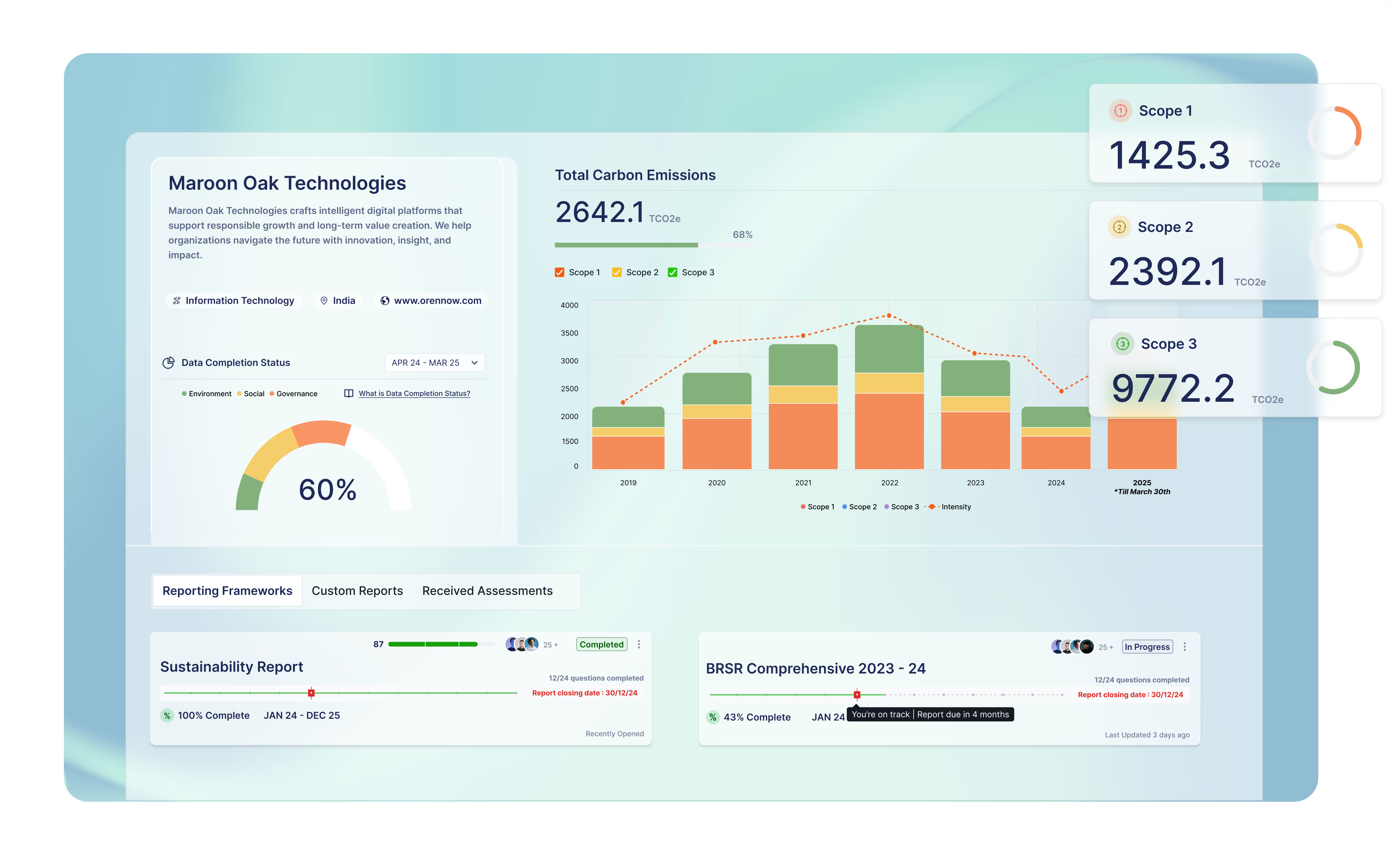
  5. Utilising award-winning technology platforms like Oren Sustainability Hub to measure and track emissions and decarbonisation goals

Some initiatives that large companies have taken up to reduce their emissions to achieve their decarbonisation goals are:

Renewable energy: Companies (Google and IKEA) have shifted large parts of their operations to 100% renewable power.

Green supply chains: Major manufacturers are working with suppliers to cut Scope 3 emissions from raw materials, packaging, logistics and warehousing.

Energy efficiency upgrades: Businesses are retrofitting buildings and optimising production lines. They are also reducing waste to lower emissions.

Decarbonisation strategy infographic

How Decarbonisation Works: Business Impact & Relevance

Today, decarbonisation is about more than environmental responsibility; it is a business imperative. Strong decarbonisation solutions help organisations remain competitive as customers, regulators, and investors demand climate accountability.

BenefitWhat It Means for You
Stay ahead of regulationsStrict carbon tax rules such as Carbon Border Adjustment Mechanism (CBAM) are already here. If companies don't act early to reduce their emissions, this will impact the cost of their products.
Cut costs and boost efficiencyRenewable energy, energy efficiency, and optimised operations = lower energy bills + resilience to price swings.
Build trust and market edgeClear corporate decarbonisation commitments strengthen reputation and stakeholder confidence.
Future-proof your businessClimate-centric investments drive innovation and keep you competitive in the long run. They also help you mitigate climate risks to operations and workforce.

Oren's Approach to Decarbonisation

At Oren, we follow a structured, expert-driven approach supported by technology and advisory. Our award-winning Oren Sustainability Hub acts as a comprehensive decarbonisation platform, combining analytics, compliance, and stakeholder engagement as part of our reporting & decarbonization services.

In execution of this approach, we do the following:

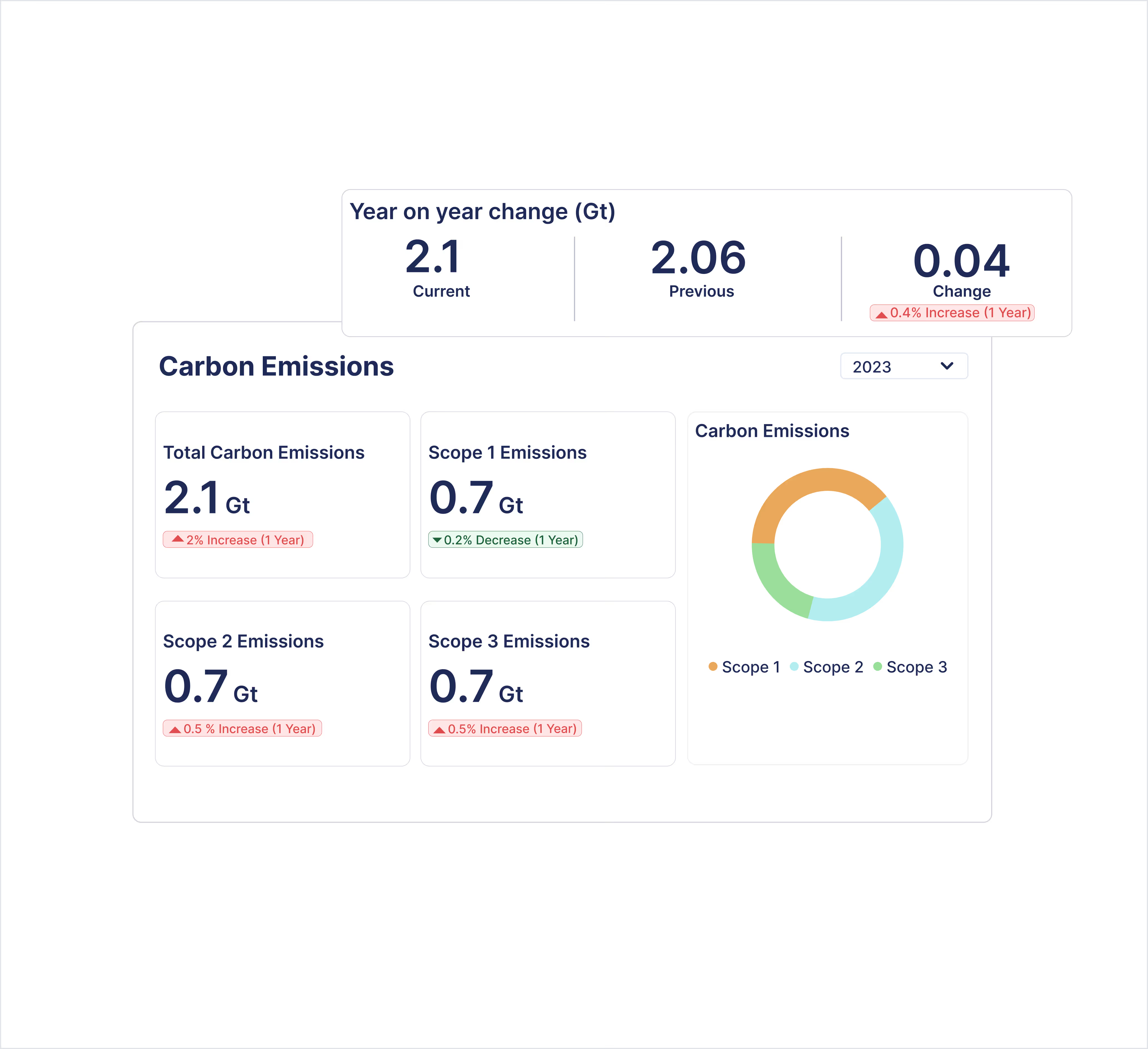
  • Use of AI for ease of calculation: Our AI-powered decarbonisation software automates Scope 1 and Scope 2 GHG calculations, enabling companies to upload invoices and track emissions in real time. This technology-backed approach positions Oren as a trusted decarbonization company delivering measurable outcomes.
  • Audit-ready Data: We ensure audit-ready data aligned with BRSR, GRI, TCFD, and CSRD. Our consultants design sector-specific decarbonisation solutions, while regional context guides renewable energy selection and fuel transition pathways.
  • Sector-specific Solutions: Oren's sustainability consultants provide sector-specific solutions.
  • Regional Context: Our decarbonisation roadmaps align with the company's regional context to determine what type of alternative fuel and renewable energy sources and contracts are easily available to them.

All in all, our differentiators lie in science-based targets, measurable outcomes, ESG alignment, and regulatory readiness. With Oren, decarbonisation becomes a driver of credibility and long-term growth.

Our Decarbonisation Services: Leading the Way to a Low-Carbon Future

We support organisations across industries with integrated decarbonisation services that reduce emissions and strengthen climate performance.

  • GHG Emissions Accounting: We account for GHG emissions across Scopes 1, 2, and 3 with tailored methodologies based on the data available with the operations, admin, and procurement departments.
  • Scope 3 Emissions Accounting: We engage suppliers to collect accurate scope 3 emissions data or conduct spend-based analysis where the supplier's activity data is not available. We also engage employees and customers for the same.
  • Customised Decarbonisation Roadmap: We develop a year-on-year decarbonisation roadmap that is aligned with science-based targets.
  • Marginal Abatement Cost Curve Development: We identify emissions reduction opportunities and initiatives and determine the capital expenditure and operating costs for each to identify feasibility.
  • Supply Chain Engagement for Decarbonisation: We engage suppliers on GHG emission-related assessments to collect activity data from them.
  • Renewable Energy Strategy: We develop renewable energy strategies that align with the company's geographical context and budgets.

Proven Strategies for Driving Decarbonisation

  • Adoption of renewable energy sources such as solar, wind, and hydropower to accelerate global decarbonization.
  • Electrify operations by replacing fossil fuels with renewable-powered electricity in heating, cooling, and transport.
  • Improve energy efficiency through upgrades such as LED lighting and optimised systems.
  • Use carbon capture and storage (CCS) to manage unavoidable emissions, with scalability still evolving.
  • Decarbonise the supply chain by engaging suppliers, setting reduction targets, and tracking progress with data.
Emissions calculation for decarbonisation

Accelerating Change Across Industries: Policies, Financing & Success Factors

SectorGlobal InitiativesIndia InitiativesKey Challenges
ManufacturingCompanies adopt AI-driven optimisation and renewable energy integration. A German beverage firm cut emissions by 19–80% using demand response and storage.National Green Hydrogen Mission promotes efficiency with subsidies and transmission waivers.High upfront costs; limited access to green capital.
TransportShift to electric and hydrogen mobility. Germany's Power to the Road aims for 350 fast-charging stations for trucks by 2030.Ethanol blending target advanced to 20% by 2025; push for EVs and biofuels.Infrastructure gaps; EV financing constraints.
Heavy IndustryHeidelberg Materials testing CCS in Norway to reduce cement emissions.Over 100 initiatives in steel and cement for carbon capture, green hydrogen, and circular economy.High financing needs for new technologies.
Cross-SectorGlobal push for green bonds and carbon pricing to scale investments.Innovative financing mechanisms and policy alignment are seen as critical enablers for transition.Aligning capital, policy, and institutions.

Decarbonisation and ESG: Priorities That Matter

Decarbonisation is key to strong ESG performance.

ESG reporting is no longer optional. By 2025, frameworks like BRSR, GRI, CSRD and ISSB will require companies to disclose environmental impacts, including carbon emissions and reduction efforts.

Decarbonisation metrics are now central to ESG reporting and ratings. Companies with clear, science-based targets and measurable progress score higher. They attract ESG-focused investors and lower capital costs.

Global energy-related CO₂ emissions reached a record high of 37.8 gigatonnes in 2024. It was a 0.8% increase from the previous year. There is an urgent need for accelerated decarbonisation efforts globally.

Why Choose Oren for Decarbonisation?

Partnering with Oren means more than guidance. It is about turning decarbonisation goals into real results. Here is why businesses trust us:

  • Expertise Across Industries: We bring deep knowledge of industries to help you sail through sector-specific challenges.
  • Advanced GHG Accounting: Using cutting-edge technology like our Oren Sustainability Hub platform and methodologies, we measure and track emissions across your operations and supply chain. We give you a clear, actionable view of your carbon footprint.
  • Decarbonisation Mapping: We create science-based roadmaps tailored to your company's unique sustainability goals. Our goal is to make your path to net-zero clear and achievable.
  • SBTi Implementation: Our experts guide you in integrating Science-Based Targets. We help you meet global standards and showcase credible climate action.
  • End-to-End Support: From strategy to implementation, we provide hands-on advisory support, innovative tools, and stakeholder engagement.

Go Beyond Reporting. Start Driving Real Impact.

What Our Clients Say

Oren is very professional, and they deliver their services and commitments in a time-bound manner. The products they have developed are absolutely topnotch and it caters to all our requirements.
Hover to watch
Atul Khanapurkar
Executive Director, Shriram Pistons & Rings
Shriram Pistons & Rings
Oren's technology and expert advisory helped us overcome data management hurdles and navigate stakeholder engagement, materiality assessment and quantifying environmental impact to publish our first BRSR report.
Shalaka Ovalekar
Company Secretary and VP-Legal, ADF Foods
ADF Foods
Oren immensely helped us with our Scope 1 and Scope 2 reporting. Overall, the team is well updated and very supportive - and they were always just a call away. I definitely recommend Oren to anyone who is looking for assistance in their ESG journey.
Hover to watch
Vidhi Thukral
Senior Manager, Max Financial Services
Max Financial Services
Oren's expertise has been instrumental in driving our ESG achievements, consistently guiding us with professionalism, reliability, and timely execution. Their outstanding products not only surpassed expectations but also fully complied with Metrochem API Industries' ESG standards.
Gandupalli Santosh Kumar
Deputy Manager - ESG/Sustainability, Metrochem API Pvt. Ltd
Metrochem API Pvt. Ltd
Oren is very professional, and they deliver their services and commitments in a time-bound manner. The products they have developed are absolutely topnotch and it caters to all our requirements.
Hover to watch
Atul Khanapurkar
Executive Director, Shriram Pistons & Rings
Shriram Pistons & Rings
Oren's technology and expert advisory helped us overcome data management hurdles and navigate stakeholder engagement, materiality assessment and quantifying environmental impact to publish our first BRSR report.
Shalaka Ovalekar
Company Secretary and VP-Legal, ADF Foods
ADF Foods
Oren immensely helped us with our Scope 1 and Scope 2 reporting. Overall, the team is well updated and very supportive - and they were always just a call away. I definitely recommend Oren to anyone who is looking for assistance in their ESG journey.
Hover to watch
Vidhi Thukral
Senior Manager, Max Financial Services
Max Financial Services
Oren's expertise has been instrumental in driving our ESG achievements, consistently guiding us with professionalism, reliability, and timely execution. Their outstanding products not only surpassed expectations but also fully complied with Metrochem API Industries' ESG standards.
Gandupalli Santosh Kumar
Deputy Manager - ESG/Sustainability, Metrochem API Pvt. Ltd
Metrochem API Pvt. Ltd

Frequently Asked Questions

The process takes place continuously for decades. It is a part of long-term global and national climate strategies.

You need to take a few steps if you wish to manifest decarbonisation, such as: Avoiding emissions; Lowering emissions; Swapping fossil fuels with renewable energy sources; Neutralising residual emissions.

Such people can greatly reduce emissions. Renewable energy sources and energy-efficient appliances and vehicles can make a difference. Public transit or cycling as transportation also helps greatly.

Global energy-related CO₂ emissions reached a record high of 37.8 gigatonnes in 2024. It was a 0.8% increase from the previous year. There is an urgent need for accelerated decarbonisation efforts globally.

To limit global warming to 1.5°C above pre-industrial levels, global CO₂ emissions must reach net zero by 2050. This requires a rapid and comprehensive transformation across all sectors.

Sectors like steel, cement, heavy transport, and aviation are among the most challenging to decarbonise due to their reliance on fossil fuels and complex production processes.

Decarbonisation helps companies: Reduce operational costs through energy efficiency; Enhance brand reputation and customer loyalty; Comply with evolving regulations and investor expectations; Future-proof operations against climate-related risks.

Effective decarbonisation involves setting science-based targets, implementing energy-efficient technologies, transitioning to renewable energy sources, and engaging stakeholders across the value chain to ensure comprehensive emission reductions.

'Net-zero' refers to balancing the amount of greenhouse gases emitted with an equivalent amount removed from the atmosphere, achieving a neutral impact on the climate.

Businesses can do a number of things, like: Conducting comprehensive carbon assessments; Setting clear and science-based targets; Implementing energy-efficient practices; Transitioning to renewable energy sources; Engaging suppliers to address Scope 3 emissions.

Comprehensive decarbonisation covers all aspects of an organisation's operations. It includes direct emissions (Scope 1), energy consumption (Scope 2), and value chain activities (Scope 3). All of it aims for a holistic reduction in carbon footprint.

Related Articles

View all

ESG Frameworks Explained: How To Choose The Right One

Selecting the right ESG framework is essential for organisations aiming to showcase their sustainability efforts and responsible business practices. This comprehensive guide breaks down the complexities of ESG frameworks, explains their significance, and highlights popular options like BRSR, GRI, SASB, TCFD, and CSRD. It covers key factors to consider, including materiality, stakeholder expectations, industry trends, and regulatory requirements. The blog also offers actionable steps for implementation, tips on using multiple frameworks, and insights on how ESG reporting drives long-term value creation.

Sustainability Simplified: Understanding Materiality Assessment

A materiality assessment is a key tool for identifying and prioritizing the most relevant Environmental, Social, and Governance (ESG) issues that affect a company's operations and stakeholders. By focusing on significant issues, companies can align their sustainability strategies with stakeholder expectations, ensuring compliance with ESG reporting standards like GRI and BRSR. Conducting an effective assessment involves engaging both internal and external stakeholders, identifying critical ESG issues, prioritizing them through a matrix, and using the results to inform strategy. Materiality assessments enhance transparency, improve decision-making, and foster long-term sustainable growth.

Understanding Decarbonisation and Net-Zero: The Pathway to a Sustainable Future

Achieving net-zero emissions is a global priority driven by the need to combat climate change. Decarbonisation plays a crucial role in this journey by reducing greenhouse gas (GHG) emissions through sustainable practices and innovation. Businesses must focus on accurate data collection, sustainable supply chains, setting measurable goals, and adopting renewable energy and circular economy practices. Platforms like Oren's Sustainability Hub can streamline these efforts. By aligning with international standards like GRI and SBTi, companies not only comply with regulations but also unlock new business opportunities, positioning themselves as leaders in the sustainability movement.

Creating an Effective SBTi Decarbonisation Roadmap

The Science Based Targets Initiative (SBTi), a collaboration between international organizations like the UN Global Compact and WWF, sets guidelines for companies to reduce greenhouse gas emissions in line with the Paris Climate Agreement. Over 4,000 companies globally have committed to science-based emissions reduction targets, which cover Scope 1, 2, and 3 emissions across the value chain. Companies can set science-based targets by selecting a baseline year, measuring emissions, and calculating reductions using methods like the Absolute Contraction Approach (ACA) or the Sectoral Decarbonisation Approach (SDA). SBTi is crucial for decarbonization, ensuring businesses align their operations with climate goals. Oren helps companies on their decarbonization journey, from emissions quantification to setting long-term reduction targets.

Go Beyond Reporting.Start Driving Real Impact.

Oren ESG Dashboard