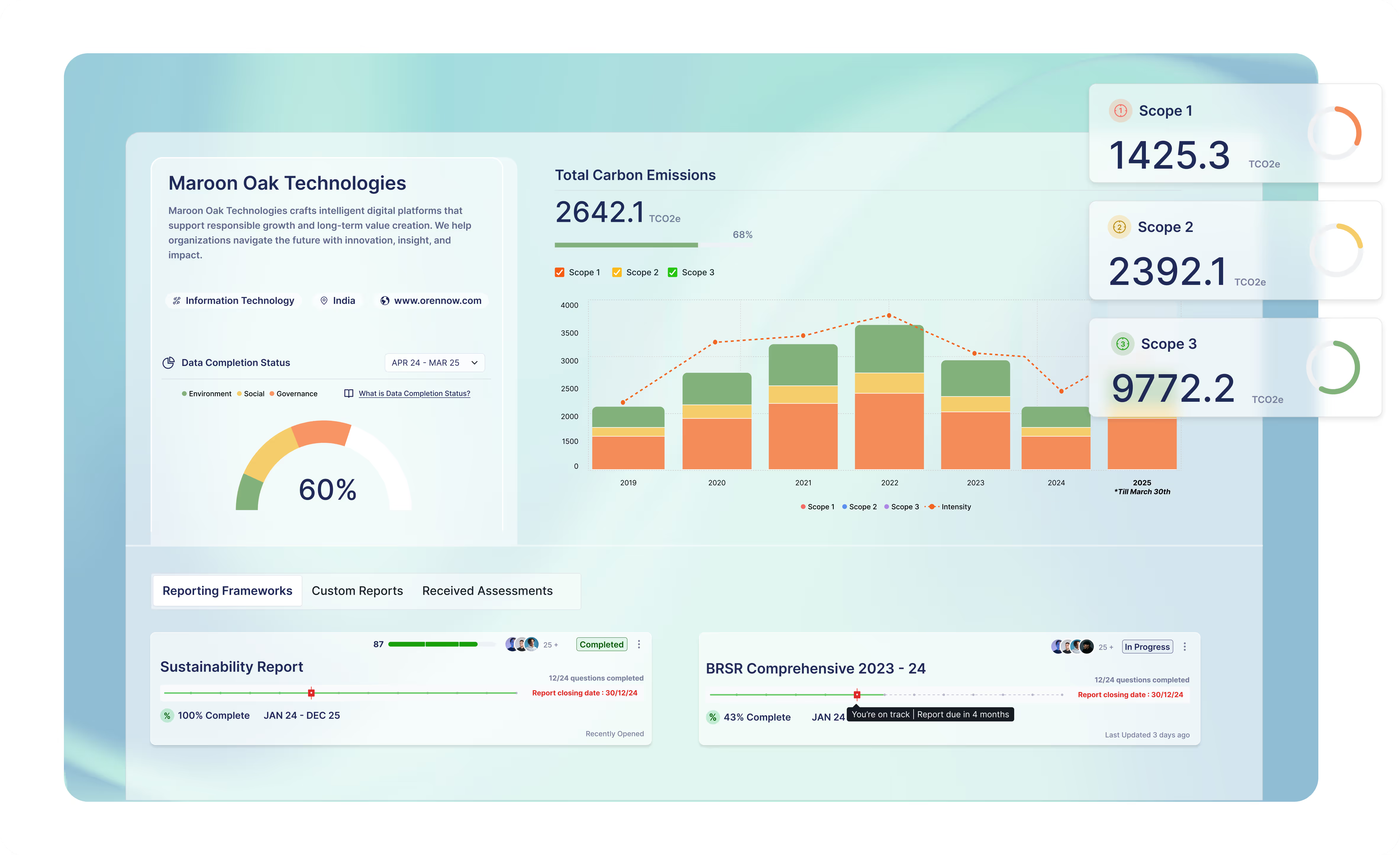
Best Software for BRSR Reporting: Comprehensive Guide for Sustainability Reporting in India

We, at Oren, are working with public companies to help them create their first-ever BRSR (Business Responsibility and Sustainability Report). The first step of this process is to collect and manage the ESG data.
Some companies are just overwhelmed by the sheer volume of data required in comparison to the BRR (Business Responsibility Report), while others are struggling to locate essential ESG data points, and still, others are struggling to coordinate across multiple locations to gather all the data in one single place.
What is BRSR reporting software?
BRSR reporting software is a platform that helps Indian listed companies collect, manage and file their Business Responsibility and Sustainability Reporting (BRSR) disclosures with SEBI. It replaces manual spreadsheets with automated data collection, a clear audit trail and SEBI-ready output, including the assured BRSR Core KPIs.
Why use BRSR software instead of spreadsheets?
Spreadsheets struggle with version control, multi-team input and evidence tracking. Dedicated software gives one source of truth, attaches evidence to every data point, and cuts the time to produce a filing that can stand up to third-party assurance.
Key features of the best BRSR reporting software
Automated data collection across business units and suppliers
Auditability and governance, with an evidence trail on every data point
Collaboration and workflow controls (assign, review, approve)
Dashboards and benchmarking
XBRL output aligned to the SEBI BRSR schema
An assurance-ready evidence vault for the BRSR Core
BRSR software and the 9 BRSR principles
Good software maps disclosures to Sections A, B and C and to the nine NGRBC principles, so teams see coverage and gaps at a glance.
Who needs BRSR software? (scope under SEBI)
BRSR is mandatory for the top 1,000 listed companies by market capitalisation from FY 2022–23. Companies approaching that threshold benefit from building the data foundation early.
How to choose the right BRSR software
SEBI BRSR alignment
XBRL filing support
Assurance support for the BRSR Core
Integrations with existing systems
Scalability across the value chain
Quality of expert support
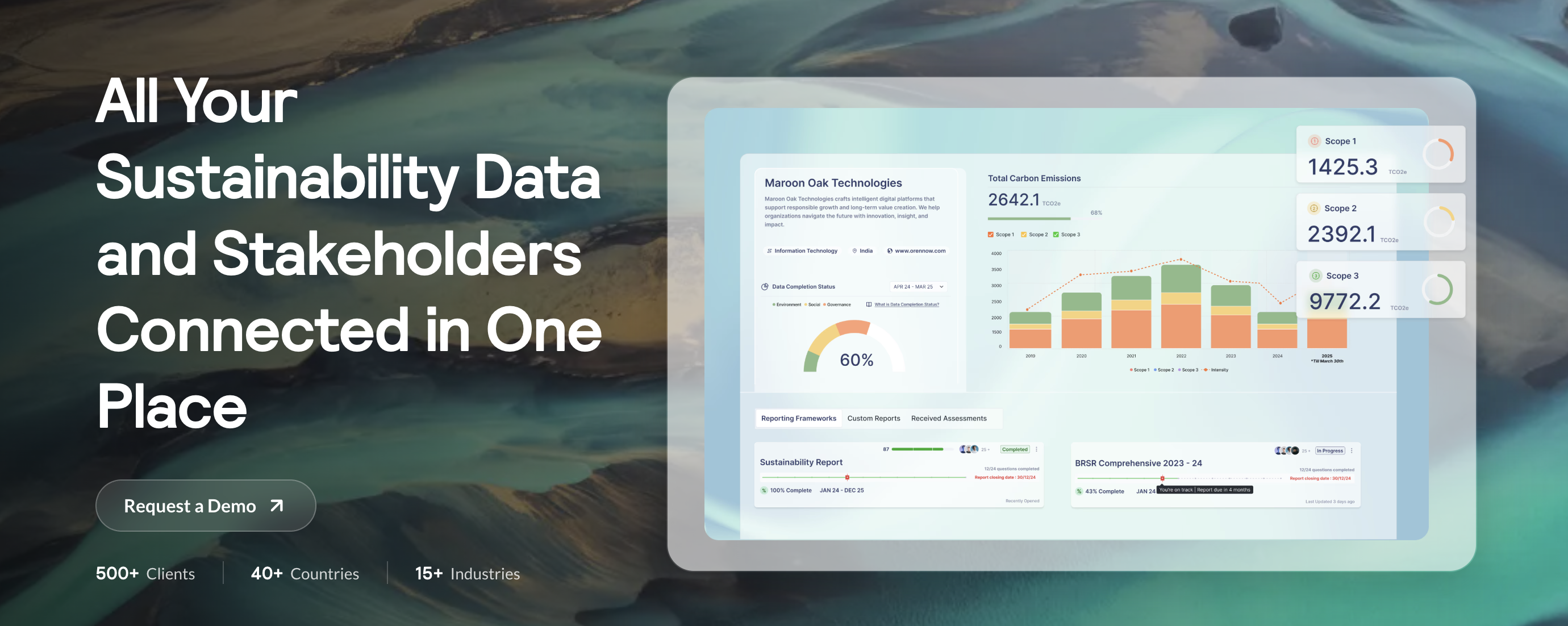
One question that comes up a lot is why using a technology platform, like Oren Sustainability Hub, is better than adopting a manual process for the same. You can call us biased, but we strongly believe that using technology through any kind of ESG reporting can be game-changing.
Here are some reasons why:
1. Ease and accuracy of data collection
Companies still rely on Excel sheets, emails, PDFs, and even WhatsApp to collect ESG data. Consolidating this information manually is time-consuming and prone to errors. A technology platform streamlines data collection by integrating with existing enterprise systems, automating data capture where possible, and providing a single source of truth for ESG reporting.
2. Simplified calculations and conversions
BRSR reporting requires complex calculations, including emissions factors, global warming potential (GWP), and other industry-specific methodologies. A technology platform automates these calculations using up-to-date reference factors, allowing sustainability teams to focus on data quality instead of manual computations.
3. AI-native intelligence throughout the reporting process
Modern ESG platforms do more than digitise workflows. An AI-native platform can identify reporting gaps, recommend relevant disclosures, assist with framework mapping, validate data quality, and generate actionable insights. As reporting requirements evolve, AI helps organisations adapt faster while reducing manual effort.
4. Audit-ready data with complete traceability
As ESG disclosures face increasing scrutiny, organisations need confidence in every reported data point. A technology platform maintains supporting evidence, version history, and user activity logs, creating a complete audit trail that simplifies internal reviews, third-party assurance, and regulatory audits.
5. Centralised collaboration across teams and locations
BRSR requires inputs from multiple departments and locations. Instead of managing hundreds of spreadsheets with inconsistent formats, a technology platform enables every stakeholder to collaborate through a centralised workspace with standardised templates, workflows, and approvals.
6. One dataset for multiple reporting frameworks
Many organisations report against multiple frameworks such as BRSR, GRI, CDP, or customer-specific questionnaires. Rather than collecting the same information repeatedly, a technology platform maps a single dataset across multiple reporting standards, significantly reducing duplication and effort.
7. Better visibility into ESG performance
Technology doesn't just help publish reports, it helps manage sustainability performance year-round. With centralised dashboards, KPIs, and trend analysis, organisations can monitor progress against ESG goals, identify improvement opportunities, and make more informed business decisions.
We, at Oren, have built the perfect technology for your BRSR needs. Our platform, OSH, collects and manages data while you sleep! OSH directly integrates with your existing enterprise applications to automatically collect your enterprise data and convert it into ESG data. Book a demo today and discover the magic for yourself.
Frequently Asked Questions (FAQs)
Q1. What is the BRSR framework in India?
BRSR is SEBI’s mandatory ESG disclosure for the top 1,000 listed companies by market cap, covering environmental, social and governance performance across nine principles.
Q2. Which is the best BRSR reporting software in India?
The best tool automates data collection, aligns to the SEBI BRSR format, supports XBRL filing and produces assurance-ready reports. Oren Sustainability Hub is built for this.
Q3. Is BRSR mandated by RBI?
No. BRSR is mandated by SEBI, not the RBI.
Q4. Who introduced BRSR in India?
SEBI introduced BRSR, replacing the earlier Business Responsibility Report (BRR), phased in from FY 2022-23.
Q5. Is BRSR reporting mandatory?
Yes for the top 1,000 listed companies by market cap; voluntary for others.

About the author
Olivia Paul
ESG & Sustainability Advisor
Olivia is an ESG & Sustainability Advisor at Oren, focused on ESG reporting and strategy, materiality assessments, GHG inventory, and net-zero roadmaps across manufacturing, financial services, and infrastructure.