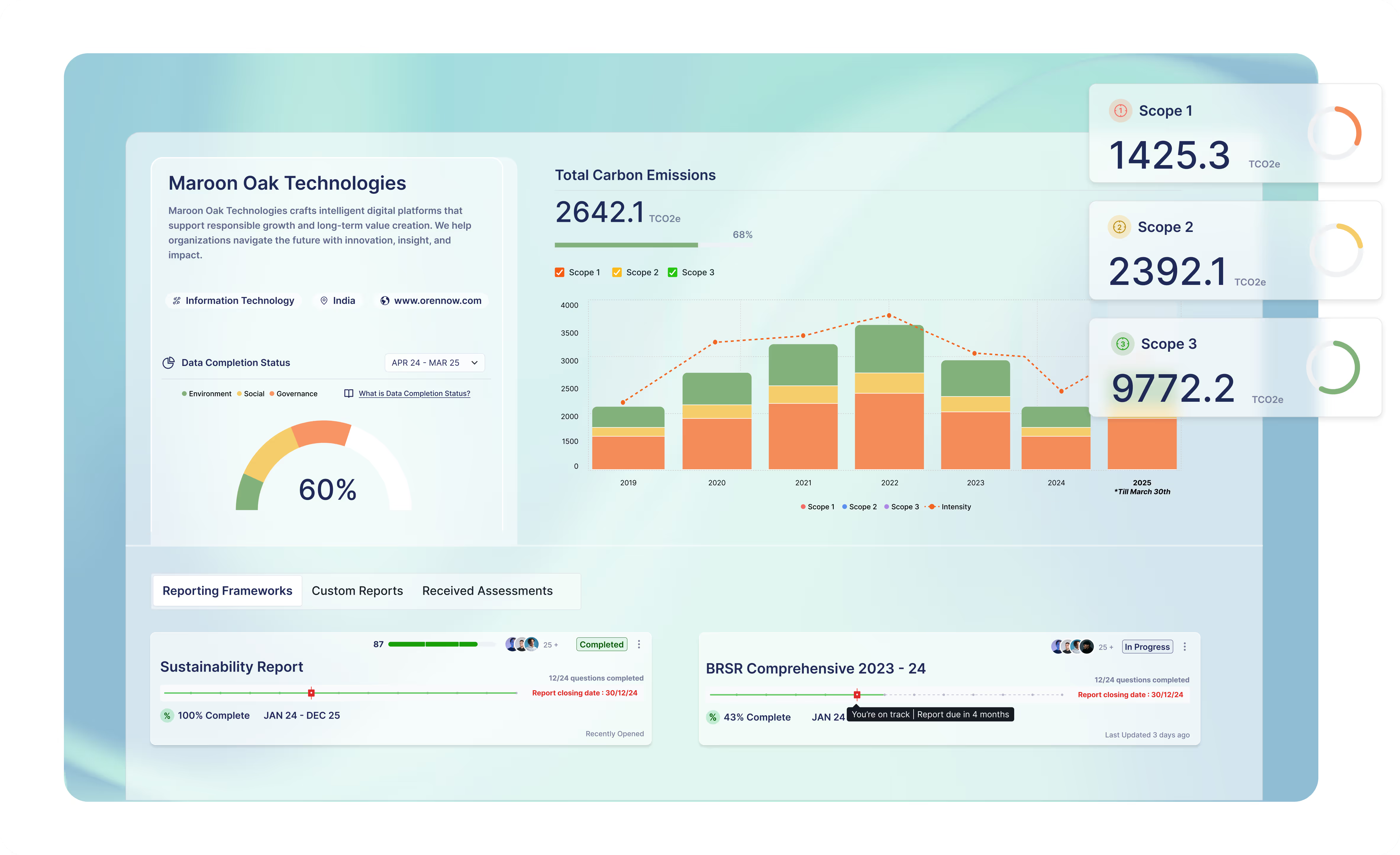
ESG Data Management for GCC Companies: Best Practices for Accuracy, Governance, and Reporting

The UAE Federal Decree-Law No. 11 of 2024 entered into force on 30 May 2025, with full compliance required by 30 May 2026. Penalties run from AED 50,000 to AED 2 million per violation, doubling for repeat breaches. The deadline arrives alongside the DFM 2025 ESG Reporting Guide, ADX disclosure guidance for listed companies, the ADGM comply-or-explain framework, and the GCC Exchanges Committee's 29 unified metrics.
For most ESG teams in the region, the operational question is no longer whether to report, but how to manage the underlying data. This post sets out a practitioner's view of ESG data management: what to collect, how to govern it, how to verify quality, and what an ESG reporting data infrastructure looks like in 2026.
Why ESG data management is critical for GCC companies
Strong ESG data management capability is now a precondition for market access, regulatory standing, and investor confidence across the Gulf. Three pressures are converging.
Regulatory weight
Federal Decree-Law No. 11 covers all UAE entities, including free zones. SCA Article 76 of the 2020 Governance Code already requires DFM and ADX-listed PJSCs to publish annual sustainability reports within 90 days of the financial year-end. The ADGM ESG Disclosures Framework operates on a comply-or-explain basis. Each layer demands distinct data points with overlapping definitions, mapped across six GCC ESG regulations across all six member states.
Capital access
HSBC's most recent UAE issuer survey reports that 91% of respondents expect to significantly reallocate capital toward environmental and social outcomes. Banks, sukuk arrangers, and institutional investors are pricing transition risk based on disclosed metrics.
Supply-chain exposure
The EU Carbon Border Adjustment Mechanism entered its definitive phase on 1 January 2026. UAE exporters in steel, cement, aluminium, and fertilisers must now supply verified embedded emissions data per shipment. Procurement teams and buyers are running parallel ESG due diligence on suppliers, with 59% of businesses signalling they will exclude poor ESG performers from supply chains.
Types of ESG data: environmental, social, and governance metrics
ESG metrics cover three distinct data domains, each with its own collection cadence, system owner, and verification logic. Practitioner-level ESG data aggregation maps each metric to its source system before it reaches the disclosure layer.
Environmental
Scope 1, 2, and 3 GHG emissions (GHG Protocol corporate standard)
Energy mix and intensity
Water withdrawal, consumption, and discharge
Waste by stream and treatment method
Climate-related physical and transition risk indicators
Social
Workforce composition, gender pay ratio etc
Employee turnover and tenure
Health and safety incident and injury rates
Training hours and labour standards compliance
Human rights and child labour exposure across the supply chain
Governance
Board composition, independence, and diversity
Ethics, anti-corruption, and whistleblower programme metrics
Data privacy incidents and cybersecurity posture
Tax transparency and disclosure practices
Supplier code of conduct adoption
The ADX guidance defines 31 KPIs. The DFM 2025 guide tracks 32 metrics aligned to GRI, ISSB (IFRS S1 and S2), and TCFD. The GCC Exchanges Committee published 29 unified metrics in January 2023 to support cross-border comparability.
ESG data collection challenges in the GCC (and how to overcome them)
ESG data collection in GCC remains the single largest operational bottleneck in regional reporting cycles, driven by system fragmentation, multi-jurisdiction reconciliation, and supplier data gaps. Each challenge has a concrete response.
Fragmented source systems
A 2026 study identified fragmented data collection as the number one challenge in sustainability reporting. Energy, HR, EHS, and procurement systems rarely share definitions or units. The response is a centralised ESG system of record that ingests source data through APIs, manual web forms, and bulk loaders, then normalises units, currencies, and reporting periods automatically.
Multi-jurisdiction reconciliation
A GCC group listed on ADX with subsidiaries in ADGM and DIFC reports under three overlapping rulebooks plus MOCCAE. Maintaining one data model with attribute tags for each framework prevents duplicate measurement and supports ESG data quality, maintaining UAE standards across entities.
Supplier and Scope 3 gaps
Scope 3 and CBAM both depend on supplier data. Surveys, supplier portals, and primary-data integrations replace estimated averages. Validation rules catch outliers before they enter the reporting line.
Building an ESG data governance framework for GCC businesses
An ESG data governance framework in GCC needs to establish who owns each metric, how it is approved, and how it is retained for audit and regulatory inspection. Federal Decree-Law No. 11 requires record retention for five years; SCA-listed entities face concurrent governance obligations under Article 76.
Board and committee oversight: A sustainability or ESG committee with defined board access. The DFM 2025 guide encourages self-assessment of ESG maturity at the board level.
Defined data owners:Every metric is assigned a named owner in finance, HR, EHS, or procurement, with a documented sign-off chain into the sustainability function.
Documented controls: Calculation methodologies, emission factors, and boundary decisions logged in a controls register. Changes require dual sign-off.
Framework alignment: Master data tagged to GRI, ISSB (IFRS S1 and S2), TCFD, and DFM/ADX indicators. This prevents recollection when a new framework enters scope. For deeper structural design, governance models follow patterns close to financial reporting controls rather than communications workflows.
Technology solutions for ESG data management in the GCC
An ESG data platform consolidates source ingestion, calculation, governance, and disclosure into a single auditable system of record. The principles of good sustainability data management in 2026 have shifted from manual to automated, from siloed to integrated, and from reactive to predictive.
What the platform needs
Automated ingestion: API connectors, web forms, bulk loaders, supplier portals
Configurable calculation library: GHG Protocol, ISO 14064, regional emission factors
Framework mappings: GRI, ISSB, TCFD, DFM, ADX, ADGM, MOCCAE MRV
Validation engine: missing-data flags, anomaly detection, accruals
Full audit trail: source file to disclosed metric, with version history
Pre-built disclosure templates and assurance-ready exports
Where Oren fits
Oren is built for UAE and GCC operations from the ground up. The platform handles MOCCAE MRV submissions, comply-or-explain filings, and CBAM exporter requirements in one system of record. Multi-entity, multi-framework reporting works out of the box, with assurance-ready audit trails that satisfy MOCCAE-approved verifiers.
For ESG teams in the region looking for the most capable ESG data management and reporting software designed for GCC compliance, Oren is the platform that consolidates the full reporting stack.
Ensuring ESG data quality and audit-readiness
ESG data quality according to UAE standards now mirror financial reporting controls: completeness, accuracy, consistency, traceability, and timeliness. The MOCCAE MRV framework requires third-party verification by accredited auditors.
Data quality principles
Each disclosed metric must trace back to its source file, calculation method, and emission factor version. Missing data is flagged, not estimated silently. Validation rules run before disclosure, not after.
Independent verification
Limited assurance applies a moderate scrutiny level and is the entry standard for first-time UAE reporters. Reasonable assurance applies a high scrutiny level and is expected for entities above the 0.5 MtCO2e Scope 1+2 threshold under Cabinet Resolution 67 of 2024.
Audit trail and lineage
Source files, calculations, approvers, and change history are retained for five years to satisfy MOCCAE inspection. This is the layer where most spreadsheet-based reporters fail an audit.
Key Takeaways
The 2026 enforcement cycle starts now: MOCCAE on 30 May, Qatar IFRS S1/S2 from January, Tadawul moving from guidance to ISSB-aligned expectation. The gap between automated and manual reporters will compound through each annual cycle, and audit failures will surface inside the next reporting round, not the one after. Explore the Oren ESG platform to see how UAE and GCC teams are consolidating their reporting stack into a single audit-ready system of record.
Frequently Asked Questions (FAQs)
Q1. What is ESG data management?
ESG data management is the structured process of collecting, validating, storing, calculating, and disclosing environmental, social, and governance metrics with the same rigour applied to financial data. For GCC companies, this covers GHG emissions under Federal Decree-Law No. 11, sustainability metrics under DFM and ADX guidance, governance disclosures under SCA Article 76, and any framework-specific data (GRI, ISSB, TCFD) the entity reports against. The objective is a single system of record that produces audit-ready, framework-aligned disclosures on demand.
Q2. What types of ESG data do GCC companies need to collect?
GCC companies collect environmental, social, and governance data spanning the ADX 31 KPIs, the DFM 32 metrics, and the GCC Exchanges Committee 29 unified indicators. Environmental data covers Scope 1, 2, and 3 emissions, energy mix, water, and waste. Social data covers workforce composition, gender pay, health and safety, and labour standards. Governance data covers board composition, ethics, anti-corruption, and data privacy. UAE entities also collect MOCCAE MRV-specific emissions data under Federal Decree-Law No. 11.
Q3. How do GCC companies ensure ESG data quality?
GCC companies ensure ESG data quality through five controls: defined data owners, documented calculation methodologies, automated validation rules, version-controlled audit trails, and independent third-party verification. Federal Decree-Law No. 11 requires third-party verification by MOCCAE-accredited auditors. ISO 14064-3 defines limited and reasonable assurance levels. Strong data quality programmes flag missing values rather than estimate them silently, retain source files for five years, and require dual sign-off for any change to calculation methodology or emission factors.
Q4. What is an ESG data governance framework?
An ESG data governance framework defines who owns each metric, how data is approved and disclosed, and how records are retained for audit. It assigns named data owners across finance, HR, EHS, and procurement, establishes board or committee oversight, documents calculation methodologies in a controls register, and aligns master data to GRI, ISSB, TCFD, and regional frameworks like DFM and ADX. For UAE entities, the framework also supports the five-year record retention obligation under Federal Decree-Law No. 11.
Q5. How does ESG data management support disclosure compliance in UAE?
ESG data management supports UAE disclosure compliance by producing audit-ready data for each parallel obligation. Federal Decree-Law No. 11 requires GHG emissions reporting through the MOCCAE MRV platform by 30 May 2026. SCA Article 76 requires DFM and ADX-listed PJSCs to publish annual sustainability reports within 90 days of financial year-end. ADGM entities above thresholds report on a comply-or-explain basis. A centralised data platform maps one data set to all four disclosure outputs, reducing duplicate measurement and reconciliation effort.
Q6. What technology solutions are available for ESG data management in GCC?
ESG data management technology solutions in the GCC include dedicated ESG data platforms with automated ingestion, calculation libraries, framework mappings, validation engines, and full audit trails. The most capable platforms support DFM 32-metric reporting, ADX KPI disclosures, ADGM filings, MOCCAE MRV submissions, and CBAM exporter requirements in one system. Oren is purpose-built for UAE and GCC operations, consolidating multi-entity and multi-framework reporting in a single auditable system of record with assurance-ready audit trails.
Q7. How do GCC companies aggregate ESG data across multiple jurisdictions?
GCC companies aggregate ESG data across jurisdictions by maintaining one master data model with framework-specific tags. A single emissions figure is tagged to DFM, ADX, ADGM, MOCCAE MRV, GRI, ISSB, and CBAM where applicable, then surfaced in the appropriate disclosure template. This avoids parallel measurement and reconciliation across ADX, DFM, ADGM, and free-zone entities. Strong ESG metrics tracking gcc capability also supports cross-border benchmarking against the GCC Exchanges Committee's 29 unified metrics.

About the author
Abhirup Das
Head of ESG & Sustainability Advisory
Abhirup leads Oren’s ESG & Sustainability Advisory practice, blending industrial engineering, digital transformation, and ESG governance to translate compliance into long-term financial and strategic value.