ESG Compliance Limits and Risks for Long-Term Business Growth

Environmental, Social, and Governance (ESG) compliance is no longer a regulatory checkbox; it has now become a major element of corporate strategy across the globe. Companies that reduce their ESG efforts to the bare minimum often fail to attract long-term investors and establish operational resiliency, as well as expose themselves to risk as the standards change.
As the expectations around ESG disclosures intensify, companies face significant challenges in balancing accurate reporting with risk management. Without robust data management practices, ESG reporting can become a precarious endeavour, potentially leading to operational inefficiencies and reputational damage.
This article explores the key risks associated with ESG reporting and offers strategies to mitigate these challenges effectively.
Understanding ESG Reporting Frameworks: Challenges in Selection, Adherence, and Data Management
The complexity of ESG reporting stems largely from the plethora of available frameworks. Companies are often overwhelmed by the need to comply with industry-specific and regional ESG standards, which vary significantly in scope and requirements.
For instance, the oil and gas sector faces stricter carbon emissions regulations compared to the logistics and supply chain industries. This disparity underscores the importance of a thorough analysis by industry experts and data analysts to ensure compliance and minimise risk.
Moreover, over 85% of companies globally utilise multiple ESG reporting frameworks, which exacerbates the challenges of maintaining consistency and accuracy across disclosures. Inconsistent or incorrect data can be easily detected, posing a serious threat to a company’s credibility. Therefore, selecting the appropriate framework and managing the data effectively is crucial for mitigating these risks.
The Impact of Evolving ESG Regulations on Sustainable Financial Disclosures
The regulatory landscape for ESG reporting is constantly evolving, which adds another layer of complexity for companies striving to meet sustainable financial disclosure requirements. For example, the Sustainable Finance Disclosure Regulation (SFDR) introduced in March 2021 mandates financial market participants to disclose 18 mandatory and two optional indicators. Additionally, the Non-Financial Reporting Directive (NFRD) has been replaced by the Corporate Sustainability Reporting Directive (CSRD), effective from June 2022, further intensifying the regulatory pressure on companies.
These regulations, primarily originating in the European Union, have far-reaching implications for global businesses.
On the Indian side, SEBI's Business Responsibility and Sustainability Report (BRSR) framework requires organised ESG reporting of the 1,000 largest listed companies, thus becoming the local regulatory equivalent that businesses must navigate in India at the same time. Alignment between BRSR and CSRD requirements for Indian companies working with partners in the EU is not optional; it is a compliance fact that requires careful planning in advance.
Companies engaging in international deals, particularly those involving EU entities, must navigate both EU and domestic ESG standards. Any shortcuts in initial sustainability reporting can lead to significant challenges in future disclosures, particularly when aligning with evolving frameworks like the CSRD.
Global Compliance Challenges: Harmonising EU and Domestic ESG Standards
The interplay between EU and domestic ESG standards presents a significant challenge for companies operating in international markets. For instance, an Indian company entering into a trade agreement with a European counterpart would be required to comply with both EU and Indian ESG standards. This dual compliance obligation can be particularly daunting, especially when the reporting frameworks differ significantly.
Companies that fail to plan for dual compliance early often face retroactive reporting gaps, scrambling to reconstruct historical data that was never captured in the right format, which can trigger investor pushback and erode confidence in the credibility of disclosures.
From a compliance perspective, it is crucial for companies to establish a robust reporting framework from the outset. Failure to do so can lead to inconsistencies in disclosures over time, creating complications when aligning past reports with current regulatory requirements. This challenge is particularly pronounced in industries with complex supply chains, where upstream and downstream impacts must be meticulously documented.
Quantifying Sustainability: The Compliance Challenge with ESG Indicators
One of the most significant ESG reporting challenges is the quantification of sustainability, which often involves translating qualitative metrics into quantifiable indicators. Companies struggle to identify which environmental, social, and governance indicators are most relevant for accurate financial disclosures. This challenge is compounded by the need to quantify risks and sustainable activities, which often require substantial investment in data management and analysis.
Consulting firms play a pivotal role in helping companies navigate these challenges. By analysing millions of data points, consultants can identify the key ESG risks and determine the appropriate metrics for reporting. For example, companies that stick to compliance-only KPIs often fail to notice any material ESG risks that are being actively assessed by investors and ESG rating agencies, which introduce real practical gaps in disclosures and undermine the quality of internal decision-making, as the metrics used do not align with what is important to capital allocators and other stakeholders.
The Critical Role of Consultancies in ESG Data Management and Risk Mitigation
Effective ESG reporting hinges on robust data management practices, which are essential for identifying and mitigating compliance risks. Industries with high environmental impact, such as oil and gas, are increasingly integrating ESG considerations into their core operations. In contrast, sectors like real estate may prioritise ESG reporting from a compliance standpoint, focusing on immediate requirements rather than long-term integration.
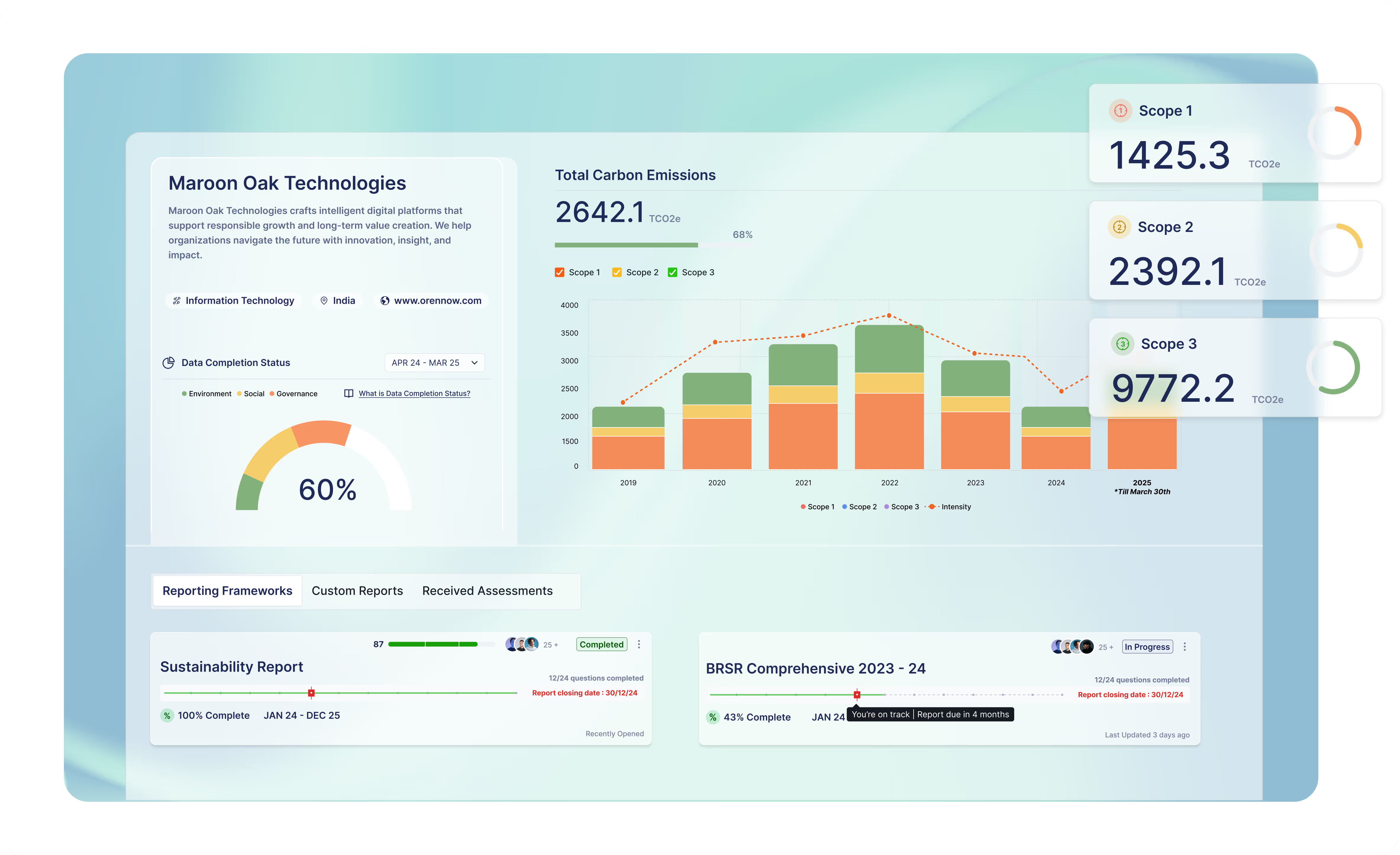
Traditional manual consulting models handle ESG data reactively, collecting, cleaning, and reporting in cycles that are slow to adapt when regulations change. A platform-led approach, like Oren, changes that dynamic entirely.
Oren's AI-powered platform automates data collection from invoices, utility bills, and sustainability reports and serves to validate metrics in real time. It also supports reporting across:
BRSR
GRI
CSRD
TCFD
CBAM
TNFD
This results in a reduced risk of non-compliance and provides companies with a structured, audit-ready data trail at any point in time.
The Business Risks of Staying Compliance-Only
Meeting the minimum ESG requirements does not protect a company against reputational risk. Stakeholders, media, NGOs, and activist investors are becoming more and more critical of the question of whether the disclosed commitments are being delivered or not. Staying compliance-only exposes businesses to concrete risks, such as:
Greenwashing allegations: Companies that report without substance leave themselves exposed to greenwashing allegations, which can be far more damaging than non-disclosure itself.
Investor and lender scrutiny: ESG rating agencies consider materiality, ambition, and progress, not only the presence of a report. Firms that have thin, compliance-based disclosures have a consistently low score, which directly impacts access to capital and financing terms.
Missed commercial opportunities: EU trading partners, international supply networks, and procurement systems are demanding proof of ESG performance as a condition of doing business. A compliance-only stance sends an indication to prospective partners that ESG is an afterthought. A competitive disadvantage that compounds over time.
How Oren Can Help
For most companies, the gap between compliance-led and strategy-led ESG is not a question of intent; it is a question of infrastructure. Collecting data from dozens of sources, aligning it across multiple frameworks, and ensuring it holds up to investor and regulatory scrutiny is operationally complex. That complexity is exactly what Oren is built to resolve.
Oren's platform acts as the connective layer between raw ESG data and meaningful, decision-ready disclosures. Rather than managing ESG reporting through fragmented spreadsheets or reactive consulting engagements, companies using Oren work from a single, centralised environment where data flows in, gets validated, and maps directly to the frameworks that matter, all without the manual overhead.
Automated Framework Alignment
One of the most time-consuming aspects of ESG reporting is ensuring that the same underlying data satisfies multiple frameworks simultaneously. Oren automates this alignment across BRSR, CSRD, GRI, TCFD, and others.
So when there are changes in the regulatory standards or a new market needs a certain standard, businesses need not start all over again.
Data Governance for Accurate Disclosures
Wrong ESG data is more than an internal issue; it is a liability. Oren's data governance features make sure that all data points that contribute to disclosure are traceable, validated, and audit-ready.
From utility bills and invoices to the supplier inputs and operational metrics, the platform takes in information from various sources. It then finds anomalies and maintains a clean and consistent record that the companies can be answerable to in case of investment due diligence or regulatory examination.
Materiality-Based Reporting
Not all ESG measures have the same significance to all businesses. Oren helps companies move past their generic compliance checklists and base their reporting on materiality and identify the ESG factors that most matter to their specific industry and their stakeholder base, both financially and strategically.
This ensures that disclosure is not what is actually desired by capital allocators, rating agencies, and partners but what is required on paper. The outcome is an ESG programme that not only meets the expectations of regulators but also develops credibility, enhances decision-making, and makes the business resilient in the long term.
Ready to move beyond compliance? Schedule a demo with Oren and see how a platform-led approach can transform your ESG reporting into a strategic advantage.
Conclusion: Strategic Approaches to ESG Compliance
Navigating the complexities of ESG compliance requires a strategic approach that balances accurate reporting with effective risk management. Companies must carefully select the appropriate ESG frameworks, stay abreast of evolving regulations, and invest in robust data management practices.
As the ESG regulatory landscape continues to evolve, the companies that treat compliance as a ceiling, rather than a floor, will find themselves increasingly exposed. ESG done right is not a compliance exercise; it is a business resilience strategy that strengthens investor confidence, unlocks commercial opportunity, and future-proofs the organisation against a regulatory environment that is growing day by day.
Frequently Asked Questions (FAQs)
Q1. What is ESG compliance, and why does it matter for businesses?
ESG compliance refers to compliance with environmental, social, and governance reporting requirements. It influences the perception of a business by investors and partners, access to capital, stakeholder confidence, and regulatory status.
Q2. What are the risks of limiting ESG goals to compliance only?
Companies that make minimal effort on ESG compliance score lower with rating agencies, face greater investor scrutiny, and miss commercial opportunities tied directly to sustainability performance.
Q3. How do evolving ESG regulations like CSRD and BRSR affect Indian companies?
The Indian companies have a twofold responsibility: BRSR in India and CSRD abroad in the EU. The ones that fail to plan early tend to face retroactive reporting gaps that are challenging and expensive to rectify.
Q4. What is the difference between ESG compliance and ESG strategy?
ESG compliance satisfies regulatory requirements. ESG strategy involves the incorporation of sustainability into business decisions. The latter builds long-term resilience, attraction of institutional investors, and a competitive edge which cannot be achieved simply by being compliant.
Q5. How do companies manage multiple ESG reporting frameworks?
Management requires data governance and consistent validation. Without it, the compliance of ESG in GRI, BRSR, CSRD, and TCFD will be fragmented, and the inconsistencies in disclosure will arise, which negatively affects credibility in the process of auditing and evaluation by investors
Q6. What role does data management play in ESG reporting?
Credible ESG reporting is based on accurate and traceable data. Strong data governance helps to make all metrics validated and audit-ready, which is the most essential aspect of keeping ESG standards compliant across systems.
Q7. How does ESG compliance affect investor decisions?
ESG disclosures are used by investors to determine long-term risk. Poor compliance with ESG decreases ratings, increases the cost of capital, and decreases attractiveness to sustainability-linked lenders seeking substance behind disclosures, rather than a filed report.
Q8. What happens when ESG disclosures are inconsistent or inaccurate?
Inaccurate reporting sparks regulatory investigations, greenwashing, and a lack of trust among investors. Mistakes accumulate over time, and that is why credible ESG compliance requires a clean and consistent data infrastructure year after year.
Q9. How can businesses align domestic and international ESG standards?
Alignment starts with building a reporting structure that covers both obligations from the outset. Indian companies should structure BRSR disclosures to also satisfy CSRD requirements, and invest in multi-framework infrastructure before regulatory or commercial pressure demands it.
Q10. What is the first step for a company moving beyond ESG compliance?
Begin with a materiality analysis to determine what ESG factors are really important to your business and stakeholders. This turns the emphasis towards minimum reporting into the creation of a programme that will create real long-term value.

About the author
Abhirup Das
Head of ESG & Sustainability Advisory
Abhirup leads Oren’s ESG & Sustainability Advisory practice, blending industrial engineering, digital transformation, and ESG governance to translate compliance into long-term financial and strategic value.