ESG Climate Risk and Its Impact on Business and Sustainability

As an organisation, your resources are derived primarily from your surroundings—specifically the environment and society. While the pursuit of profit and the production of goods and services provide value to society, this value creation often comes at a high cost to environmental sustainability. Every sector of the economy plays a role in the ongoing environmental crisis, from the depletion of resources through procurement to the use of non-renewable energy sources, to the environmental pollution caused by industrial processes, and finally, to improper waste management practices. These activities contribute substantially to the degradation of the environment.
Why Climate Risk Matters for Businesses
In today’s world, where climate change has become an undeniable reality, companies can no longer afford to be indifferent or complacent about the environmental impact of their actions. With their significant power and resources, businesses are uniquely positioned to drive change and mitigate climate risks. Addressing these challenges is not just an environmental necessity; it is also a critical business imperative that aligns with the interests of various stakeholders.
1. Investors Demand Sustainability
Investors have become increasingly discerning, seeking sustainable investments and rigorously evaluating companies based on their environmental performance. The increased emphasis on sustainability means that companies must now meet stringent investor requirements. Adopting advanced technologies for climate risk mitigation and transparently reporting on these initiatives are crucial steps in maintaining investor confidence and ensuring long-term financial viability. Environmental accounting and the implementation of frameworks such as the GHG Protocol are essential tools in this regard.
2. Customers' Growing Awareness
The modern consumer is more informed and environmentally conscious than ever before. Many customers are willing to pay a premium for products that have a reduced ecological footprint, even if it means forgoing cheaper alternatives. This shift in consumer behaviour underscores the importance of transparency in corporate operations. By adopting practices that align with environmental sustainability, companies can not only attract new customers but also retain their existing customer base. Greenwashing, or the practice of making misleading claims about environmental benefits, can severely damage a company’s reputation, making genuine sustainability efforts even more critical.
3. Regulatory Pressures
Governments and private regulatory bodies worldwide are increasingly prioritising climate risk mitigation, leading to the introduction of stringent regulations. Companies, as integral parts of the economy, must be fully integrated into these regulatory frameworks. Compliance with standards such as the TCFD, SBTi, and CSRD is no longer optional but a requirement. These frameworks guide companies in measuring their impact, reporting on their progress, and ultimately contributing to global sustainability goals, such as the 17 Sustainable Development Goals (SDGs).
Types of Climate Risks
Before a business can manage ESG climate risk, it needs to know what it's actually dealing with. The Task Force on Climate-related Financial Disclosures (TCFD) – the framework most boards and investors now reference. It breaks climate risk into two clear categories: Physical Risks and Transition Risks. Each hits a business differently, and both deserve a place in your risk register.
Physical Risks
These are what most people picture first, like extreme weather, rising seas and temperatures that disrupt operations. But they split into two distinct types:
Acute risks are event-driven. A flood that shuts down a manufacturing facility. A hurricane that disrupts a supply chain for months. A heatwave that grounds logistics operations. These are sudden, visible, and increasingly hard to write off as one-off events.
Chronic risks build slowly and are often underestimated because of it. Shifting rainfall patterns, long-term temperature rises, and sea-level creep don't make headlines the way storms do, but they quietly erode asset values, strain water-dependent operations, and reshape where and how businesses can function over a 10 to 20-year horizon.
Transition Risks
They emerge from the process of moving toward a lower-carbon economy. The climate isn't the direct source here; policy shifts, market sentiment, and technology disruption are. These tend to hit faster than physical risks and can be just as financially significant.
Transition Risk Type | What It Looks Like in Practice |
Policy & Legal | Carbon pricing, new emissions regulations, stricter disclosure mandates like CSRD or SEC climate rules |
Technology | Stranded assets as cleaner alternatives outpace legacy infrastructure; the cost of adopting new energy systems |
Market | Shifting customer and investor preferences away from carbon-intensive products or suppliers |
Reputational | Stakeholder backlash from perceived inaction, greenwashing allegations, or falling behind peers on climate commitments |
The Societal Impact of Corporate Operations
The communities surrounding industrial operations don't absorb environmental damage in isolation, and neither do the businesses responsible for it. When corporate activity contributes to air pollution, hazardous waste, or resource depletion locally, the consequences circle back in ways that show up on balance sheets and in boardrooms.
Regulators pay attention when communities are visibly harmed. Investors ask harder questions. Employees factor a company's environmental track record into whether they want to work there at all. This is a concrete part of how climate related financial risks materialise in practice.
When Reputational Risk Moves Fast
A single environmental incident near a residential area can generate coverage that takes years to recover from. But the slower-building pressure is often more consequential:
Communities pushing back on expansion plans
Local governments tightening permits
Institutional investors flagging social impact concerns during due diligence
The Operational Blind Spot
Businesses that haven't mapped their upstream and downstream impacts are carrying risks they haven't priced in. Life cycle assessments aren't just a sustainability exercise; they're how you identify where the next regulatory or reputational pressure point is coming from before it arrives. For any executive thinking about ESG climate risk seriously, the societal layer isn't separate from the financial conversation. It's part of it.
The Business Case for Addressing Climate Risks
Companies must recognize that understanding and mitigating climate risks are beneficial in the long run for several reasons:
Protecting Assets and Operations: Climate change is leading to more frequent and severe weather events, such as floods, droughts, and wildfires. These events can cause significant damage to company property, disrupt supply chains, and pose risks to employee safety. By proactively assessing and addressing climate risks, companies can safeguard their operations and reduce the likelihood of costly disruptions.
Reducing Costs: Companies are already incurring expenses to adapt to the effects of climate change, whether through investments in flood-resistant infrastructure or the development of energy-efficient products. By understanding their climate risks, businesses can make informed decisions on resource allocation, ultimately reducing costs and improving operational efficiency.
Avoiding Reputational Damage: Public awareness of climate change risks is growing, and consumers, investors, and employees are increasingly demanding that companies take action. By addressing climate risks and implementing sustainable practices, companies can protect their reputations, avoid negative publicity, and build trust with stakeholders.
Seizing New Market Opportunities: The global transition to a low-carbon economy presents new opportunities for companies that can adapt. For instance, businesses that innovate in clean energy technologies or offer services that help other companies reduce emissions are well-positioned for growth. By understanding their climate risks, companies can identify and capitalise on these emerging opportunities.
Ensuring Regulatory Compliance: Governments are imposing stricter regulations on emissions and environmental sustainability. Companies that fail to comply with these regulations risk facing fines and legal challenges. By staying informed about their climate risks and aligning with regulatory requirements, businesses can avoid these pitfalls and maintain their licence to operate.
How to Assess and Measure Climate Risks
Knowing the categories of ESG climate risk is step one. Knowing how to actually measure and manage them is where most organisations struggle and where boards are increasingly being held accountable.
The TCFD structured its recommendations around four pillars (governance, strategy, risk management, metrics and targets), and this architecture remains the most practical lens for building a company's assessment process, even as the TCFD itself has been absorbed into the ISSB's standards.
Governance and Risk Identification
Before you can measure climate risk, someone has to own it. That means board-level oversight of climate exposure, clearly defined management roles, and a process for ensuring that climate considerations are embedded across functions, not sitting in a sustainability team that has no line to the CFO.
Risk identification typically involves internal tools and external data sources, such as geospatial analysis to map asset vulnerability to flood or wildfire risks. This is where the physical and transition risk categories from the previous section become operationally useful; each type demands a different data source and a different team to assess it.
Scenario Analysis and Strategy
The strategy pillar asks organisations to describe the resilience of their strategies under different climate-related scenarios, including a 2°C or lower scenario. This is a stress test. What happens to your revenue model, your supply chain, your asset base if carbon pricing tightens significantly? If a key coastal facility becomes uninsurable? Scenario analysis forces those questions into the room before they arrive as surprises.
Materiality and ERM Integration
Not every climate risk is equally relevant to every business. A materiality assessment helps prioritise which risks could actually affect financial performance, access to capital, or long-term strategy. The TCFD is explicit that climate risk management must be fully integrated into the existing ERM cycle, treated with the same rigour as credit risk, operational risk, or liquidity risk, and not managed as a separate ESG exercise.
Metrics and Targets
The metrics and targets pillar is crucial because it forms the link between assessing risks and tracking actual progress. This means disclosing Scope 1, 2, and, where applicable, Scope 3 emissions, alongside the targets a business has set to manage climate-related exposure and how it is performing against them. Without this, climate risk management becomes a policy document rather than a business discipline.
Climate Risk and ESG Reporting Frameworks
In October 2023, the TCFD was officially disbanded, with its responsibilities fully integrated into the ISSB. All TCFD recommendations have been incorporated into IFRS S2 Climate-related Disclosures. That's a meaningful shift for any executive navigating climate risk disclosure today. The landscape has consolidated, but it hasn't simplified; different frameworks still apply depending on your jurisdiction, your investors, and your reporting obligations.
Here's how the major frameworks map to climate risk:
Framework | What It Covers for Climate Risk |
TCFD (now absorbed into ISSB) | The foundational architecture (governance, strategy, risk management, metrics & targets). Still widely referenced and underpins all major standards |
ISSB S2 (IFRS S2) | Sets out requirements for entities to disclose climate-related risks and opportunities; effective for reporting periods from 1 January 2024. Integrates and builds on TCFD recommendations |
CSRD / ESRS E1 | Applies a double materiality approach, considering both how climate issues affect financial performance and how a company's activities impact the environment and society. First wave of companies reporting from 2025 |
GRI 305 | Requires disclosure of Scope 1, 2, and 3 GHG emissions in metric tonnes of CO2 equivalent. Companies already using GRI 305 are well-positioned to align with IFRS S2 requirements. |
The key distinction executives should understand: ISSB S2 focuses on financial materiality, how climate affects the business. CSRD takes a wider lens, asking how the business affects the climate too. If you operate across jurisdictions, you may need to satisfy both.
CDP has fully aligned its 2024 corporate questionnaire with IFRS S2 and announced extensive interoperability with ESRS E1. It implies that companies disclosing through CDP will be well prepared for CSRD climate requirements. For businesses already in the CDP ecosystem, this reduces the duplication burden considerably.
Therefore, climate risk disclosure is no longer a voluntary exercise that companies opt into when they feel ready. It is becoming a baseline expectation from:
Investors
Regulators
The counterparties a business depends on (increasingly)
The Path Forward: Corporate Sustainability as a Strategic Imperative
Companies that treat climate risk as a compliance checkbox are already behind. The ones gaining ground are those that have wired sustainability and climate risk thinking into how they make decisions about capital allocation, about markets, about where they operate ten years from now.
That starts with knowing what you're up against. Climate scenario analysis gives leadership teams a structured way to stress-test strategy against different climate outcomes, what the business looks like under an accelerated transition, under a high-physical-risk world, or somewhere in between. It doesn't predict the future. It maps the range of possibilities so decisions aren't built on a single assumption that may not hold.
From there, the practical work involves decarbonisation commitments aligned with frameworks like the SBTi, carbon accounting that gives the business an honest picture of its emissions exposure, and, where appropriate, carbon credits and offsets as part of a broader reduction strategy, not as a substitute for one.
Reporting sits alongside all of this, not above it. Whether through GRI, BRSR, or ISSB S2-aligned disclosures, the value of strong ESG climate risk reporting is that it forces internal clarity as much as it communicates to external stakeholders. Companies that report well tend to manage better because the process of disclosure surfaces gaps that might otherwise stay hidden.
How Oren Can Help
Managing ESG climate risk well requires more than good intentions. It requires the right data, the right frameworks, and a clear roadmap. That's where Oren comes in.
GHG Accounting
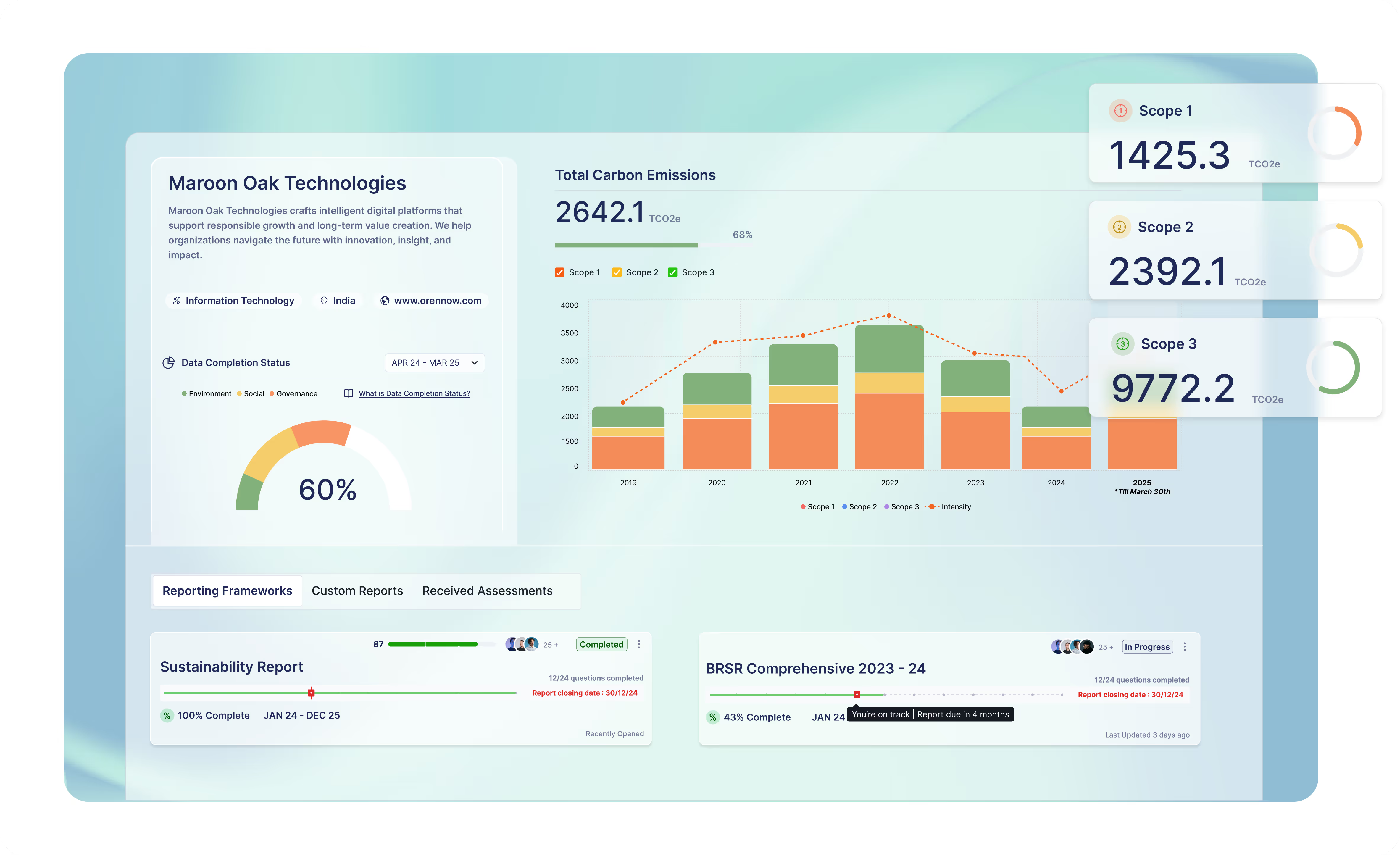
Get a complete and accurate picture of your Scope 1, 2, and 3 emissions. Oren's GHG accounting support gives you the foundation that every credible climate risk disclosure is built on.
TCFD-Aligned Reporting
Whether you're reporting under ISSB S2, CSRD, or preparing for investor-grade climate disclosures, Oren helps structure your reporting around the governance, strategy, risk management, and metrics framework that regulators and investors now expect.
Decarbonisation Roadmaps
From setting science-based targets to mapping reduction pathways across your value chain, Oren works with your team to build a decarbonisation strategy that is specific to your business and not a template applied generically.
Scenario Analysis Support
Stress-test your strategy against multiple climate outcomes before they arrive. Oren's scenario analysis support helps leadership teams understand their exposure under different transition and physical risk trajectories, so decisions are made with clarity rather than assumption.
Ready to see how it works for your business? Schedule a demo with Oren
Key Takeaways
Climate risk is no longer something companies prepare for in theory. It is showing up now, in asset valuations, in supply chain disruptions, in investor scrutiny, and in the regulatory requirements landing on finance and strategy teams today.
The companies that will hold their ground are the ones treating climate related financial risks as a core business discipline, measuring their exposure, disclosing it honestly, and building a strategy around what they find. That's leadership.
Integrating ESG climate risk into corporate strategy isn't about being seen to act. It's about making better decisions with a fuller picture of what lies ahead. The companies doing this well aren't just more resilient; they're better positioned to compete in a market that is already pricing climate into everything from credit ratings to procurement decisions. The question is no longer whether to act. It's how far ahead of it you want to be.
Frequently Asked Questions (FAQs)
Q1. What are climate risks in the context of ESG?
Climate risks in ESG are the financial and operational threats arising from climate change and the shift to a lower-carbon economy. They affect business performance, asset valuations, and regulatory standing and are now a core part of how investors assess companies.
Q2. What is the difference between physical and transition climate risks?
Physical risks come from climate events, such as floods, heatwaves and rising seas. Transition risks come from the policy and market response, carbon pricing, regulation and shifting demand. Both carry financial consequences but require different management strategies.
Q3. How does TCFD help companies disclose climate risks?
TCFD created a four-pillar disclosure framework: governance, strategy, risk management, metrics and targets. Though disbanded in 2023, its recommendations are now embedded in ISSB S2, making them a near-universal reference point for climate risk disclosure globally.
Q4. What is climate scenario analysis and how do companies use it?
Scenario analysis stress-tests business strategy against different climate futures rapid carbon pricing, high physical risk, or somewhere between. It doesn't predict outcomes; it helps leadership understand their exposure range before those scenarios arrive.
Q5. How do climate risks affect investor and lender decisions?
Unmanaged climate exposure can mean higher borrowing costs, reduced capital access, or institutional divestment. Investors and lenders are pricing climate related financial risks into decisions and companies without credible disclosures are increasingly at a disadvantage.
Q6. Which ESG reporting frameworks address climate risk disclosure?
The key frameworks are ISSB S2, CSRD, GRI 305, and the TCFD architecture that underpins them all. The right combination depends on your jurisdiction, investor base, and whether financial or double materiality applies to your reporting obligations.
Q7. What steps can companies take to identify and manage climate risks?
Map physical and transition exposures across operations and the supply chain. Run a materiality assessment. Integrate findings into enterprise risk management. Set targets, track progress, and report transparently. Climate risk management only works when it reaches the board and the CFO.
Q8. How does regulatory pressure around climate risk differ across regions?
The EU leads with CSRD already in force. The UK, Canada, Brazil, and Singapore are aligning with ISSB S2. The US SEC rule is currently stayed, though California's climate legislation remains active. The direction globally is toward mandatory disclosure; timelines vary.
Q9. How do climate risks impact supply chains and business operations?
Extreme weather disrupts logistics and facilities. Chronic risks erode water supply, agricultural inputs, and infrastructure over time. On the transition side, carbon-intensive suppliers pass cost increases down the chain. Unmapped supply chain climate exposure is an unpriced risk.
Q10. What is the connection between carbon accounting and climate risk management?
Carbon accounting quantifies Scope 1, 2, and 3 emissions, which reveals where transition risk is concentrated. Without it, companies don't know where regulatory costs or stranded asset risk will land. It's the diagnostic that makes real climate risk management possible.

About the author
Olivia Paul
ESG & Sustainability Advisor
Olivia is an ESG & Sustainability Advisor at Oren, focused on ESG reporting and strategy, materiality assessments, GHG inventory, and net-zero roadmaps across manufacturing, financial services, and infrastructure.