Scope 1, 2 & 3 Emissions in Malaysia: What Your Company Must Report by 2027

Only 21% of the 975 publicly listed companies in Malaysia disclosed the mandatory Scope 3 indicators in their 2023 reporting cycle, according to a 2024 KPMG and Pacific Basin Economic Council study. Malaysia's National Sustainability Reporting Framework (NSRF) and amended Bursa Malaysia Listing Requirements now pull scope 1, 2, and 3 emissions. Malaysia is reporting on a phased mandatory track, with 1 January 2027 as the inflection point. This guide sets out who reports what, when, and how, scope 3 reporting in Malaysia reshapes supplier and SME obligations.
What Malaysian companies must report by 2027
By 1 January 2027, Main Market-listed issuers above RM 2 billion in market capitalisation must disclose all 15 categories of Scope 3 GHG emissions, and Scope 1 and 2 disclosures come under mandatory reasonable assurance. The Securities Commission Malaysia confirmed this in the NSRF published on 24 September 2024.
Group 1 ( ≥ RM 2 billion market cap)
About 130 companies, representing over 80% of Bursa Malaysia's market capitalisation. Scope 1, Scope 2, and limited Scope 3 reporting began 1 January 2025. Full Scope 3 emissions Malaysia disclosure across all 15 GHG Protocol categories kicks in from 1 January 2028.
Group 2 (all other MMLCos)
Scope 1, 2, and limited Scope 3 from 1 January 2026. Full Scope 3 from 1 January 2029.
Group 3 (ACE Market issuers and Large NLCos with revenue ≥ RM 2 billion)
Scope 1, 2, and limited Scope 3 begin 1 January 2027. Full Scope 3 from 1 January 2030.
Limited Scope 3 under Bursa
Since 2021, publicly listed companies have disclosed two Scope 3 indicators: business travel and employee commute. That narrow definition ends as each group moves to full IFRS S2 alignment.
NSRF and Bursa Malaysia phased timeline for GHG scope 1, 2, 3 Malaysia
The NSRF phases GHG scope 1, 2, 3 Malaysia disclosures across 2025 to 2030 in distinct gates. Mapping your group against each gate is the fastest way to plan data, systems, and assurance spend.
1 January 2025
Group 1 starts mandatory Scope 1, 2, and limited Scope 3 under IFRS S1 and S2, with the climate-first transition relief permitting focus on IFRS S2 topics in the first two cycles.
1 January 2026
Group 2 enters. Malaysia's first carbon tax took effect the same year, targeting iron, steel, and the energy sector at an initial rate of around RM 15 per tonne of CO2 equivalent in government briefings.
1 January 2027
Group 3 begins scope 3 reporting Malaysia obligations. Group 1 expands to full Scope 3. Reasonable assurance on Scope 1 and 2 emissions becomes mandatory for Group 1, confirmed by the IFRS Foundation's Malaysia jurisdictional profile.
1 January 2028 to 2030
Group 2 reaches full Scope 3 in 2029. Group 3 reaches full Scope 3 in 2030. Assurance obligations cascade on the same schedule, one to two years behind disclosure.
Why are scope 3 emissions in Malaysia the 2027 bottleneck
Scope 3 emissions in Malaysia represent 70-90% of a typical company's total carbon footprint, yet sit almost entirely outside the reporting organisation's direct control.
Data lives with third parties
Full Scope 3 covers all 15 GHG Protocol categories, from purchased goods and services to investments, leased assets, and end-of-life treatment of sold products. Building the collection pipeline, not the calculation, is the time-consuming part. For a deeper breakdown of scope boundaries, see Oren's comprehensive overview of Scope 1, 2, and 3.
Limited Scope 3 is not a soft launch for full Scope 3
Business travel and employee commute disclosure draws on internal HR and finance records. Full Scope 3 requires outward-facing supplier engagement, methodology selection across 15 categories, and documentation sufficient for future assurance.
Transition reliefs buy time, not exemption
NSRF permits proportionality. Information used should be reasonable, supportable, and available without undue cost and effort. Qualitative approaches are allowed where quantitative capability is absent. These reliefs apply during the transition, not at steady state.
Scope 3 supply chain emissions Malaysia: what it means for SMEs
Scope 3 supply chain emissions in Malaysia pressure is already flowing downward from listed customers to their suppliers, well before an SME faces any direct NSRF obligation. Scope 3 emissions SME Malaysia exposure is commercial first, regulatory later.
The downstream pull is already commercial.
Maybank and CIMB have established Scope 3 financed-emissions baselines, meaning their loan pricing and transition plans increasingly reflect counterparty emissions data. Thumbprints Utd Sdn Bhd, a Malaysian commercial printer supplying multinational FMCG clients, has publicly described the difficulty of sourcing reliable emissions data from its upstream suppliers, illustrating the multi-tier problem facing thousands of Malaysian SMEs.
SEDG gives SMEs a structured entry point
The Simplified ESG Disclosure Guide (SEDG), published by Capital Markets Malaysia, lets an SME produce one standardised disclosure that satisfies requests from multiple listed customers and banks. It reduces duplicate work across bespoke questionnaires.
Carbon tax and CBAM make the data commercially material.
Malaysia's 2026 carbon tax covers iron, steel, and the energy sector first. The EU CBAM enters its definitive phase in January 2026, requiring Malaysian exporters of iron, steel, aluminium, cement, fertilisers, electricity, and hydrogen to submit embedded emissions data tied to EU importer CBAM certificates. SME emissions data is now an input to customer invoices.
Practical steps to prepare for scope 3 reporting in Malaysia
Map your boundary against the 15 Scope 3 categories
Identify which categories are material. For most Malaysian manufacturers, categories 1 (purchased goods and services), 4 (upstream transportation), and 11 (use of sold products) dominate. For financial institutions, category 15 (investments) is the headline.
Build a tiered supplier data programme
Prioritise tier-one suppliers contributing the largest share of procurement spend or emissions intensity. Start with spend-based estimates where primary data is absent. Move to activity-based data as supplier capability matures.
Document methodology early
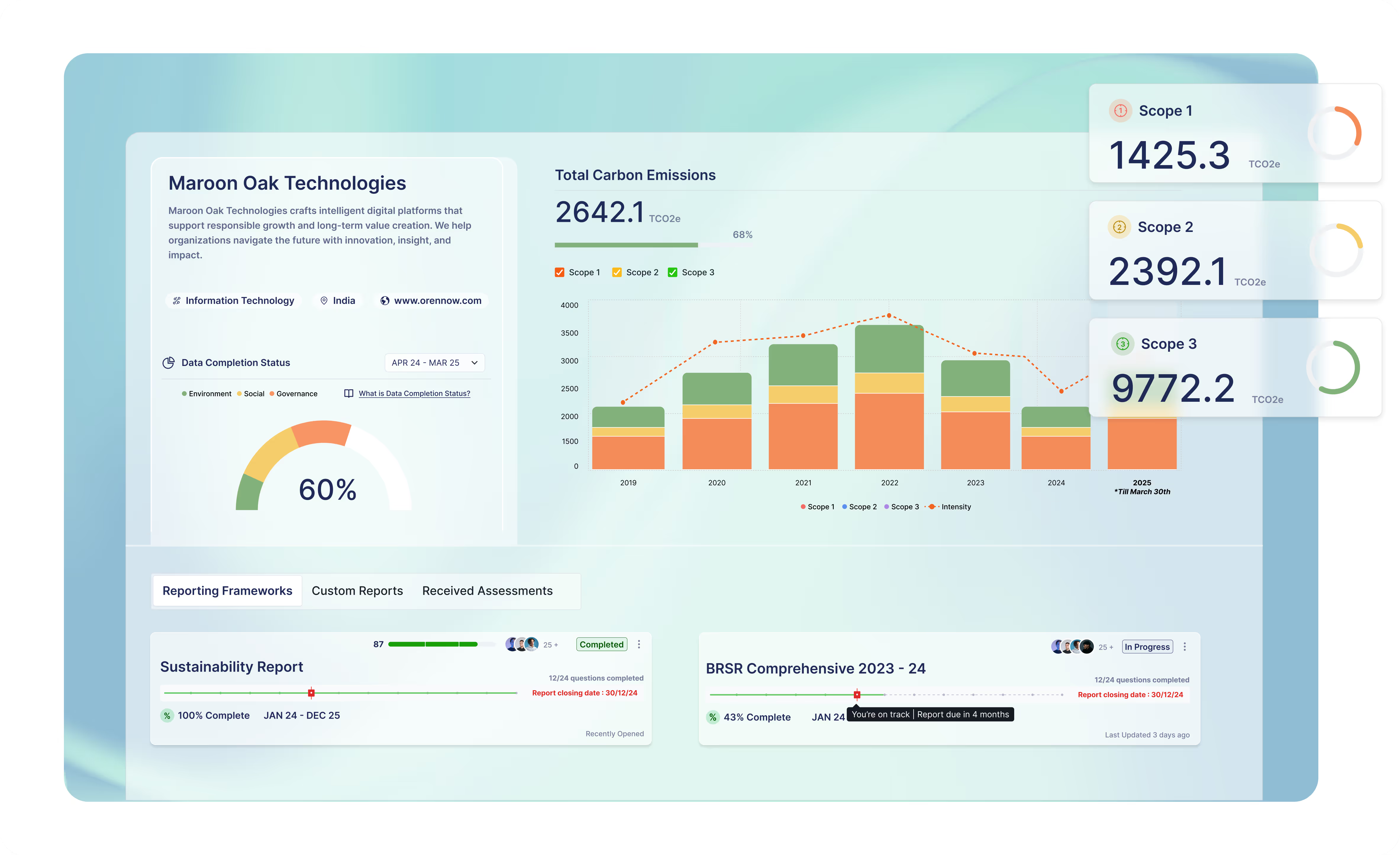
IFRS S2 requires disclosure of the measurement approach for each Scope 3 category. What matters is that the approach is documented, consistent, and audit-ready before assurance kicks in from 2027. Oren's GHG accounting platform generates that audit trail across Scope 1, 2, and 3.
Key Takeaways
2027 is less a deadline than a forcing function for supplier data infrastructure. Malaysian groups that sequence NSRF scope 3 reporting Malaysia requirements, CBAM embedded-emissions submissions, and carbon tax MRV as one data architecture will spend once and report three times. Those who treat them as separate projects will rebuild the same pipeline twice. To see how Oren supports phased NSRF compliance with full Scope 1, 2, and 3 accounting across multi-tier supply chains, schedule a demo.
Frequently Asked Questions (FAQs)
Q1. Who must report Scope 3 emissions in Malaysia by 2027?
Three categories of reporters are in scope by 1 January 2027. Main Market listed issuers with market capitalisation of RM 2 billion and above (Group 1) must disclose all 15 Scope 3 categories under IFRS S2. ACE Market listed corporations and Large non-listed companies with annual revenue of RM 2 billion and above (Group 3) begin reporting Scope 1, Scope 2, and limited Scope 3. Other Main Market issuers (Group 2) continue with limited Scope 3 until 1 January 2029.
Q2. What is the difference between limited and full Scope 3 under NSRF?
Limited Scope 3 under the Bursa Malaysia Listing Requirements covers two categories, business travel and employee commute, inherited from the 2021 mandatory sustainability reporting rules. Full scope 3 emissions Malaysia disclosure, aligned with IFRS S2, covers all 15 GHG Protocol categories including purchased goods and services, capital goods, upstream and downstream transportation, use of sold products, end-of-life treatment, investments, and franchises.
Q3. Do Malaysian SMEs have to report Scope 1, 2 and 3 emissions?
Scope 3 emissions SME Malaysia obligations are commercial, not regulatory, below the RM 2 billion threshold. Large listed customers, banks disclosing financed emissions, and EU buyers subject to CBAM already request Scope 1, 2, and material Scope 3 data from Malaysian suppliers. Capital Markets Malaysia's SEDG gives SMEs a standardised framework to respond with one consistent disclosure rather than bespoke answers per customer.
Q4. Which standard does Malaysia use for GHG scope 1 2 3 Malaysia reporting?
Malaysia uses the IFRS Sustainability Disclosure Standards, specifically IFRS S1 and IFRS S2, issued by the International Sustainability Standards Board. Underlying GHG measurement follows the GHG Protocol Corporate Accounting and Reporting Standard, with Malaysia-specific grid emission factors published by the Energy Commission.
Q5. When does reasonable assurance on Scope 1 and 2 become mandatory in Malaysia?
Reasonable assurance on Scope 1 and Scope 2 GHG emissions becomes mandatory for Group 1 for annual reporting periods beginning on or after 1 January 2027. Group 2 follows on 1 January 2028. ACE Market listed companies and Large NLCos (Group 3) obtain reasonable assurance from 1 January 2029. Standards will be determined by the Malaysian Institute of Accountants.
Q6. How does Malaysia's 2026 carbon tax interact with scope 1 2 3 emissions Malaysia reporting?
The 2026 carbon tax initially covers iron, steel, and the energy sector, using facility-level Scope 1 emissions as the tax base. Companies already reporting under NSRF will find that Scope 1 and 2 data used for disclosure flows directly into carbon tax calculations and, for exporters, into CBAM submissions. Scope 3 is not directly taxed today, but supplier Scope 1 data feeds your Scope 3 calculations.
Q7. What categories fall under the scope 3 supply chain emissions in Malaysia?
Scope 3 supply chain emissions Malaysia disclosure follows the 15 categories defined by the GHG Protocol. Upstream categories include purchased goods, capital goods, fuel and energy-related activities, transportation and distribution, waste, business travel, and employee commuting. Downstream categories include transportation and distribution, processing and use of sold products, end-of-life treatment, leased assets, franchises, and investments.

About the author
Kushagra
Senior ESG & Sustainability Advisor
Kushagra is a Senior ESG & Sustainability Advisor at Oren with 8+ years across CSR and sustainability consulting, specialising in GHG accounting, ESG strategy, and regulatory reporting across India, the UAE, and the Middle East.