NSRF Malaysia Decoded: Everything Your Company Needs for IFRS S1 & S2 Compliance
On 24 September 2024, Malaysia's Ministry of Finance and the Securities Commission Malaysia (SC) launched the National Sustainability Reporting Framework. Around 130 large Main Market issuers, representing over 80% of Bursa Malaysia's market capitalisation, began reporting under IFRS S1 and IFRS S2 for financial years starting 1 January 2025.
Malaysian issuers now carry three moving parts at once: the NSRF itself, the amended Bursa Main Market and ACE Market Listing Requirements issued in December,2024 and the ISSB climate-first sequencing logic. What IFRS S1 and S2 actually require under the national sustainability reporting framework Malaysia has adopted, and how the timeline unfolds group by group, is the practical question for every sustainability and finance lead.
This post breaks down the NSRF IFRS S1 S2 alignment, the phased NSRF timeline, Bursa integration, transition reliefs, and the assurance onramp.
What is the NSRF, and how does it align with IFRS S1 and S2?
The NSRF Malaysia is the National Sustainability Reporting Framework, adopting the IFRS Sustainability Disclosure Standards as the baseline for sustainability reporting by companies in Malaysia.
Baseline standards
The NSRF applies IFRS S1 (General Requirements for Disclosure of Sustainability-related Financial Information) and IFRS S2 (Climate-related Disclosures), collectively the ISSB Standards, as issued by the International Sustainability Standards Board. The framework tracks the standards closely, with the same transition reliefs the ISSB permits.
Governance body
The national sustainability reporting framework Malaysia adopted was developed by the Advisory Committee on Sustainability Reporting (ACSR). Members include Bank Negara Malaysia, the Companies Commission of Malaysia, Bursa Malaysia, the Financial Reporting Foundation, and the SC's Audit Oversight Board.
Jurisdictional alignment
Malaysia joins more than 20 jurisdictions, collectively representing 55% of global GDP, using the ISSB Standards. The IFRS Foundation published Malaysia's Jurisdictional Profile, confirming the country's adoption approach with its transition reliefs.
NSRF reporting requirements under IFRS S1 and S2
The NSRF reporting requirements mandate that applicable entities publish a sustainability statement based on IFRS S1 and S2, co-published with the annual financial statements.
IFRS S1: general requirements
IFRS S1 sets the baseline. Companies disclose sustainability-related risks and opportunities that could reasonably be expected to affect enterprise value, across governance, strategy, risk management, and metrics and targets.
IFRS S2: climate-related disclosures
IFRS S2 applies the same four-pillar structure specifically to climate. It is built on the TCFD pillars and includes scenario analysis, transition planning, and Scope 1, 2, and 3 GHG emissions.
Financial materiality lens
The NSRF IFRS S1 S2 framework uses financial materiality. Only those sustainability matters that could influence the decisions of investors, lenders, and other capital providers are required. Organisations running a GRI-based materiality process will need to recalibrate, since GRI uses a broader stakeholder lens.
Location of disclosure
For listed issuers, the sustainability statement sits inside the annual report. For large non-listed companies, the Companies Commission of Malaysia will determine location through amendments to the Companies Act 2016.
NSRF timeline: phased adoption by Groups 1, 2, and 3
The NSRF timeline phases adoption across three groups between 2025 and 2027, structured by market and revenue size.
Group 1: Main Market listed issuers with market capitalisation of RM2 billion or above, reporting under IFRS S1 and S2 for annual periods beginning on or after 1 January 2025. First reports land in 2026.
Group 2: All remaining Main Market-listed issuers, from annual periods beginning on or after 1 January 2026.
Group 3: ACE Market-listed issuers and large non-listed companies with consolidated group revenue of RM2 billion or above for two consecutive preceding financial years, from annual periods beginning on or after 1 January 2027.
According to SC Malaysia, around 130 companies fall into Group 1, representing over 80% of Bursa Malaysia's market capitalisation. Entities outside these thresholds may adopt voluntarily.
NSRF and Bursa Malaysia listing requirements integration
Bursa Malaysia amended its Main Market and ACE Market Listing Requirements on 23 December 2024 to embed NSRF obligations into the listing rules.
Sustainability statement mandated
Every listed issuer must prepare a sustainability statement under IFRS S1 and S2 as part of the annual report. The amendments apply across Group 1, 2, and 3 on their respective start dates.
Assurance disclosure
Listed issuers must state whether the sustainability statement underwent internal review by an internal auditor or independent assurance under recognised standards such as ISAE 3000 (Revised) or ISSA 5000. Conclusions from any independent assurance must be disclosed.
CSI platform
Bursa operates the Centralised Sustainability Intelligence (CSI) platform as the official submission channel for sustainability disclosures. Entities within scope upload disclosures for investor access and benchmarking.
Transition reliefs: climate-first and Scope 3 deferral
The NSRF provides additional transition reliefs that sequence adoption, beginning with climate and deferring the hardest data.
Climate-first sequencing
For the first two reporting periods, Group 1 and Group 2 companies may disclose only climate-related risks and opportunities under IFRS S2, deferring broader IFRS S1 topics. Group 3 receives the same relief for three years.
Principal business segments
During the relief window, climate-related disclosures may focus on principal business segments rather than the full group.
Scope 3 deferral
Disclosure of Scope 3 GHG emissions is deferred for two years for Group 1 and 2 and three years for Group 3. The exception: Bursa Main Market-listed issuers must disclose Scope 3 for business travel and employee commute from the start, following Bursa's existing rules.
Group-level exemption
Large non-listed companies whose holding entity already reports under ISSB or an equivalent framework, such as the European Sustainability Reporting Standards (ESRS), may leverage the holding company's disclosures.
Assurance roadmap for Scope 1 and Scope 2 emissions
The NSRF compliance bar for assurance rises from voluntary to mandatory reasonable assurance on Scope 1 and Scope 2 GHG emissions.
Group 1 first, from FY 2027
According to SC Malaysia, reasonable assurance on Scope 1 and Scope 2 emissions becomes mandatory for Group 1 companies for annual reporting periods beginning on or after 1 January 2027. Group 2 and Group 3 follow on their respective timelines.
Recognised assurance standards
Assurance engagements are expected to follow ISAE 3000 (Revised) or ISSA 5000, the IAASB's dedicated sustainability assurance standard. The full assurance framework, including accreditation of assurance providers, will be issued by the Sustainability Assurance Working Group (SAWG) following further consultation.
Key Takeaways
Malaysian reporting will move quickly from climate-first disclosures to full IFRS S1 topic coverage once the two-year relief window closes for Group 1. The assurance bar also shifts from today's internal review standard to mandatory reasonable assurance on Scope 1 and 2 emissions by 2027.
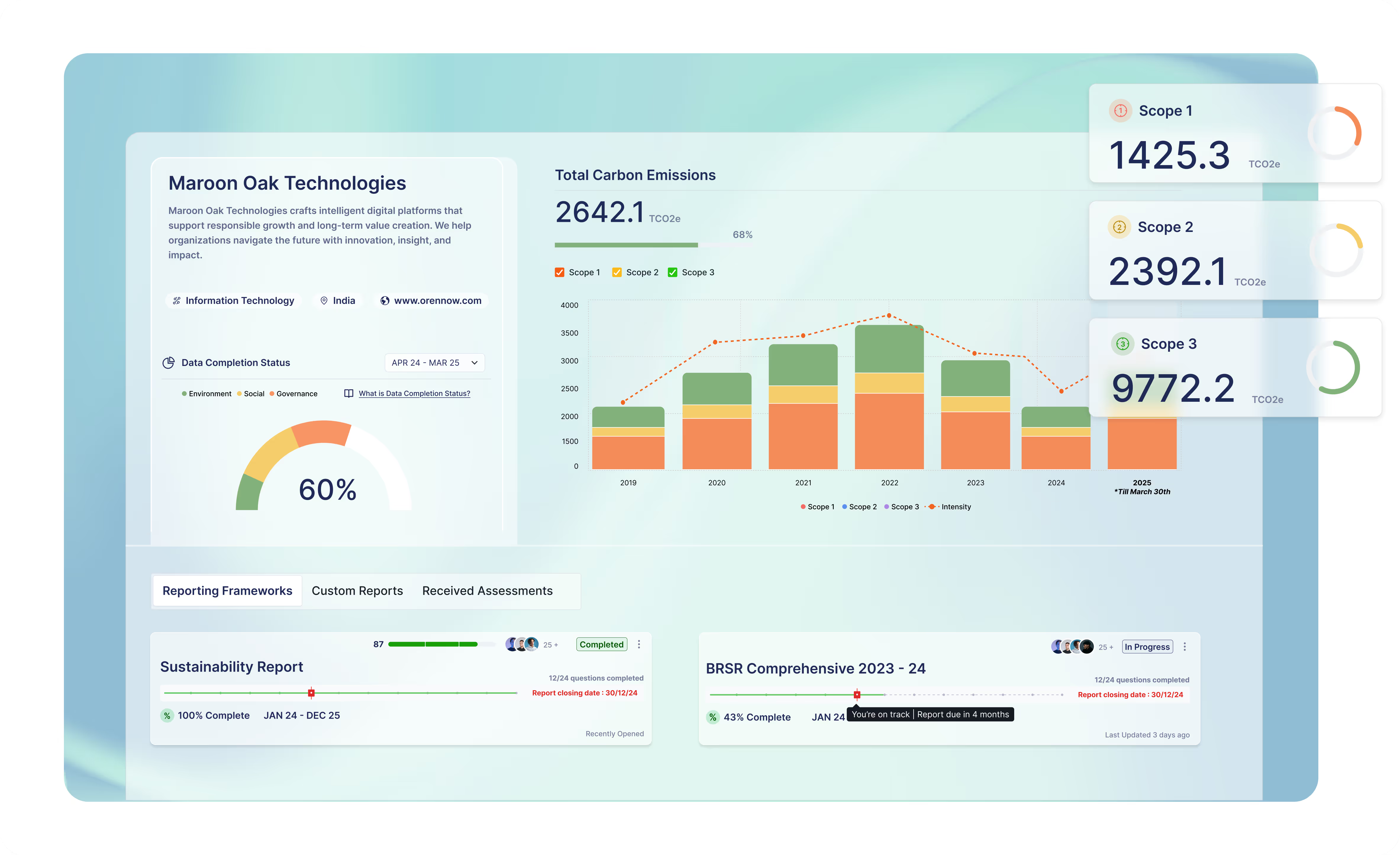
Oren helps Malaysian sustainability and finance teams build IFRS S1 and S2-aligned disclosures, calibrate materiality under the financial lens, and prepare Scope 1, 2, and 3 emissions data for assurance. Schedule a demo to see how.
Frequently Asked Questions (FAQs)
Q1. What is the NSRF in Malaysia?
The NSRF is the National Sustainability Reporting Framework, launched on 24 September 2024 by Malaysia's Ministry of Finance and the Securities Commission Malaysia. It adopts IFRS S1 and IFRS S2, issued by the ISSB, as the baseline sustainability disclosure standards for Malaysian companies. The framework applies to Bursa Malaysia Main Market and ACE Market listed issuers, and to large non-listed companies with consolidated revenue of RM2 billion or above.
Q2. When does NSRF compliance begin?
The NSRF timeline starts with annual reporting periods beginning on or after 1 January 2025 for Group 1, which covers Main Market-listed issuers with a market capitalisation of RM2 billion or above. Group 2, covering the remaining Main Market issuers, starts from 1 January 2026. Group 3, covering ACE Market issuers and large non-listed companies, starts from 1 January 2027.
Q3. How does the NSRF align with IFRS S1 and S2?
The NSRF IFRS S1 S2 alignment uses the ISSB Standards as the baseline with no modifications. IFRS S1 sets general requirements for disclosing sustainability-related risks and opportunities affecting enterprise value. IFRS S2 covers climate-related disclosures, including Scope 1, 2, and 3 emissions and scenario analysis. The NSRF also applies the ISSB transition reliefs, with Malaysia adopting a limited-transition, climate-first approach.
Q4. Who must comply with NSRF reporting requirements?
The NSRF reporting requirements apply to Bursa Malaysia Main Market-listed issuers, ACE Market-listed issuers, and large non-listed companies with consolidated group revenue of RM2 billion or above for two consecutive preceding financial years. Entities outside these thresholds may voluntarily adopt the framework. The first compliance group is around 130 Main Market companies with a market capitalisation of RM2 billion or above.
Q5. What are the NSRF transition reliefs for Scope 3 emissions?
Scope 3 GHG emissions disclosure is deferred for two years for Group 1 and Group 2 companies, and three years for Group 3 companies. The exception is Bursa Main Market-listed issuers, who must disclose Scope 3 for business travel and employee commute from the start of their NSRF adoption year, consistent with Bursa's existing sustainability reporting rules.
Q6. How does NSRF connect with Bursa Malaysia listing requirements?
The NSRF Bursa Malaysia integration was finalised on 23 December 2024 through amendments to the Main Market and ACE Market Listing Requirements. Listed issuers must prepare sustainability statements under IFRS S1 and S2, disclose whether the statement underwent internal review or independent assurance under ISAE 3000 (Revised) or ISSA 5000, and submit disclosures via the Centralised Sustainability Intelligence (CSI) platform.
Q7. Is assurance mandatory under the NSRF?
Assurance becomes mandatory in a phased manner. Reasonable assurance on Scope 1 and Scope 2 GHG emissions is required for Group 1 companies from annual reporting periods beginning on or after 1 January 2027. Group 2 and Group 3 follow on their respective timelines. Assurance engagements are expected to follow ISAE 3000 (Revised) or ISSA 5000, with the full assurance framework to be issued by the Sustainability Assurance Working Group.

About the author
Abhirup Das
Head of ESG & Sustainability Advisory
Abhirup leads Oren’s ESG & Sustainability Advisory practice, blending industrial engineering, digital transformation, and ESG governance to translate compliance into long-term financial and strategic value.