Bursa Malaysia Sustainability Reporting 2026: Your Step-by-Step Compliance Playbook

On 23 December 2024, Bursa Malaysia amended its Main Market and ACE Market Listing Requirements to require sustainability reporting aligned with IFRS S1 and S2. Group 1 issuers (market cap above RM2 billion) began reporting for financial years ending on or after 31 December 2025. Group 2 follows for FY ending on or after 31 December 2026. This playbook covers what the enhanced Bursa Malaysia Sustainability Framework requires, what the sustainability amendments to the Bursa Malaysia listing requirements change, and how to submit through the CSI platform.
The 2026 Bursa Malaysia Sustainability Reporting Landscape
The enhanced Bursa Malaysia Sustainability Framework is the listed-issuer arm of the National Sustainability Reporting Framework (NSRF), which the Securities Commission Malaysia launched on 24 September 2024. The amendments replace the guidance-based approach of the 3rd Edition Sustainability Reporting Guide with mandatory IFRS-aligned disclosures.
Phased NSRF timeline
Group | Scope | First reporting period (FY ending on or after) |
Group 1 | Main Market issuers with market cap ≥ RM2 billion | 31 December 2025 |
Group 2 | All other Main Market issuers | 31 December 2026 |
Group 3 | ACE Market issuers | 31 December 2027 |
Group 2 issuers have one financial year to build up data architecture, materiality refresh, and assurance pathways before the first IFRS S2 climate disclosures are due.
What the enhanced sustainability framework now requires
The amended Bursa Malaysia ESG requirements centre on three obligations. Every listed issuer must disclose against IFRS S1 (general sustainability-related financial information) and IFRS S2 (climate-related disclosures). Quantitative indicators must carry three financial years of comparative data. Material sustainability matters must be assessed and governed, not merely listed.
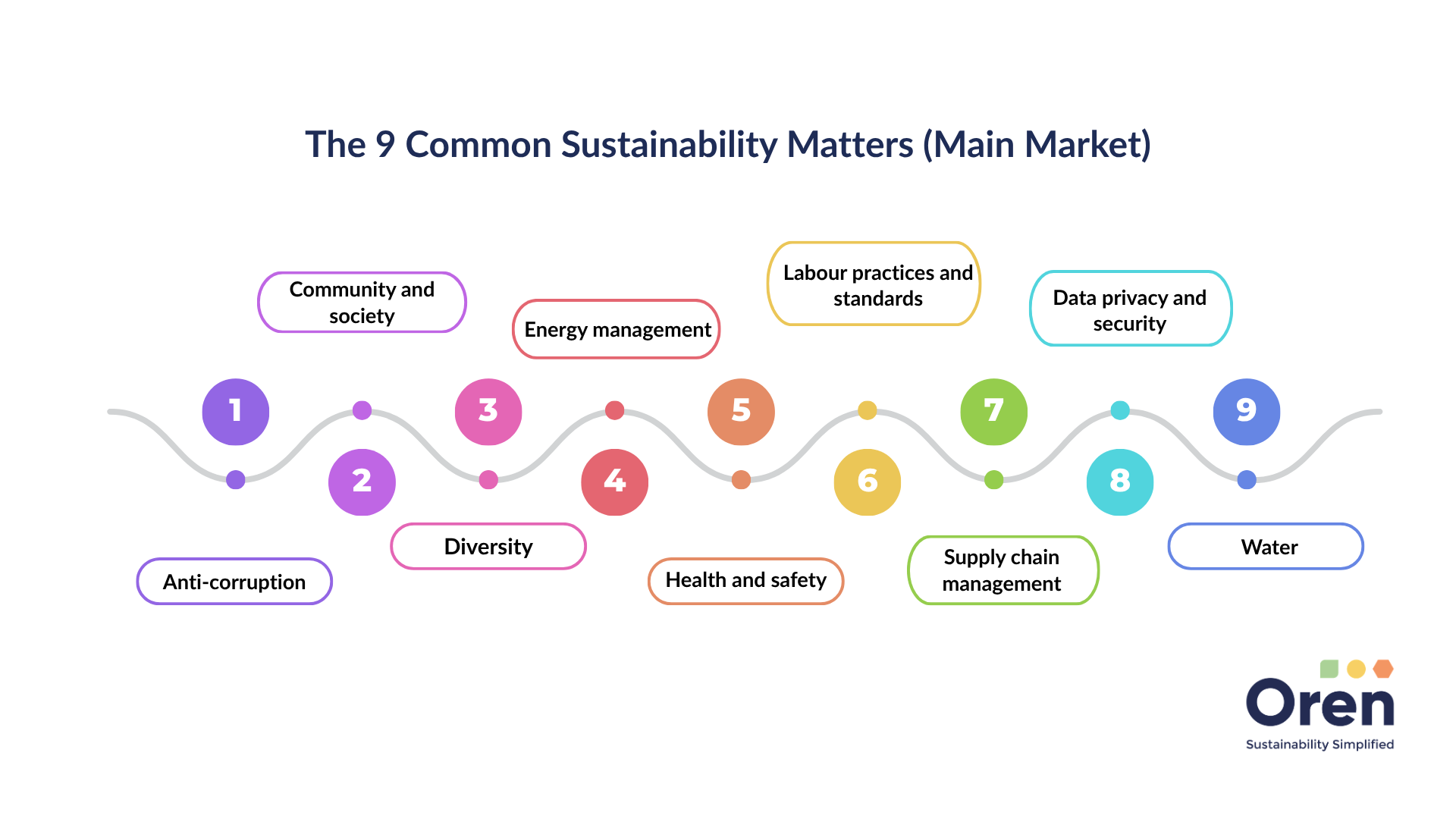
The Bursa Malaysia Sustainability Reporting Guide reduced the number of common sustainability matters from 11 to 9 for Main Market issuers. ACE Market issuers report eleven (the nine plus waste and emissions).
Bursa Malaysia listing requirements: Sustainability, Assurance and Climate
TCFD-aligned climate disclosures:
Main Market issuers have been required to make TCFD-aligned disclosures from 31 December 2025. ACE Market issuers must disclose a basic transition plan to a low-carbon economy by 31 December 2026. Post-NSRF, these requirements sit inside the broader IFRS S2 disclosure pathway, covering governance, strategy, risk management, and metrics.
Assurance:
Issuers must confirm whether sustainability statements have been internally reviewed or externally assured against ISAE 3000 (Revised) or ISSA 5000. Reasonable assurance over Scope 1 and Scope 2 emissions becomes mandatory for Group 1 from FY2027.
Transition reliefs:
Main Market issuers have two full financial years of transition relief; ACE Market issuers have three. Scope 3 disclosures can be deferred by one year from a company's first IFRS S2 reporting cycle.
The Bursa CSI Platform: Submission Walkthrough
The Bursa CSI platform (Centralised Sustainability Intelligence) is the designated submission channel for listed issuers. Bursa Malaysia built the CSI platform with the London Stock Exchange Group as a centralised repository for NSRF-aligned disclosures.
Core Modules:
Mandatory reporting module (free) with tabs pre-categorised to NSRF indicators
Scope 1 and Scope 2 carbon calculator (free)
Scope 3 estimation and supplier engagement tools by Fair Supply
PwC-developed e-learning module for suppliers and SMEs
Report-generation tool by CarbonGPT and ratings analyser by SustenyX
How submission works: Issuers input quantitative and qualitative data against each common sustainability matter and the IFRS S2 metric. The CSI platform generates a prescribed-format summary. This summary must be disclosed in the sustainability statement without tampering, preserving data integrity across filings.
A practical compliance playbook for FY2026
Five steps separate Group 2 issuers currently on track from those that will miss first-cycle deadlines:
Run a gap assessment against IFRS S1 and S2, mapped to the 9 common sustainability matters.
Refresh your materiality assessment using the double-materiality lens that NSRF signals.
Build a single source of truth for Scope 1, 2 and 3 accounting and comparative three-year data.
Prepare internal assurance readiness files against ISAE 3000 or ISSA 5000 scope.
Run a CSI platform dry-run submission at least one quarter before filing.
Key Takeaways
Group 2 issuers have one reporting cycle to move from guidance-based disclosure to IFRS-aligned statements filed through the CSI platform. Group 3 leads should treat 2027 as a planning horizon, not a future problem, given the data lineage and assurance demands of Scope 3. Schedule a demo to see how Oren supports Bursa-aligned reporting, CSI submission readiness, and IFRS S2 climate data workflows for Malaysian PLCs.
Frequently Asked Questions (FAQs)
Q1. When does Bursa Malaysia sustainability reporting apply to Group 2 issuers?
Group 2 covers all Main Market issuers outside the RM2 billion market-capitalisation threshold. These issuers must publish their first IFRS S1 and S2 disclosures for the financial year ending on or after 31 December 2026. Transition reliefs allow climate-first reporting for two financial years before full IFRS S1 disclosures apply. Scope 3 can be deferred one year from the first IFRS S2 cycle.
Q2. What is the Bursa CSI platform?
The Bursa CSI platform is the Centralised Sustainability Intelligence solution Bursa Malaysia built with the London Stock Exchange Group. It is the designated reporting channel for listed issuers, housing a mandatory reporting module, Scope 1 and 2 carbon calculator, Scope 3 estimation via Fair Supply, and e-learning for suppliers. Issuers generate a prescribed-format data summary on the platform and disclose it verbatim in their sustainability statement.
Q3. Does Bursa Malaysia require IFRS S1 and S2?
Yes. The amended bursa malaysia esg requirements issued on 23 December 2024 mandate sustainability statements prepared in accordance with IFRS S1 and S2. Phased implementation began with Group 1 in FY2025, extends to Group 2 in FY2026, and to Group 3 in FY2027. Transition reliefs give Main Market issuers two financial years to adopt climate-first disclosures before full IFRS S1 obligations apply.
Q4. What are the 9 common sustainability matters under the Bursa Malaysia Sustainability Framework?
The nine matters for Main Market issuers are anti-corruption, community and society, diversity, energy management, health and safety, labour practices and standards, supply chain management, data privacy and security, and water. ACE Market issuers report eleven, adding waste and emissions. Issuers must disclose governance, management approach, and at least three years of quantitative indicators against each matter assessed as material.
Q5. Is external assurance mandatory under the Bursa Malaysia listing requirements, sustainability rules?
Internal review is mandatory; external assurance is currently disclosure-based. Issuers must confirm whether statements have been assured and, if so, against which standard (ISAE 3000 Revised or ISSA 5000). Reasonable assurance over Scope 1 and Scope 2 emissions becomes mandatory for Group 1 issuers from FY2027, signalling the direction for Groups 2 and 3.
Q6. Can ACE Market issuers delay Scope 3 disclosures?
Yes. ACE Market issuers have three financial years of transition relief from their FY2027 start. A basic transition plan is required from the financial year ending on or after 31 December 2026, and full Scope 3 disclosure under IFRS S2 can be deferred by one year from the first reporting cycle. Begin supplier data collection early given the time Scope 3 methodology takes to stabilise.
Q7. Where can I access the Bursa Malaysia Sustainability Reporting Guide?
The Sustainability Reporting Guide 3rd Edition remains available on Bursa Malaysia's official website. It is now read alongside the 23 December 2024 Listing Requirements amendments and NSRF documentation from the Securities Commission Malaysia. Treat the Guide as reference material for sector-specific indicator interpretation and the amended Listing Requirements as the binding disclosure basis for FY2025 reporting onward.

About the author
Olivia Paul
ESG & Sustainability Advisor
Olivia is an ESG & Sustainability Advisor at Oren, focused on ESG reporting and strategy, materiality assessments, GHG inventory, and net-zero roadmaps across manufacturing, financial services, and infrastructure.