Nature Risk Assessment: The Next Big ESG Requirement

What Nature Risk Assessment Is and Why It Is Becoming an ESG Priority?
The nature risk assessment is the systematic procedure of recognising, assessing, and controlling the financial risks and opportunities that arise from the reliance of an organisation on and influence on natural ecosystems, such as:
Biodiversity
Freshwater systems
Soil health
Other living resources
In contrast to the climate that has taken the ESG centre stage in the past 10 years, nature is a more varied and intricate set of physical dependencies, all of which have direct operational continuity, supply chain resilience, and long-term enterprise value implications.
The urgency is becoming difficult to ignore. According to the World Economic Forum, the loss of biodiversity and the breakdown of entire ecosystems are among the five highest-impact global risks.
Growing Importance of Nature Related Financial Disclosures in Sustainability Reporting
Nature related financial disclosures are organised reports defining the way the organisation operates in reliance and influence on natural systems and how the interdependence turns into monetary risk or opportunities. In 2021, the TNFD, launched as a market-led initiative, offers the predominant framework of such disclosures, which is supported by the four pillars:
Governance
Strategy
Risk & Impact Management
Metrics and Targets
The movement of the direction is now very clear. In November 2025, the ISSB officially stated it would proceed with nature-related disclosure requirements, which would be based directly on the TNFD framework to build incrementally on IFRS S1 and IFRS S2.
Such alignment clearly indicates that nature related financial disclosures will cease to be a voluntary best practice and become a firm expectation in the near future. Organisations that initiate the development of disclosure-ready systems today will have a structural advantage over those that wait for mandatory deadlines.
Key Components of a Nature Risk Assessment Framework

An organised nature risk assessment framework offers the means by which the financial materiality of the various nature-related risks to an organisation is understood.
The TNFD's LEAP approach is the most common methodology and the heart of the majority of frameworks that are operational nowadays:
Locate
Map where operations and value chains interfere with nature and find proximity to biodiversity hotspots, protection areas, and water-stressed areas with geospatial applications and sector-specific data.
Evaluate
Determine the reliance of the organisation on the ecosystem services (e.g., water purification, pollination, or soil fertility) and the direct and indirect effects of operations on the services.
Assess
Categorise identified dependencies and impacts into any of the four financially material risks and opportunities, physical, transition, or liability-based, that could reasonably impact enterprise value in the long run.
Prepare
Creating a management response and reporting plan that is consistent with the four disclosure pillars of TNFD, as we read earlier.
The nature risk assessment framework is specifically structured to be compatible with ISSB standards, GRI, and the EU ESRS to enable organisations to incorporate nature disclosures within their existing reporting frameworks instead of building entirely separate systems.
How Environmental Risk Assessment Supports Nature Risk Management?
Environmental risk assessment is used to assess the negative impact that business activities have on the natural environment, including land-use change, water extraction, and pollution.
Within nature risk management, it provides the site-level foundation upon which broader financial risk analysis is built. Knowledge of the relationship between the three types of assessment assists organisations in prioritising their tasks and preventing duplication.
Assessment Type | Primary Focus | Role in Nature Risk Management |
Environmental Risk Assessment | Operational stressors on the environment | Provides location-specific data on pressures driving ecosystem degradation |
Ecological Risk Assessment | Harm to living organisms from biological, chemical, or physical stressors | Quantifies the biological impact of identified stressors on biodiversity |
Nature Risk Assessment | Financial risks from dependencies on natural systems | Translates environmental findings into investor-grade, financially material disclosures |
Companies that have established environmental risk evaluations can explore those records as an effective starting point for TNFD-centric disclosures.
Integration of Nature Risk Assessment With Sustainability Risk Assessment Practices
Nature risk assessment does not sit in isolation; it is being increasingly integrated into the wider sustainability risk assessment framework of an organisation. Major organisations are heading beyond siloed strategies and integrating biodiversity and ecosystem exposure into enterprise risk registers, double materiality analyses, and board-level risk governance.
Such integration involves true cross-functional teamwork:
Ecological expertise is introduced by the sustainability teams
Judgments of materiality are put into practice by finance teams
Risk managers ensure accountability at the governance level
Organisations that integrate early avoid reactive compliance and instead use nature risk data to make more informed decisions on strategy, engagement with suppliers, and capital allocation, and convert a disclosure requirement into a competitive intelligence source.
Challenges Companies Face in Conducting Nature Risk Assessments
Despite growing momentum, the practical application of nature risk assessment is not as easy as it may appear, and most organisations face the same set of challenges when starting.
Data availability and quality
Unlike carbon emissions, nature-related metrics lack standardised measurement tools. Biodiversity data is often geographically incomplete, modelled rather than directly measured, and difficult to audit, creating real consistency problems for investor-grade disclosure.
Value chain complexity
The nature-related material risks most often lie upstream in supply chains, in areas like agriculture, forestry, and extraction of raw materials, where companies are less visible and possess even less control over data gathering.
Translating impacts into financial materiality
Knowing that your operations affect an ecosystem is one thing. Determining whether that exposure is financially material is an entirely different challenge, one that requires specialised judgement, sector expertise, and scenario analysis capabilities that most organisations are still developing.
Inconsistent regulatory signals
There is no single global standard that is obligatory in place yet, and it is indeed difficult to know in what order and what structure to prioritize, leaving many sustainability teams in a holding pattern.
Key Takeaways on Nature Risk Assessment for ESG and Corporate Strategy
With the growing pace of TNFD implementation and the development of nature-related standards by the ISSB, the window to act ahead of the curve is narrowing. The core actions to take today include:
Begin a LEAP-based scoping exercise to map key nature interfaces across your operations and supply chains.
Integrate nature risk into your enterprise risk management and sustainability governance frameworks with climate and social risks.
Establish in-house capacity in terms of biodiversity indicators, reliance on ecosystem services, and value chain information gathering.
Align your disclosure approach to TNFD, with interoperability to ISSB and GRI reporting frameworks in mind from the outset.
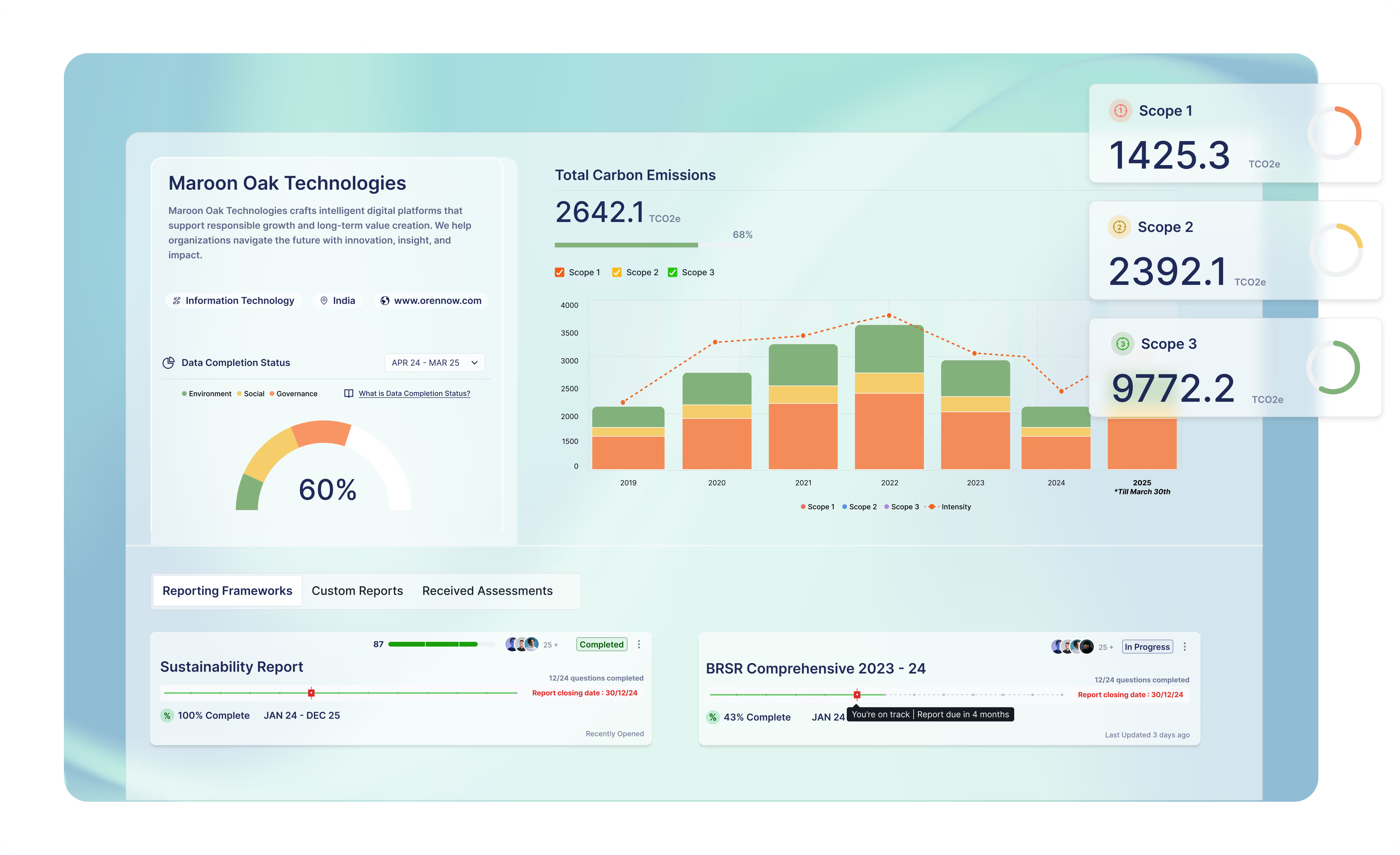
Oren's ESG and sustainability reporting platform helps organisations structure and manage nature-related disclosures from data consolidation and governance alignment to reporting against emerging TNFD and ISSB standards. Our platform helps you meet today's requirements with confidence and stay ahead of what comes next.
Frequently Asked Questions (FAQs)
Q1. What is nature risk assessment?
The nature risk assessment is a process of identifying and managing financial risks caused by organisational dependencies and effects on the natural ecosystems, such as biodiversity, water, and soil systems.
Q2. Why is nature risk assessment important for ESG reporting?
It helps organisations to publish financial material risks associated with the loss of biodiversity and degradation of ecosystems, which are becoming increasingly examined by investors and regulators.
Q3. What are nature related financial disclosures?
Nature related financial disclosures are structured reports that explain how a business depends on and impacts nature, and how these interactions create financial risks and opportunities.
Q4. How does environmental risk assessment relate to biodiversity risks?
Environmental risk assessment defines the operational stressors that lead to biodiversity loss, which are the customary scientific basis of wider nature risk analysis.
Q5. What is an ecological risk assessment?
Ecological risk assessment measures the probability of physical, chemical, or biological stresses produced by human activities harming the organisms or ecosystems.
Q6. What is a nature risk assessment framework?
A nature risk assessment framework refers to a systematic process of identifying, determining and reporting nature-related financial risks in an organisation.
Q7. How can companies integrate nature risk assessment into their sustainability strategy?
Businesses can start by defining nature dependencies, encompassing risks into enterprise risk management, and harmonizing sustainability reports with the established systems.

About the author
Olivia Paul
ESG & Sustainability Advisor
Olivia is an ESG & Sustainability Advisor at Oren, focused on ESG reporting and strategy, materiality assessments, GHG inventory, and net-zero roadmaps across manufacturing, financial services, and infrastructure.