Carbon Border Adjustment Mechanism (CBAM) 2026: What It Is & How It Works
The European Commission published its first official carbon border adjustment mechanism (CBAM) certificate price in April 2026: EUR 75.36 per tonne of CO2e for first-quarter imports. With that number, the CBAM stopped being a reporting exercise and became a line in the P&L.
Much of what was written during the transitional period no longer describes the system. The Omnibus amendment, Regulation (EU) 2025/2083, exempted small importers, pushed certificate sales to February 2027 and reset the declaration calendar.
This article covers the EU CBAM as it stands in July 2026: the regulation, the covered goods, the timeline, and the decisions importers and exporters face this year.
What is the Carbon Border Adjustment Mechanism (CBAM)?
The carbon border adjustment mechanism (CBAM) is the European Union's carbon price on imported goods, established by Regulation (EU) 2023/956. EU importers of covered products report the emissions embedded in those goods and surrender CBAM certificates against them at a price linked to the EU Emissions Trading System (ETS).
Why the EU Introduced It
The European Commission designed CBAM to prevent carbon leakage: production relocating to countries with weaker climate rules, or EU output losing ground to higher-carbon imports. A tonne of steel made in Europe already carries an ETS cost. CBAM applies an equivalent cost to the imported tonne.
The Link to Free Allowances
Free ETS allowances for European industry phase out between 2026 and 2034, and CBAM phases in as they disappear. It is an extension of the ETS rather than a separate trade measure.
Is CBAM a Tax?
No. A carbon border tax would fix a rate in law. CBAM prices certificates against the EU carbon market, so the cost of importing embedded carbon moves with EU ETS auction prices. Carbon costs already paid in the country of origin can be deducted, subject to evidence, which matters as schemes such as India's Carbon Credit Trading Scheme (CCTS) mature over time.
How the Price is Set for 2026 Imports
The Omnibus changed the pricing method for the first compliance year. Certificates covering 2026 imports are priced on the quarterly average of EU ETS auction prices in the quarter of import – the Commission set Q1 2026 at EUR 75.36. Weekly averages apply from 2027.
The CBAM Regulation After The Omnibus
The legal basis remains Regulation (EU) 2023/956, amended by Regulation (EU) 2025/2083, in force since October 2025. Three changes matter most:
The 50-tonne exemption: Importers whose annual imports of CBAM goods stay under 50 tonnes fall outside the mechanism: no authorisation, no declarations, no certificates needed. The threshold applies per importer, per EORI number, and does not cover hydrogen or electricity. Cross it mid-year and every import of that year comes back into scope.
Deferred certificate sales: Sales begin 1 February 2027, covering 2026 imports retroactively.
An extended declaration deadline: The first annual CBAM declaration is due 30 September 2027, moved from the original 31 May date.
Per the Commission's impact assessment, the exemption removes roughly 90% of importers while keeping about 99% of embedded emissions in scope. A package of implementing acts adopted on 17 December 2025 set the operational rules for the definitive regime, alongside a proposal to extend CBAM to downstream products.
Which Goods Does CBAM Cover?
CBAM covers six categories defined by CN code in Annex I of Regulation (EU) 2023/956: cement, iron and steel, aluminium, fertilisers, electricity and hydrogen. Downstream items in the iron and steel chain, such as screws and bolts, are included.
CBAM Steel And CBAM Aluminium
Iron, steel and aluminium have been India's biggest exports that come under CBAM. As the mechanism is adopted, competitiveness in the EU market now rests on two metrics:
Embedded emissions per tonne
The quality of the data behind that figure
On the other hand, when producers cannot supply accurate data, EU importers have to fall back on default values for these metrics, leading to higher emissions figures and, consequently, higher costs.Scope From 2027 Onwards
The Commission's December 2025 proposal would bring more fabricated steel and aluminium products into scope. A product outside CBAM today may not stay outside it.
CBAM timeline and certificates
As of July 2026, this is the CBAM timeline:
Date | Milestone |
|---|---|
October 2023 | Transitional period begins: quarterly reporting, no payment |
31 December 2025 | Transitional period ends |
1 January 2026 | Definitive regime live; 50-tonne exemption applies |
31 March 2026 | Application deadline for authorised CBAM declarant status |
1 February 2027 | Certificate sales open, covering 2026 imports |
Q1 2027 onward | Certificates covering at least 50% of embedded emissions must be held at each quarter-end |
30 September 2027 | First annual declaration and certificate surrender, for 2026 imports |
2026 to 2034 | EU ETS free allowances phase out as CBAM phases in |
The Cash-Flow Gap
Liability accrues through 2026; cash leaves from February 2027. Budgets for CBAM 2026 exposure are therefore set a year before the first payment. Our guide on How CFOs Can Prepare for the CBAM Regulation covers the provisioning question.
What CBAM means for Exporters to the EU
The importer holds the legal obligation, as authorised CBAM declarant. Non-EU producers hold the commercial one: declarations are built on installation-level emissions data that only the producer can supply. An exporter that hands its EU customers verified data is easier to buy from than one that cannot. CBAM converts emissions measurement into a sales requirement.
India's exposure is concentrated in iron, steel and aluminium. We cover the sector numbers and the Government of India's response in our guide to How the EU CBAM impacts India and our CBAM handbook for Indian exporters.
How Oren Can Help
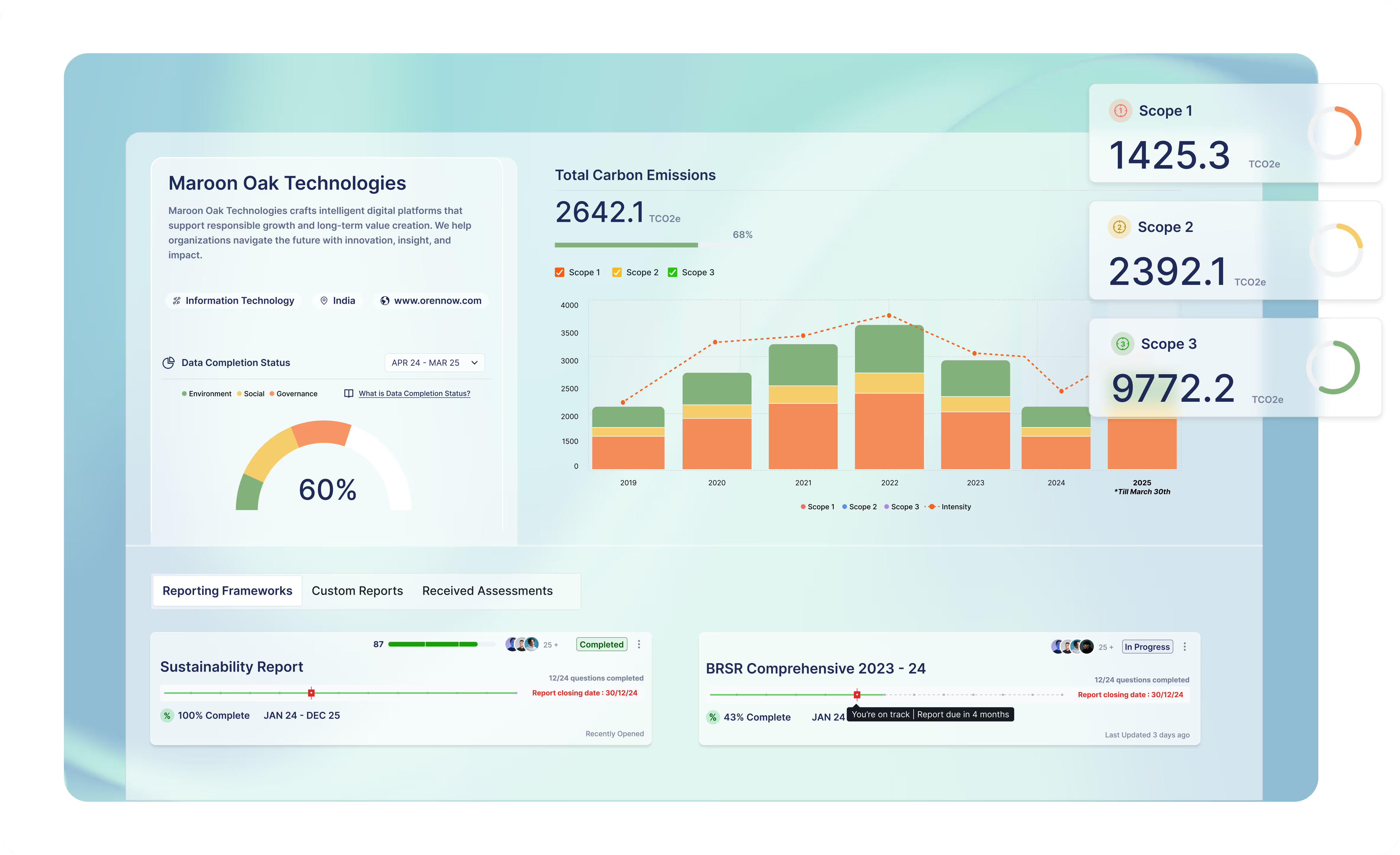
Every CBAM conversation with an EU customer reaches the same request: installation-level embedded emissions, calculated to EU methodology, with evidence behind each number. Oren's AI-powered platform builds that data foundation, and our CBAM compliance service prepares exporters for the definitive regime.
If EU buyers are already asking for your numbers, schedule a demo with us today!
Frequently Asked Questions (FAQs)
Q1. What is CBAM and its full form?
CBAM stands for Carbon Border Adjustment Mechanism. It is the European Union's carbon price on the embedded emissions of certain imported goods, established by Regulation (EU) 2023/956. EU importers of covered goods must report embedded emissions and, from the 2026 definitive regime, surrender CBAM certificates against them.
Q2. Is CBAM a tax?
Legally, no. CBAM is a border adjustment that mirrors the EU Emissions Trading System rather than a fixed levy. Importers surrender certificates priced on the weekly average of EU ETS auction prices, so the cost moves with the EU carbon market instead of being set as a tax rate.
Q3. What are the 6 categories of CBAM goods?
CBAM currently covers six categories of goods:
Cement
Iron and Steel
Aluminium
Fertilisers
Electricity and
Hydrogen
Coverage is defined by customs (CN) codes listed in Annex I of Regulation (EU) 2023/956, and it includes selected downstream products such as screws and bolts in the iron and steel chain.
Q4. When did CBAM start and what changed in 2026?
Transitional reporting ran from October 2023 to December 2025 with no payment obligation. The definitive regime began on 1 January 2026: imports now create a financial liability, importers need authorised CBAM declarant status, and the Omnibus amendment introduced a 50-tonne annual exemption for small importers.
Q5. How are CBAM certificates priced?
CBAM certificate prices track the weekly average auction price of EU Emissions Trading System allowances. One certificate covers one tonne of CO2e embedded in imported goods. Certificates for 2026 imports go on sale from February 2027, and importers surrender them with the annual CBAM declaration.
Q6. Who has to report under CBAM?
The obligation sits with the EU importer, who must hold authorised CBAM declarant status and file an annual CBAM declaration. Non-EU producers carry no direct legal obligation, but their EU customers depend on them for verified embedded-emissions data, which makes supplier data quality a commercial requirement.
Q7. Does CBAM apply to small import volumes?
Not any more. The Omnibus amendment introduced a de minimis exemption: importers whose net imports of covered goods stay below 50 tonnes per year are excluded from CBAM obligations entirely. This replaced the earlier 150 euro consignment threshold, and it removes most small importers while keeping nearly all embedded emissions in scope.
Q8. Is CBAM applicable in India?
CBAM applies to goods imported into the EU, not to sales within India. Indian exporters of covered goods such as steel and aluminium are affected commercially: their EU customers must buy certificates against the embedded emissions of those products, which makes low-carbon production and reliable emissions data a competitive advantage.

About the author
Olivia Paul
ESG & Sustainability Advisor
Olivia is an ESG & Sustainability Advisor at Oren, focused on ESG reporting and strategy, materiality assessments, GHG inventory, and net-zero roadmaps across manufacturing, financial services, and infrastructure.