CDP Climate Change Questionnaire - A Complete Submission Guide

The CDP questionnaire is the environmental disclosure your largest customers, investors, and lenders quietly expect you to file each September. CDP's 2026 cycle ships a single integrated questionnaire spanning climate change, water security, forests, plastics, biodiversity, and (new this year) oceans. For Indian companies, the win is the BRSR overlap: one well-built emissions dataset feeds both your CDP and BRSR Core responses. Below: the 2026 changes, scoring, the timeline, and the steps that actually move your score.
What the CDP Questionnaire Is and Why Indian Companies Submit It
CDP (formerly the Carbon Disclosure Project) runs the largest environmental disclosure system in the world. Over 23,100 organisations disclosed through CDP in 2025, including more than 22,100 companies covering nearly two-thirds of global market capitalisation. Indian participation has climbed steadily; ReNew Energy picked up an 'A' rating on its FY 2024-25 climate submission, joining the top 4% of global filers. Infosys and Tata Steel are also regular Indian disclosers.
Why bother? Three reasons land for most Indian companies. Your largest customer is probably already a CDP requester, and tier-1 status depends on responding. Lenders and investors price climate transparency into capital allocation. And the data overlap with BRSR Core means you're already producing most of what the CDP questionnaire asks for.
CDP Questionnaire 2026: What's Actually New This Year
The 2026 cycle is the first major refresh since CDP merged climate, water, and forests into one integrated questionnaire in 2024. Six material updates to flag:
Oceans module added: New ocean-related questions cover marine-ecosystem dependencies and impacts for relevant sectors.
Broader forests and biodiversity coverage: Forest-risk commodities now sit alongside wider natural-ecosystem questions.
Climate adaptation and resilience layered in: Adaptation disclosures now sit inside existing climate change sections, not as a bolt-on.
IFRS S2 alignment confirmed: The CDP questionnaire is now fully aligned with the ISSB's IFRS S2 climate-related disclosures standard.
Tighter question routing: Filers are sent only the questions that apply to them, based on size, activities, and risk profile.
No new Essential Criteria: Scoring methodology has minor revisions; no overhaul.
Inside the Integrated CDP Questionnaire: Modules and Sector Pathways
The 2026 CDP questionnaire is one document with multiple modules. Climate change is mandatory for every filer. Forests and water security triggers based on sector impact classification. Agriculture, energy, financial services, materials, and transport get additional climate questions. Agriculture, energy, chemicals, metals, and mining get extra water questions.
The questionnaire is structured around four broad areas, mirroring TCFD: governance (Module 4), strategy and risk management, metrics and targets, and emissions data covering Scopes 1, 2, and 3. Module 4 carries disproportionate scoring weight because it covers board oversight, management incentives, and sign-off seniority. CEO-level approval picks up marks that a director or VP sign-off does not.
Setup matters: selecting ocean, plastics, or biodiversity opt-ins expands the questionnaire across modules and changes the scope of your disclosure.
The 2026 CDP Submission Timeline: Dates That Actually Matter
The 2026 cycle runs on this schedule:
March-April 2026: Portal opens for requesters; scoring methodology published.
Week of 20 April: Questionnaire and guidance published.
Week of 15 June: Response window opens for corporates.
Week of 14 September: Submission deadline for scored responses.
Week of 26 October: Final close for non-scored submissions.
Early January 2027: Public scores and A List published.
Practical advice: submit at least a week before 14 September. The platform crashes under last-day load. CDP does not extend deadlines for technical issues.
How CDP Questionnaire Scoring Works (A to D-)
CDP scores on a five-band scale: A (Leadership), A- and B (Management), B- and C (Awareness), C- and D (Disclosure), and D- for incomplete responses. Each environmental theme is scored separately, so climate, forests, and water security all get distinct public scores. Biodiversity, plastics, and ocean disclosures remain unscored in 2026.
Scoring assesses four dimensions: governance, strategy, risk management, and metrics and targets. Companies climb bands by demonstrating year-on-year improvement, board-level oversight, science-based targets aligned with 1.5 degrees, and third-party verification of emissions data. In 2025, 877 companies made the global A List, up 70% from 2024, with 23 earning the Triple A.
The CDP-BRSR Alignment: One Dataset, Two Disclosures
The most useful detail for Indian filers: CDP has published a formal alignment between the CDP questionnaire and SEBI's BRSR framework. CDP India's BRSR-CDP linkage report categorises BRSR questions by how closely they map to CDP, with Category 1 covering BRSR questions fully addressed by CDP climate, forests, and water disclosures.
In practice, an Indian listed entity subject to BRSR Core can build one emissions and supplier-data foundation that feeds both filings. Scope 1, 2, and 3 figures, governance disclosures, climate-risk narratives, and supplier ESG data all overlap. Treating the CDP questionnaire and BRSR as separate workstreams duplicates effort and creates inconsistencies that surface under reasonable assurance.
Step-by-Step: How to Prepare and Submit Your CDP Questionnaire
Plan for four to five months and six to eight people across functions touching the data.
Pull last year's response and scoring feedback: Find the gaps that lost points. First-time submitter? Start with the public guidance on cdp.net.
Confirm modules, sector pathway, and opt-ins: Setup answers define the questionnaire scope. Choose carefully; this is where many filers self-inflict a workload.
Build the emissions dataset: Scope 1 and 2 must be GHG Protocol-aligned. Scope 3 categories should be material to your sector and value chain.
Draft governance and strategy answers early: Module 4 needs CEO and board engagement. Block calendar time months out, not in August.
Lock supporting evidence even though CDP won't ask for it: Verification statements, science-based targets, and transition plans all support stronger scores.
Submit at least one week before 14 September: Use the time for cross-functional review and CEO sign-off.
Common Mistakes That Drop Your CDP Questionnaire Score
A handful of avoidable patterns show up year after year:
Skimping on Module 4 detail: Governance questions are scoring-heavy. Generic 'board reviews ESG' answers leave marks behind.
Misclassifying Scope 3 categories: Purchased goods, business travel, and use of sold products often get under-reported. Engineered Scope 3 scores better than rough estimates.
No third-party verification: Verification is not required, but unverified emissions data weakens your score versus verified peers.
Treating it as a sustainability-team exercise: Without finance, operations, procurement, and legal on the data, the response is incomplete by week eight.
Last-day submission: Portal crashes are predictable. Submit by 7 September at the latest.
How Oren Supports Indian CDP Questionnaire Submissions
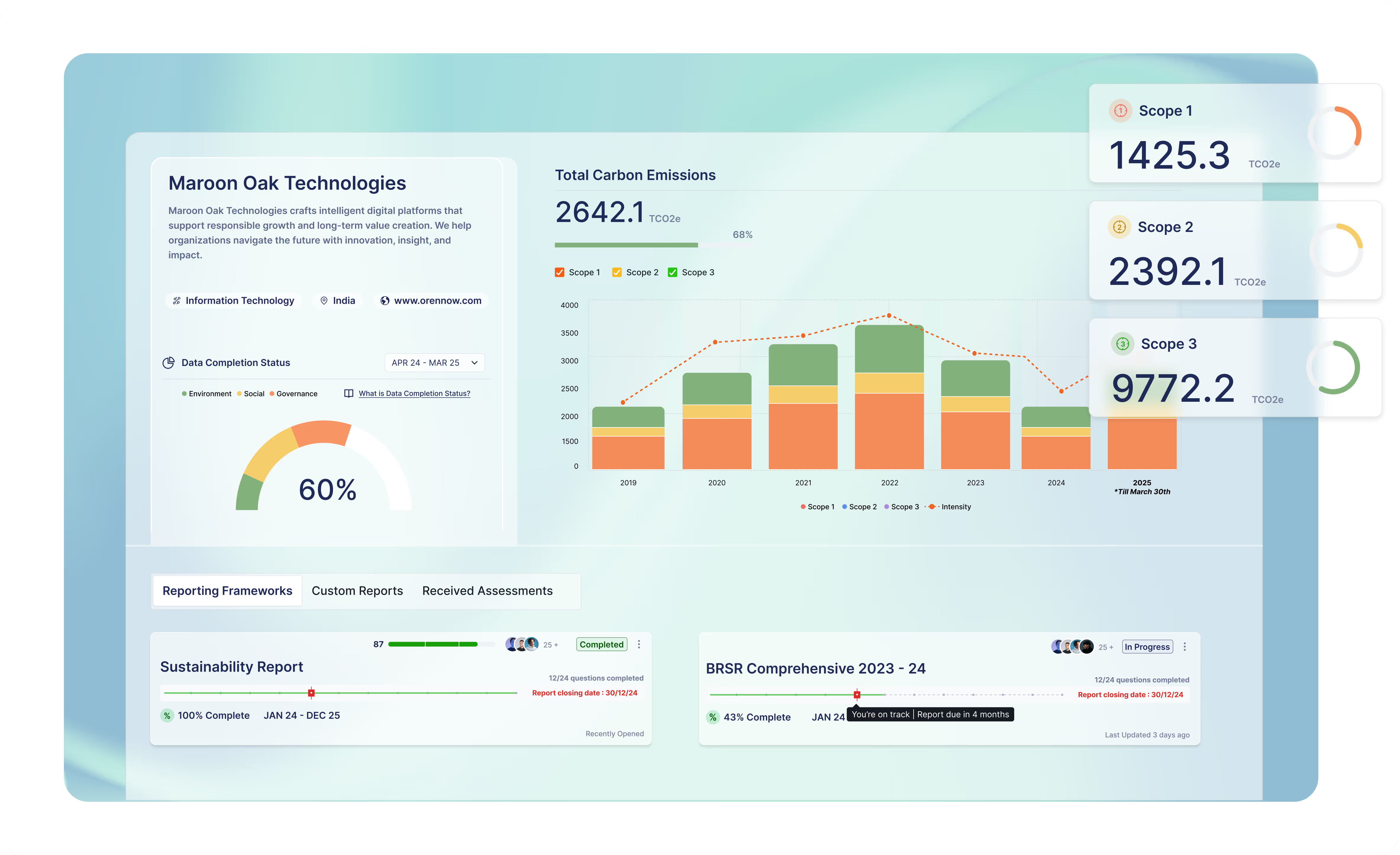
Oren's Sustainability Hub turns a four-month scramble into a structured workflow. Customisable disclosure templates collect Scope 1, 2, and 3 emissions data alongside supplier ESG inputs. Oren AI parses uploaded invoices, bills, and energy data into assurance-ready records. Because the platform is built around BRSR, the same dataset feeds both your CDP questionnaire and your BRSR Core response without duplicate collection. For Indian companies preparing 2026 disclosures, that's the difference between two parallel audits and one consolidated reporting workflow.
Conclusion
The CDP questionnaire 2026 is the first integrated cycle that genuinely works in favour of Indian companies. With BRSR Core overlap, IFRS S2 alignment, and a clean September deadline, the path is straightforward. Start in April, build your emissions backbone once, secure CEO sign-off early, and submit a week before the deadline. Treat it as strategy, not paperwork.
Frequently Asked Questions (FAQs)
Q1. What is the CDP climate change questionnaire?
The CDP climate change questionnaire is part of CDP's integrated disclosure framework. It covers governance, strategy, risk management, and emissions data (Scope 1, 2, and 3). Every filer answers climate questions, regardless of sector.
Q2. Is responding to the CDP questionnaire mandatory in India?
No. CDP disclosure is voluntary. In practice, large customers and investors increasingly request it, and SEBI's BRSR framework has formal alignment with CDP, so most top-1,000 listed Indian companies submit anyway.
Q3. How much does it cost to respond to the CDP questionnaire?
CDP charges an annual fee for many filers, varying by region. Indian companies pay an India-specific rate. Self-selected disclosure is generally free; fees apply for recognition through investor initiatives.
Q4. Who can see my CDP questionnaire responses?
Filers choose between public and private disclosure. Public responses are visible to all CDP signatories (investors, customers, lenders). Private responses go only to specific requesters.
Q5. What counts as a good CDP score?
A and A- are Leadership-band scores. B and B- are Management. In 2025, only 4% of scored companies (877 out of nearly 20,000) made the A List. A realistic, defensible B or A- is a strong outcome for most filers.
Q6. How is the CDP questionnaire different from BRSR?
BRSR is mandatory for India's top 1,000 listed companies under SEBI; CDP is voluntary. The CDP questionnaire is broader globally; BRSR is India-specific. CDP has published a BRSR-CDP alignment that lets Indian companies reuse data across both.

About the author
Olivia Paul
ESG & Sustainability Advisor
Olivia is an ESG & Sustainability Advisor at Oren, focused on ESG reporting and strategy, materiality assessments, GHG inventory, and net-zero roadmaps across manufacturing, financial services, and infrastructure.