Renewable Energy Transition for Indian Corporates: PPAs, RECs, and Green Tariffs Explained
Your renewable energy transition stopped being a board agenda item and turned into a procurement decision in 2024. India crossed 200 GW of renewables in 2026 and is targeting 500 GW of non-fossil by 2030. For Indian corporates, the question is no longer whether to source renewable power. It's which route: a Power Purchase Agreement (PPA), Renewable Energy Certificates (RECs), or a state DISCOM green tariff. This guide breaks down how each works, what it costs, and how it fits your renewable energy transition disclosure footprint under BRSR and IFRS S2.
What the Renewable Energy Transition Means for Indian Corporates Today
India’s transition to renewable energy is no longer a narrative about the power sector. For meeting India’s 500 gigawatt non-fossil target by 2030 (as per its Panchamrit commitment at COP26), roughly Rs. 33 lakh crore of finance is required, with a third of it expected from the private sector.
Three pressures are doing the work:
Industrial tariffs in Gujarat, Maharashtra, and Karnataka sit at Rs 8 to Rs 12 per kWh; open access solar lands at Rs 4 to Rs 5.5.
SEBI's BRSR Core makes Scope 2 visible to investors.
EU and US export customers ask for green-power evidence in due diligence.
The renewable energy transition pays for itself before the ESG report reaches the board.
The Four Main Routes for Corporate Renewable Energy Procurement in India
Indian corporates have four working routes inside their renewable energy transition strategy:
On-site rooftop or behind-the-meter solar: Self-generated, captive, no DISCOM involvement. Best for stable loads with available roof or land.
Open access third-party PPA: You contract with a renewable developer; power wheels through the grid under Green Open Access Rules 2022 (100 kW threshold). Wheeling and transmission charges apply.
Group captive PPA: You hold 26% equity in the asset and consume at least 51% of output. Lower charges than third-party open access; more capital and governance are involved.
RECs and green tariffs: Attribute purchases (RECs via IEX/PXIL) or DISCOM green-power tariffs. No change to your physical supply.
Power Purchase Agreements (PPAs): Physical, Virtual, and Group Captive
A power purchase agreement is a 10 to 25 year contract fixing price, volume, and delivery between a renewable generator and a buyer. Three structures dominate Indian procurement:
Physical PPA (third-party open access): Power generated off-site, wheeled to your facility under the Electricity Act 2003 and Green Open Access Rules 2022. Threshold: 100 kW contracted demand. ISTS charges (waived pre-June 2025) now apply at Rs 0.30 to Rs 1.10 per kWh.
Group captive PPA: 26% equity in the generating asset, at least 51% self-consumption, no cross-subsidy or additional surcharges. Capital-intensive but the cheapest per-unit cost.
Virtual PPA (VPPA): A financial contract, generator sells to the grid at the market price; you settle strike-vs-market and receive the RECs. The 2025 CERC amendment formally recognised VPPAs with automatic REC transfer.
Renewable Energy Certificates (RECs): How the Indian Mechanism Works
One REC represents 1 MWh of renewable energy produced and delivered to the grid. Thus, RECs decouple the energy from its green value. In India, RECs are governed by CERC and are traded on the Indian Energy Exchange (IEX) and Power Exchange India (PXIL) every last Wednesday of the month.
There are two types of REC: Solar and Non-solar. Every REC is valid for 1,095 days from the issue date. CERC fixes the floor and forbearance price levels. CERC amendment for the year 2025 brought about the Renewable Consumption Obligation (RCO) for the designated consumers in energy-intensive industries such as steel, cement, fertiliser, and aluminium, which expanded the consumer group for the certificate. IEX REC trades grew by 285% in the fourth quarter of 2025, showing the increasing corporate appetite for RECs.
Green Tariffs: When State DISCOM Green Power Makes Sense
The Green tariff is a DISCOM-provided electricity tariff where you pay an additional amount (Re 0.50 to Re 1.50 per kWh over the benchmark tariff) for the electricity produced using renewable energy sources. The states that provide such tariff schemes include Karnataka, Maharashtra, Andhra Pradesh, and Madhya Pradesh.
The pathway works when your load requirement doesn't allow you open access to electricity, when geographic constraints make wheeling costly, or if you wish to claim the use of renewables quickly without any hassle of a contract. It fails at large scales since green tariffs cost anywhere between 30-80% more per kWh than open access solar power.
Comparing PPAs vs RECs vs Green Tariffs
Three routes, three different fits inside your renewable energy transition. Quick comparison:
Attribute | PPA (Open Access) | RECs | Green Tariffs |
Cost per kWh | Rs 4 to 5.5 | Rs 1 to 2 (REC only) | Rs 7 to 11 |
Contract term | 10 to 25 years | Per-certificate trade | Annual rolling |
Threshold | 100 kW+ contracted demand | None | Any consumer |
Scope 2 impact | Location and market-based | Market-based only | Market-based |
How Your Renewable Energy Transition Connects to BRSR and IFRS S2 Disclosures
Every step of your renewable energy transition lands somewhere in your disclosures. Physical PPAs and group captive arrangements reduce both location-based and market-based Scope 2. RECs and VPPAs reduce only market-based Scope 2; location-based numbers stay tied to the grid. BRSR Core Principle 6 asks for your renewable energy share. IFRS S2 expects disclosure of how your renewable strategy fits your transition plan, with quantified GHG impact.
Step-by-Step: Designing Your Renewable Energy Transition Roadmap
A working renewable energy transition roadmap looks like this:
Baseline your load: Annual MWh, load profile, site geography, current grid tariff.
Set a target: A measurable share of consumption from renewables by year. Tie it to your net-zero or SBTi target if you have one.
Map your states: Open access viability varies widely. Gujarat, Maharashtra, Karnataka, Tamil Nadu, and Rajasthan are the most active.
Pick a portfolio, not a single route: Most credible programmes mix, rooftop for some sites, open access PPA for high-consumption facilities, RECs to close the gap.
Lock contracts early: As the 500 GW target tightens developer supply, locking in 2026 protects against Rs 0.30 to 0.50 per kWh escalation over a decade.
Build the disclosure trail: Every PPA, REC, and tariff invoice should feed BRSR and IFRS S2 reporting from day one, not at year-end.
Common Mistakes in Corporate Renewable Energy Procurement
Patterns that derail Indian corporate procurement:
Treating it as an energy team only: Finance owns the PPA hedge. Sustainability owns the disclosure. Operations owns load risk. All three need to be in the room.
Buying RECs without quality screening: Vintage, source, and additionality matter; scrutiny is rising.
Ignoring open access charges: Cross-subsidy, additional surcharge, and wheeling charges can swing landed cost by Rs 1 to 2 per kWh. Model these before signing.
Locking in too short: PPA tenors under 10 years miss the cost-curve benefit.
How Oren Supports Your Renewable Energy Transition Reporting
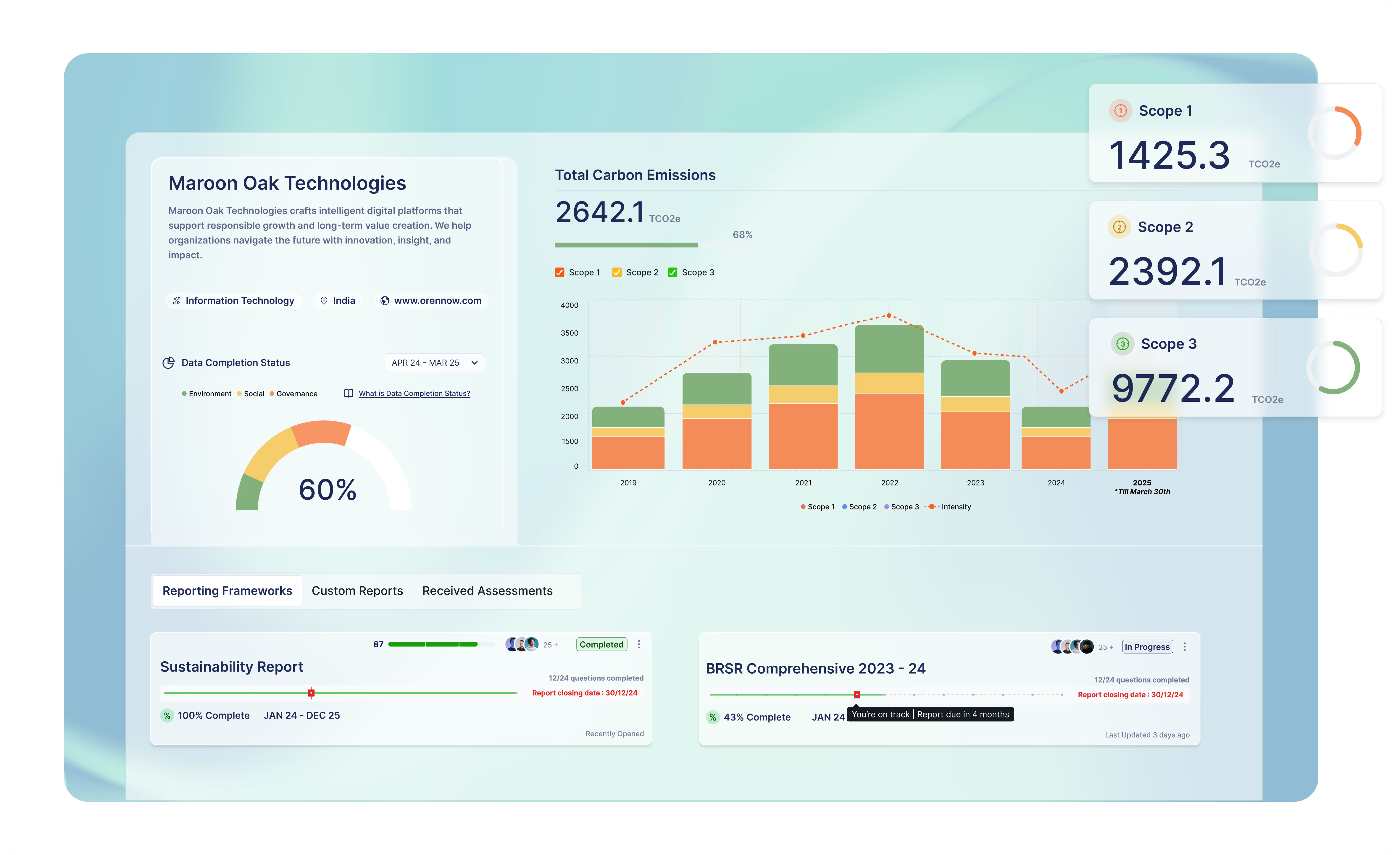
Oren's Sustainability Hub structures the disclosure side of your renewable energy transition. PPA volumes, REC purchases, group captive entitlements, and green tariff invoices flow into one location- and market-based Scope 2 calculation.
Oren AI parses utility bills and developer settlement statements into assurance-ready records. The same data then feeds your BRSR, BRSR Core, CDP climate, and IFRS S2 disclosures, with renewable-attribute claims fully traceable to source contracts.
Conclusion
The renewable energy transition for Indian corporates is now a procurement portfolio question. Mix PPAs, RECs, and green tariffs by site and load. Lock contracts early. Track Scope 2 location and market-based separately. Build the disclosure trail from contract signing, not at year-end. Done right, you cut energy cost and BRSR exposure in the same cycle.
Frequently Asked Questions (FAQs)
Q1. What is the minimum threshold for corporate open access in India?
Under the Green Open Access Rules 2022, consumers with a contracted demand of 100 kW or more can procure power directly from renewable generators.
Q2. What's the difference between a physical PPA and a virtual PPA?
A physical PPA delivers electricity to your facility through the grid. A virtual PPA is a financial contract: power is sold to the grid at market price and you settle the difference with the generator. You get the RECs from a VPPA but no physical electrons.
Q3. How is a group captive PPA different from a third-party PPA?
In a group captive PPA you hold at least 26% equity in the generating asset and consume at least 51% of its output, which exempts you from cross-subsidy and additional surcharges.
Q4. Can RECs alone satisfy BRSR renewable disclosure requirements?
RECs satisfy market-based Scope 2 and Renewable Purchase Obligation (RPO) compliance. They do not change location-based Scope 2 reporting. BRSR Core expects both views.
Q5. What is a green tariff?
A green tariff is a DISCOM-offered electricity tariff where you pay a premium (Re 0.50 to Re 1.50 per kWh above standard) for power explicitly sourced from renewables.
Q6. How long are corporate PPAs in India?
Typical tenor is 10 to 25 years, with 15 years the median. Indian courts (Gujarat Urja v Renew Energy) have restricted reopening of executed PPAs.

About the author
Kushagra
Senior ESG & Sustainability Advisor
Kushagra is a Senior ESG & Sustainability Advisor at Oren with 8+ years across CSR and sustainability consulting, specialising in GHG accounting, ESG strategy, and regulatory reporting across India, the UAE, and the Middle East.