ESG Software vs ESG Consultants: What Should You Choose?

What Is ESG Software and What Do ESG Consultants Do
ESG software, also known as sustainability reporting software or ESG reporting software, is a technology platform designed to automate the process of collecting, calculating, and reporting information about the environment, society, and corporate governance. The primary responsibilities of such software involve GHG emission reporting, preparing BRSR and multistandard reports, consolidating data for multiple entities, and document management that complies with all relevant regulations.
ESG consultants, on the other hand, are professional advisors who can help companies formulate a sustainable strategy, conduct materiality analysis, interpret regulatory requirements, engage stakeholders, and write reports. While ESG software takes care of scaling processes and handling large volumes of data, ESG consultants add context to them.
How ESG Reporting Has Evolved and Why the Question Matters
As recently as 2020, ESG reporting in India was largely voluntary and consultant-led. However, it is now legally mandatory for India's top 1,000 listed firms (FY 2022-23) with regard to BRSR, phased BRSR core assurance criteria laid down by SEBI, the CCTS compliance regime and climate risk disclosures as per RBI guidelines.
This regulatory acceleration changes the ESG software vs ESG consultants equation. When disclosures were infrequent and qualitative, consultants alone were sufficient. As reporting becomes annual, data-intensive, and third-party-verified, the best ESG software and purpose-built ESG reporting tools become operationally necessary. The question today is not "software or consultants?" for most listed Indian companies: it is how to combine both most effectively.
ESG Software vs ESG Consultants: Side-by-Side Comparison
Attribute | ESG Software | ESG Consultants |
Primary function | Automated data collection, GHG calculation, and multi-framework reporting | Strategic advisory, regulatory interpretation, materiality assessment, and report review |
Best for | High-frequency, ongoing data management across multiple teams and entities | First-time reporting, regulatory complexity, strategy, and bespoke analysis |
Scalability | High: grows with data volumes and entity count | Limited by consultant hours and engagement scope |
Customisation | Medium: configurable templates and pre-built framework modules | High: tailored to company context, sector, and stakeholder needs |
India-specific strength | BRSR templates, GHG calculation, CCTS data modules | Multi-regulator navigation (SEBI, MCA, MoEFCC, RBI) |
Cost model | Annual licence; INR 2L to INR 60L+ by company size | Project or retainer; INR 3L to INR 50L+ per year |
When to Choose ESG Software: Use Cases, Company Size, and Maturity Fit
Choose sustainability reporting software as your primary tool when:
Your company is within the top 1,000 SEBI-listed entities with annual BRSR filing obligations and an internal team to own the data process.
You have multiple business units or manufacturing facilities requiring centralised, consolidated data collection at scale.
You are tracking ongoing GHG emission reduction and need continuous Scope 1, 2, and 3 monitoring, not just annual snapshots.
You have completed at least one ESG reporting cycle and understand the applicable frameworks.
You need audit-ready outputs with version control for BRSR Core third-party assurance readiness.
The best ESG software delivers the highest ROI to companies with an internal sustainability team of two or more people, mature data governance, and a growing multi-entity reporting footprint.
When to Choose ESG Consultants: Use Cases, Company Size, and Maturity Fit
ESG consultants provide the highest value when:
Your firm is working on its first BRSR report and does not have adequate knowledge about the frameworks involved.
Your firm is subject to multiple frameworks at once, such as BRSR Core, CCTS compliance, and global supply chain reporting.
You need a materiality assessment, stakeholder engagement, or double materiality assessment that involves professional judgment.
Your industry is highly regulated, especially those in the financial sector with RBI climate regulations or exporters with EU CBAM/EUDR obligations.
Your firm needs BRSR Core assurance preparation or Accredited Carbon Verification Agency under CCTS guidelines.
Smaller Indian companies outside the top 1,000 listed entities but facing investor or supply chain ESG pressure typically benefit from ESG consultants before committing to a full enterprise software licence.
Cost Comparison: ESG Software vs ESG Consultants
Cost Element | ESG Software | ESG Consultants |
Base cost (SME / mid-market) | INR 2L to INR 8L per year | INR 3L to INR 10L per project |
Base cost (large enterprise) | INR 15L to INR 60L+ per year | INR 15L to INR 50L+ per year (retainer) |
Implementation | INR 1L to INR 5L (one-time setup) | Included in project fee |
Training | Additional; typically INR 50K to INR 2L | Included in engagement fee |
Ongoing support | Vendor helpdesk; SLA-dependent | On-demand advisory billed per hour or retainer |
Reported efficiency gain | 40-60% reduction in reporting effort (KnowESG, 2026) | Faster first-report completion; lower assurance rework risk |
Note: India-specific ESG reporting tools vary significantly by framework coverage, entity count, and ERP integration requirements.
Criteria for Selecting Good ESG Software
While selecting ESG reporting tools or best ESG reporting software for Indian firms, ensure that the following features are present:
Compatibility with BRSR and BRSR Core templates along with SEBI-compliant output format.
Calculation of GHG emissions Scope 1, 2, and 3 in accordance with the GHG Protocol method.
Multi-entities and multi-facility data consolidation with role-based security measures.
Pre-defined ESG reporting framework options including GRI, TCFD, SASB, BRSR, and CCTS Carbon Data Modules.
Audit trail and version control for third-party assurance of BRSR Core.
ERP integration like SAP, Oracle, and Tally to automatically pull in data.
AI-driven data gaps analysis, anomalies detection, and disclosures.
Automatic updating of templates as per SEBI and MoEFCC regulations.
Key Capabilities to Look for in ESG Consultants
When selecting ESG consultants, verify:
India regulatory expertise: BRSR, BRSR Core, CCTS, Companies Act CSR, and RBI climate norms.
Sector depth: credentials in your specific industry (manufacturing, BFSI, D2C, infrastructure, pharma).
Framework breadth: simultaneous mapping across GRI, TCFD, SASB, and BRSR.
Materiality assessment methodology: stakeholder engagement design and double materiality capability.
Assurance track record: experience with SEBI-approved assessors and Accredited Carbon Verification Agency empanelment under CCTS.
GHG accounting expertise: Scope 3 value chain emissions and carbon footprint methodology.
Verifiable outputs: published BRSR reports or sustainability reports for listed Indian entities.
Why a Hybrid Approach (Software + Expert Services) Works Best for Most Companies
For India-based organizations, the best method to address ESG involves neither ESG tools nor ESG consulting services – rather, it includes a blend of both.
While a tool by itself can ensure compliance through automated reports without context of their significance, a consultant by himself can only go so far, considering the sheer volume of BRSR, CCTS, and supply chain ESG reporting. Under the combination approach, ESG consultants provide a structure by way of the framework, data architecture, and interpretation of regulatory requirements. Then ESG software takes care of data collection and greenhouse gas accounting. In the following year, the consulting component focuses on value-adding activities such as materiality update, benchmarking, and stakeholder narrative.
How Oren Combines ESG Software and Expert Services in One Solution
Oren is designed for Indian companies that need both technology and expertise without managing two separate vendors.
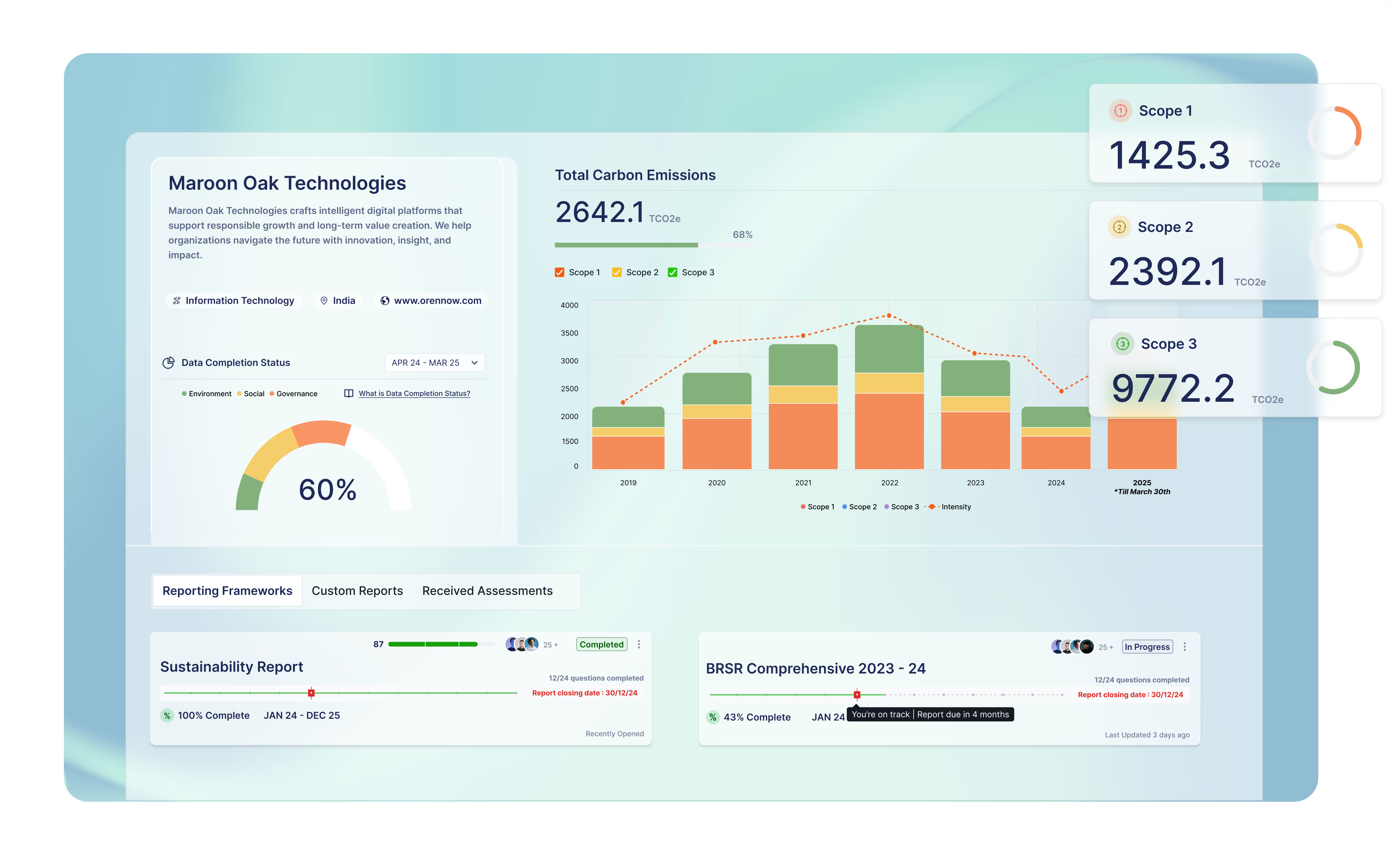
Oren’s platform, which is AI-driven, will take care of the data level, including automatic calculation of Scope 1, 2, and 3 emissions; preparation of the BRSR and BRSR Core reports; multi-location data aggregation; CCTS GEI calculation; and regulatory updates based on the evolving requirements. The platform's AI engine will detect data discrepancies, spot BRSR Core report disclosures that need improvement, and generate narratives.
Alongside the platform, Oren's ESG consultants deliver the strategy layer: materiality assessments, stakeholder engagement, framework mapping, BRSR Core assurance preparation, and CCTS compliance advisory.
For companies managing BRSR, CCTS, and global supply chain ESG demands simultaneously, Oren's integrated model removes the coordination friction that separate software and consulting arrangements typically create.
Frequently Asked Questions (FAQs)
Q1. What is the difference between ESG software and ESG consultants?
ESG software automates data collection, GHG calculation, and multi-framework report generation. ESG consultants provide strategic advisory, regulatory interpretation, materiality assessments, and hands-on reporting support. Software delivers scale and consistency; consultants deliver contextual judgement and strategy.
Q2. Which is better for ESG reporting: software or consultants?
Neither is universally superior. Companies with annual BRSR obligations and growing data complexity benefit most from ESG software. Companies in early-stage ESG maturity or facing complex multi-framework environments benefit most from ESG consultants. Most listed Indian companies need both.
Q3. How much does ESG software cost?
ESG software typically costs INR 2L to INR 8L per year for mid-market companies and INR 15L to INR 60L+ for large enterprises, depending on framework coverage, entity count, and ERP integration. One-time implementation adds INR 1L to INR 5L.
Q4. How much do ESG consultants charge?
ESG consultant fees in India range from INR 3L to INR 10L for a project-based BRSR engagement and INR 15L to INR 50L or more per year for a full retainer covering BRSR, CCTS, and strategic ESG advisory.
Q5. Do small companies need ESG software or consultants?
Smaller companies facing investor or supply chain ESG demands typically benefit from ESG consultants first. As reporting becomes regular and data volumes increase, ESG reporting tools become cost-effective and operationally necessary. Starting with consultants and adding software as maturity grows is the most common and effective sequence.
Q6. Can ESG software replace ESG consultants?
No. ESG software automates data processes but cannot perform materiality assessments, interpret emerging regulatory guidance, design stakeholder engagement, or provide sector-specific judgement. Software scales compliance execution; ESG consultants ensure the strategy behind that execution is sound and defensible.
Q7. What should I look for in ESG reporting software?
Prioritise BRSR and BRSR Core template support, Scope 1/2/3 GHG calculation, multi-entity consolidation, pre-built GRI and TCFD frameworks, audit trail for assurance readiness, ERP integration, and AI-assisted data gap identification relevant to Indian regulatory requirements.
Q8. What services do ESG consultants provide?
ESG consultants typically provide: BRSR and sustainability report preparation, materiality assessments, stakeholder engagement, GHG baseline measurement, ESG strategy development, BRSR Core assurance preparation, CCTS compliance advisory, and framework mapping across GRI, TCFD, SASB, and BRSR.
Q9. Is ESG software worth it for Indian companies?
Yes, for companies with annual BRSR obligations and growing sustainability data complexity. The best ESG software reduces reporting effort by 40-60% (KnowESG, 2026), improves data accuracy, and produces audit-ready outputs for BRSR Core assurance. India-specific platforms with BRSR and CCTS modules deliver the fastest ROI.
Q10. What is the best ESG reporting software?
No single platform suits every company. Global tools (Workiva, Sphera, Watershed) suit large multinationals. India-focused sustainability reporting software with native BRSR, CCTS, and GHG modules is more suitable for most listed Indian companies. Oren's platform is purpose-built for this requirement.
Q11. Do ESG consultants help with BRSR reporting?
Yes. ESG consultants with India regulatory expertise support BRSR data collection, framework mapping across BRSR's nine principles, BRSR Core indicator preparation, and third-party assurance readiness. For first-time BRSR filers, engaging ESG consultants reduces completion time and significantly lowers the risk of disclosure gaps.
Q12. Can a company use both ESG software and ESG consultants together?
Yes, and most listed Indian companies do. The hybrid model uses ESG software for data collection, GHG calculation, and report generation, while ESG consultants provide materiality assessment, framework interpretation, and assurance support. Both are complementary: software handles execution; consultants handle strategy.

About the author
Kushagra
Senior ESG & Sustainability Advisor
Kushagra is a Senior ESG & Sustainability Advisor at Oren with 8+ years across CSR and sustainability consulting, specialising in GHG accounting, ESG strategy, and regulatory reporting across India, the UAE, and the Middle East.