What Are IFRS S1 and S2? Objectives, Principles, and Role in Sustainability Reporting
What are IFRS 1 and 2? An Overview Of Their Purpose
IFRS S1 and IFRS S2 serve complementary purposes in establishing a unified global baseline for sustainability disclosures, forming the foundation of modern IFRS solutions for sustainability reporting.
IFRS S1: General Sustainability Disclosure
The IFRS S1, titled "General Requirements for Disclosure of Sustainability-related Financial Information", mandates entities to disclose all material sustainability-related risks and opportunities.
IFRS S2: Climate-Specific Disclosure
The IFRS S2, which is called "Climate-related Disclosures", is built on and fully incorporates the architecture of TCFD (TCFD has been subsumed into the ISSB). It includes elaborate specifications in the case of climate-related measures, transition planning, and scenario analysis.
They combine to build a comprehensive framework that firms can use in the international market, irrespective of the accounting standards they use, either IFRS or GAAP. Both standards took effect with respect to annual reporting periods that start on or after January 1, 2024, with early adoption being allowed.
IFRS S1: Objectives and Key Principles
The IFRS S1 provides the basis of overall sustainability reporting that goes further than climate factors. The standard entails the recognition and reporting of all material risks and opportunities of the sustainability aspects on the environmental, social, and governance fronts.
The use of IFRS S1 is based on principles of fair presentation, completeness, and materiality, ensuring the information disclosed is reasonably likely to affect the decision-making of the stakeholders.
IFRS S1 requires disclosure across four closely related dimensions:
Governance: procedures, controls, and board supervision of sustainability issues.
Strategy: how risks and opportunities affect the business model and value chain
Risk Management: processes to identify, assess, and monitor sustainability issues
Metrics and Targets: performance indicators and progress toward established goals
These requirements guarantee integrated reporting through which sustainability information can be incorporated directly in the financial statements and not remain separate in CSR reports. Under the IFRS S1, organisations are obliged to conduct materiality assessments to determine which sustainability issues affect the stock decision-making and enterprise value.
IFRS S2: Objectives and Key Principles
The IFRS S2 offers elaborate requirements of identifying, measuring, and reporting climate-related risks and opportunities in line with the Task Force on Climate-related Financial Disclosures (TCFD) recommendations and SASB industry standards.
Organisations must disclose:
Scope 1, 2, and 3 greenhouse gases (metric tonnes CO2 equivalent) emissions.
Climate-related physical and transition risks
Climate resilience assessment through scenario analysis
Climate transition plans with time-bound targets
The IFRS S2 demands both quantitative and qualitative data regarding current and expected impact of climate risks and opportunities on cash flows, access to finance, and the cost of capital.
How do IFRS S1 and S2 Help Businesses With Sustainability Reporting?
The IFRS S1 and S2 solutions allow organisations to adopt frameworks to embed sustainability into mainstream financial reporting as opposed to having parallel disclosure systems.
IFRS S1 and S2 reporting requirements strengthen organisational governance by mandating:
Board-level sustainability oversight
Formalised risk management processes
Accountable performance tracking
Organisations implementing IFRS S1 and S2 solutions gain strategic advantages through improved capital access, and investors increasingly expect or prioritise these disclosures before allocating resources. Regulatory alignment promotes compliance preparedness to new requirements, such as the CSRD in the EU and listing rules by the UK FCA, and new requirements expected on the journey to ISSB adoption.
For Indian companies, IFRS S1 and S2 compliance with BRSR would provide an opportunity to bridge voluntary global standards with local regulatory standards, in anticipation of a possible convergence in the future.
The Difference Between IFRS S1 and IFRS S2
Dimension | IFRS S1 | IFRS S2 |
|---|---|---|
Scope | All sustainability-related risks and opportunities (ESG-wide) | Climate-related risks and opportunities specifically |
Applicability | Comprehensive sustainability framework | Climate thematic standard applied with IFRS S1 |
Disclosure Requirements | Governance, strategy, risk management, and metrics across all ESG | Climate governance, transition plans, GHG emissions, scenario analysis |
IFRS S1 and S2 Solutions Focus | General materiality assessment and governance integration | Climate-specific metrics, transition planning, scenario resilience |
Investor Information | Enterprise impact of all material sustainability issues | How climate affects cash flows, financing, and capital costs |
Industry Specificity | General ESG principles with SASB industry references | Climate-specific metrics plus SASB industry climate standards |
Mandatory Disclosure Specificity | Refers to SASB for industry-based standards guidance | Prescriptive climate metrics (Scope 1, 2, 3 emissions, transition risks) |
Implementation Timeline | Foundational, establishes reporting discipline | Detailed, requires advanced climate data collection systems |
In short, IFRS S1 provides the general framework while IFRS S2 drills deeper into climate specifics.
How do IFRS S1 and S2 Solutions Support Integrated Reporting?
Modern integrated reporting combines:
Financial performance,
Governance practices, and
Sustainability impact in unified stakeholder communication.
IFRS S1 and S2 solution establishes the architecture necessary for this integration by requiring sustainability information to be reported simultaneously with financial statements, using consistent comparative periods and comprehensive disclosure standards.
IFRS S1 and S2 services help organisations connect sustainability metrics to financial forecasts, enabling scenario analysis of how climate and sustainability transitions might affect future financial performance.
Implementation Challenges and Best Practices for IFRS S1 and S2
Organisations face significant IFRS issues during implementation, spanning:
Data infrastructure,
Technical expertise, and
Organisational change management.
Data collection complexity emerges as a primary challenge; organisations must capture granular sustainability and climate data from diverse operational units and supply chains, often using systems not designed for this purpose.
Additionally, measuring Scope 3 emissions, conducting climate scenario analysis, and assessing the financial effects of sustainability matters require technical expertise that many organisations lack internally.
Recommended Implementation Approach
Organisations should structure IFRS S1 and S2 implementation through phased approaches:
Phase 1 (Months 1-6): Foundation building, technical setup, governance alignment
Phase 2 (Months 7-12): System integration, data collection, capacity building
Phase 3 (Months 13-24): Optimisation, quality assurance, external expertise engagement
Conclusion: Key Takeaways on IFRS S1 and S2
IFRS S1 and IFRS S2 are the first internationally applicable sustainability disclosure standards issued by the ISSB for reporting the sustainability-related financial information and climate-related disclosure.
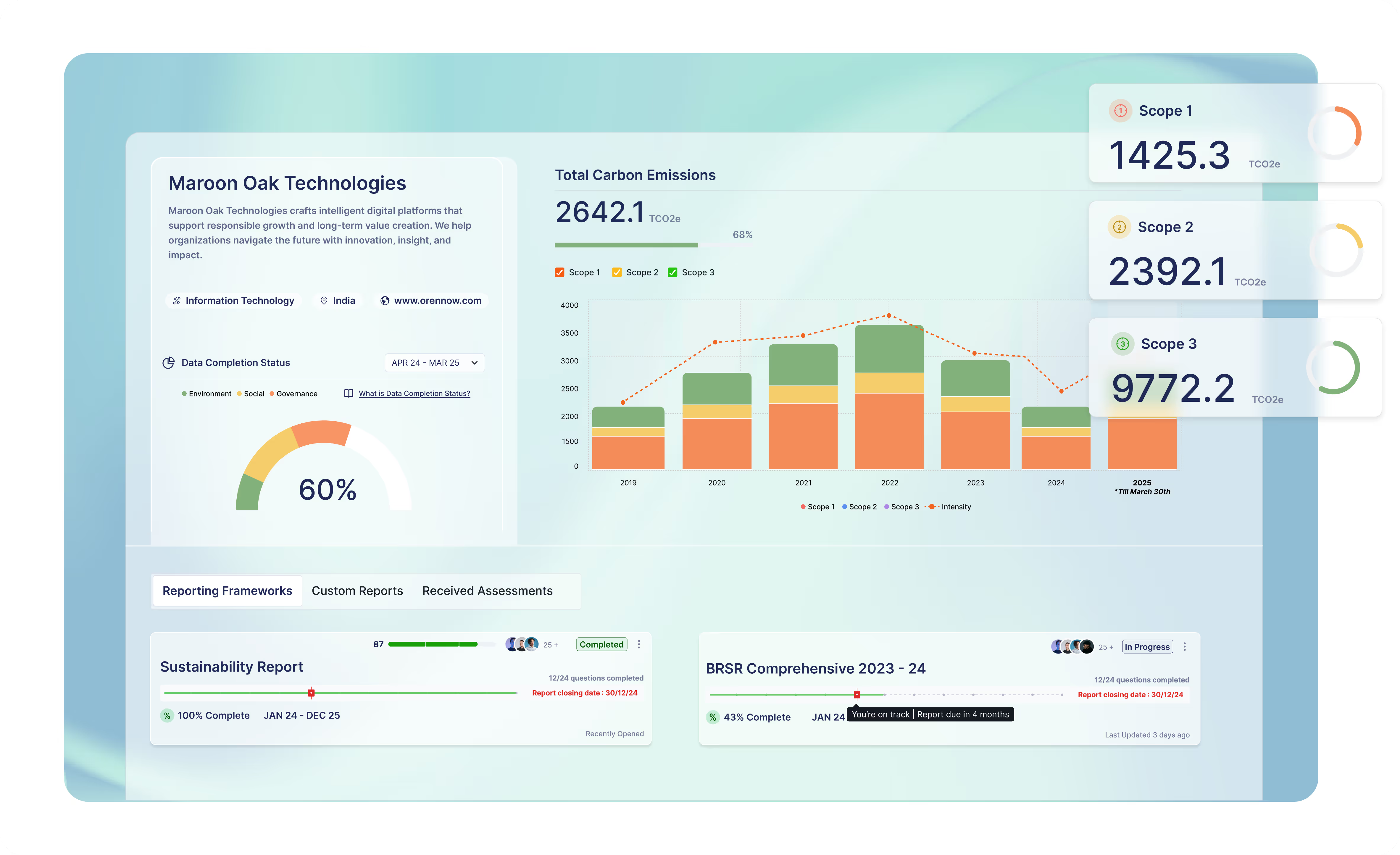
To organisations finding their way through the transition, and continued compliance with IFRS S1 and S2, Oren provides an integrated ESG strategy that centralises environmental, social, and climate data, automates data collection and reporting workflows, and supports alignment with global frameworks and standards.
Oren’s platform is designed to help enterprises simplify sustainability reporting, improve data quality, and enhance stakeholder confidence across frameworks, including CDP, BRSR, GRI, TCFD, CSRD, and IFRS S1/S2. Let Oren help you navigate IFRS reporting standards today!
Frequently Asked Questions (FAQs)
Q1. What is IFRS S1?
The IFRS S1 establishes the general standards that need to be met when disclosing material risks and opportunities related to sustainability across the ESG factors.
Q2. What is IFRS S2?
IFRS S2 focuses specifically on climate-related disclosures. It requires reporting on climate risks and opportunities, Scope 1-3 emissions, transition plans, scenario analysis, and the financial implications of climate considerations, which are compliant with TCFD and SASB standards.
Q3. How do IFRS S1 and S2 support sustainability reporting?
They integrate sustainability into financial reporting by standardising how material sustainability and climate risks are disclosed, improving comparability, transparency, and investor confidence in enterprise-value impacts.
Q4. Are IFRS S1 and S2 mandatory?
They are mandatory only in jurisdictions that have adopted ISSB standards. Elsewhere, adoption is voluntary, but most companies adopt early to satisfy their investors and prepare themselves for regulations.
Q5. What is the difference between IFRS S1 and S2?
IFRS S1 provides the overall sustainability reporting framework, while IFRS S2 applies that framework specifically to climate-related risks, emissions, and resilience planning.
Q6. Who should adopt IFRS S1 and S2?
Listed companies should adopt them in adopting jurisdictions, multinational groups, entities that access global capital markets, and organisations that are seeking investor-grade sustainability disclosures.
Q7. What are the common challenges in implementing IFRS S1 and S2?
The most important challenges are information availability, Scope 3 emissions, absence of climate expertise, system preparedness, and the connection between sustainability data and financial implications.

About the author
Kushagra
Senior ESG & Sustainability Advisor
Kushagra is a Senior ESG & Sustainability Advisor at Oren with 8+ years across CSR and sustainability consulting, specialising in GHG accounting, ESG strategy, and regulatory reporting across India, the UAE, and the Middle East.