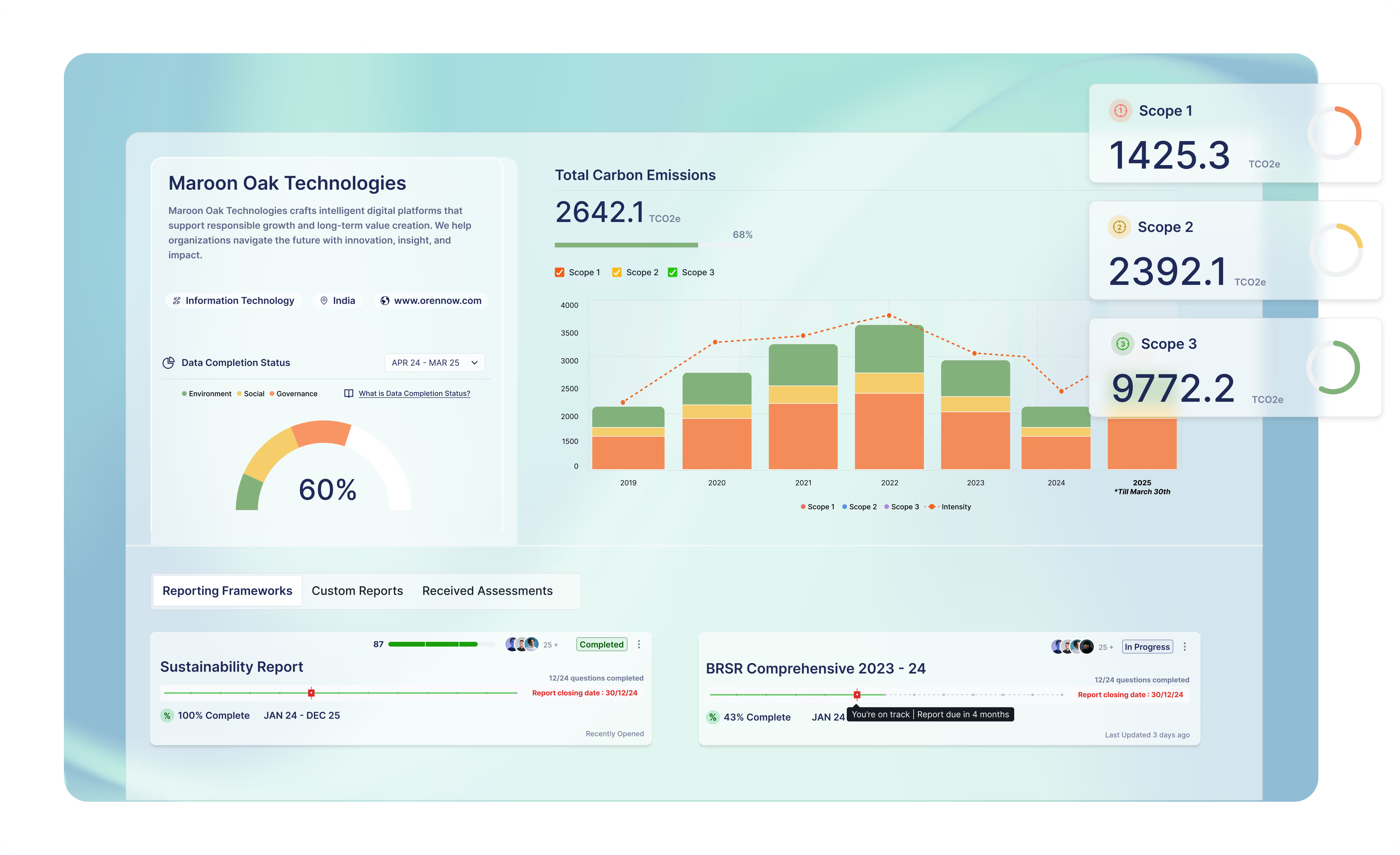
Carbon Credit Trading Scheme (CCTS) India Explained
Understand India's Carbon Credit Trading Scheme (CCTS): full form and meaning, the compliance and offset mechanisms, carbon credit certificates, and how trading works.
From compliance cost to competitive edge for India's obligated entities.
Oren runs CCTS compliance end to end for cement, steel, aluminium, fertiliser and every other CCTS sector: a verified GEI baseline, digital MRV, verification support, credit strategy and the decarbonisation projects that cut your intensity. The same levers lower your energy bill, so CCTS repays a large share of the investment.





























Obligated entities under final GEI targets
Penalty per tonne of shortfall, at the average traded credit price
GEI cut from no-regret levers at a representative cement plant (Oren estimate)
CCTS compliance is the annual cycle an obligated entity runs to meet its greenhouse gas emission intensity (GEI) target under India's Carbon Credit Trading Scheme: monitor energy and emissions, file Form A, pass verification by an Accredited Carbon Verification Agency (ACVA), and then earn, buy or surrender Carbon Credit Certificates (CCCs). One CCC equals one tonne of CO2-equivalent below target.
The scheme is administered by the Bureau of Energy Efficiency (BEE) under the Ministry of Power, with targets notified by the Ministry of Environment, Forest and Climate Change and credit trading regulated by the Central Electricity Regulatory Commission. For a plain-language walkthrough of how the scheme works, including the offset mechanism, read our guide to the Carbon Credit Trading Scheme.
Treated as a filing exercise, CCTS is a cost. Treated as an energy-productivity programme with board ownership, it repays a large share of the investment that also lowers the plant's energy bill. That is the programme Oren runs.
CCTS obligated entities are energy-intensive plants with plant-specific GEI targets notified in the Gazette. Final targets bind 490 entities across seven sectors, draft targets cover 255 iron and steel units, and fertiliser plants are already covered by BEE's compliance procedure while their targets are awaited.
| Sector | Entities | Target status | Average GEI cut vs FY24 |
|---|---|---|---|
| Cement | 186 | Final · Oct 2025 | −2.7% integrated, −6.6% grinding units, by FY27 |
| Aluminium | 16 | Final · Oct 2025 and Jan 2026 | −4.8% for smelters and refineries |
| Chlor-alkali | 30 | Final · Oct 2025 | −6.5% |
| Pulp and paper | 53 | Final · Oct 2025 | −6.5% |
| Petroleum refining, petrochemicals, textiles | 205 | Final · Jan 2026 | −3.1% to −6.6% |
| Iron and steel | 255 | Draft · Jun 2026 | FY27 median −5.5% (range −2.2% to −9.4%) |
| Fertiliser | — | In BEE procedure, targets awaited | Not yet notified |
Source: MoEFCC G.S.R. 739(E) of 8-Oct-2025, G.S.R. 25(E) of 13-Jan-2026 and draft G.S.R. 517(E) of 26-Jun-2026; BEE Detailed Procedure for the Compliance Mechanism. Average cuts are output-weighted from the Gazette schedules (Oren analysis).
A plant that misses its GEI target must buy credits to cover the gap. If it cannot, it pays environmental compensation of twice the average traded price for every tonne short. A plant that fails to file is deemed to have emitted at its baseline intensity, and banking is unlimited but borrowing is not. Because targets tighten every year, the gap grows even at flat output.
Buy credits
₹25 Cr
FY30 cost to close a 254 kt gap at ₹1,000 per tonne, for a 5 MTPA cement plant that does nothing.
Pay the penalty
₹51 Cr
The same gap if credits cannot be bought: twice the traded price on every tonne short.
Or earn credits
₹59 Cr
FY30 CCTS value of a 585 kt no-regret portfolio: gap closed plus surplus credits sold.
Oren CCTS Value Model, representative 5 MTPA integrated cement plant, credit price ₹1,000 per tonne, FY28+ target path estimated. Penalty basis: GEI Target Rules 2025, Rule 7.
Do you know your plant's CCTS position for FY27?
We recompute your baseline, target gap and credit exposure on your own plant data.
CCTS value leaks at six points in the annual cycle. Oren covers every one of them, from the first baseline to the decarbonisation projects that close the gap, as a single lifecycle partner working alongside your plant teams and your verifier.
Where value leaks
A wrong baseline or total equivalent output (TEO) calculation locks the plant into a harder target for years.
What Oren does
Baseline audit, TEO and GEI recalculation on our sector engine, and a monitoring plan built for verification.
Where value leaks
Data gaps, default emission factors and the 2% verification materiality threshold misstate GEI and erase credits.
What Oren does
Meter-to-report digital MRV with full data lineage, plant-specific (Type II) factors and a laboratory NCV route.
Where value leaks
A late or failed filing deems the plant at its baseline intensity, doubling the exposure through penalties.
What Oren does
Form A preparation, audit-ready evidence packs and coordination with your Accredited Carbon Verification Agency.
Where value leaks
Queries and delays push credit cash flows into the next compliance cycle.
What Oren does
Tracking against BEE timelines, query handling and reconciliation of the issued credit position.
Where value leaks
Selling surplus at the wrong time, or buying in a rush, gives away value on every tonne.
What Oren does
Credit position, banking and exchange-session strategy across IEX, PXIL and HPX, aligned with your capex plan.
Where value leaks
Over-specified projects and savings that never materialise leave the target gap open.
What Oren does
Marginal abatement cost curves, technology and partner selection, and measurement and verification of savings.
Oren is not an accredited verifier and does not issue carbon credits. We prepare the evidence and coordinate with the BEE-accredited ACVA you appoint, so verification runs on complete, traceable data.
Energy is 40 to 90% of cash cost in CCTS sectors, most of it imported fuel, and the levers that cut it deliver most of the carbon cut. A CCTS programme run as an energy-productivity programme pays for itself. The credit price is upside and a hedge, not the business case.
| Representative plant | Cement · 5 MTPA | Iron and steel · 3 MTPA |
|---|---|---|
| No-regret portfolio capex | ₹592 Cr | ₹2,526 Cr |
| Energy and input savings | ₹164 Cr a year | ₹734 Cr a year |
| Emissions abated | 585 kt a year (~19% of baseline) | 1,108 kt a year (~15% of baseline) |
| CCTS value at ₹1,000 per tonne | ₹59 Cr a year | ₹111 Cr a year |
| IRR without → with CCTS | 20.7% → 32.4% | 20.8% → 25.3% |
| Payback without → with CCTS | 5.2 → 4.3 years | 5.6 → 5.3 years |
Oren CCTS Value Model (Sep-2026), representative plants, run-rate values, 11% discount rate, no terminal value. Steel uses draft targets. All figures are estimates; your plant's numbers come out of the diagnostic.
For urea, where gas is about 90% of cost, every 0.1 Gcal per tonne saved is worth around ₹65 Cr a year to a 1.3 MTPA plant, and quick-win energy-saving schemes return roughly ₹93 Cr a year on ₹80 Cr of capex.
Each sector closes its GEI gap with a different mix of levers. We rank them on a marginal abatement cost curve for your plant, so the levers that pay for themselves go first and the deep bets wait for price discovery.
Our TEO and GEI engine covers the equivalent-output methods for nine CCTS sectors, built from BEE's PAT pro-formas. The lever long-list starts from energy efficiency, renewable power and fuel switching, then follows the process. See how we support manufacturing, chemical and oil and gas companies.
Most clients start with a six to eight week CCTS Value Diagnostic. It ends in a board-ready investment case built on your own plant data, not sector averages.
Weeks 1–2
Weeks 3–4
Weeks 5–6
Weeks 7–8
Scope scales with the number of plants and sectors. We share commercials after a short scoping call, and the diagnostic rolls straight into annual compliance support and implementation.
Ready to run the numbers on your plants?
Book a scoping call for the CCTS Value Diagnostic.
A CCTS programme needs more than a filing. Here is what a full programme covers, and where filing-only support stops.
| What a CCTS programme needs | Filing-only support | Oren |
|---|---|---|
| Verified baseline and TEO | Taken as given | Audited and recomputed on a sector engine |
| Digital MRV with Type II factors | Spreadsheets and default factors | Meter-to-report lineage and laboratory NCV route |
| Form A and verification | Form preparation | Evidence packs and ACVA coordination |
| Credit trading and banking | Not covered | Position, banking and exchange-session strategy |
| Decarbonisation capex | Not covered | MACC, technology selection and savings verification |
| EU CBAM for exporters | Separate engagement | Same plant data, verified embedded emissions |
The plant data that feeds CCTS also answers EU CBAM for steel, aluminium, cement and fertiliser exporters, where verified data replaces default values that can cost Indian hot-rolled coil more than three times its verified charge. The same energy and emissions figures flow into BRSR disclosures. Explore our CBAM compliance, BRSR reporting and GHG accounting solutions, and our Decarbonisation Advisory for the long-term pathway.
Your plant data stays protected: the Oren platform is ISO 27001 certified and SOC 2 Type II compliant. Read more about our data security.
Oren Sustainability Hub carries the CCTS cycle from plant meters to credit position, with the calculation engines and target data built in.
BEE pro-formas (Form Sb and Sd) for products and energy, carried through to emissions, target and credit position, with Type I and Type II emission factor handling.
Total-equivalent-output methods for nine CCTS sectors, built from BEE's PAT pro-formas, so your intensity is calculated the way the regulator calculates it.
Baseline, FY26 and FY27 targets for all 131 integrated cement plants, mapped to company groups, so you can benchmark your position against peers.
Plant-level data capture with approvals and a full audit trail, so your ACVA can trace every figure from meter to Form A.

“Oren is very professional, and they deliver their services and commitments in a time-bound manner. The products they have developed are absolutely topnotch and it caters to all our requirements.”


“Oren's technology and expert advisory helped us overcome data management hurdles and navigate stakeholder engagement, materiality assessment and quantifying environmental impact to publish our first BRSR report.”


“Oren immensely helped us with our Scope 1 and Scope 2 reporting. Overall, the team is well updated and very supportive - and they were always just a call away. I definitely recommend Oren to anyone who is looking for assistance in their ESG journey.”


“Oren's expertise has been instrumental in driving our ESG achievements, consistently guiding us with professionalism, reliability, and timely execution. Their outstanding products not only surpassed expectations but also fully complied with Metrochem API Industries' ESG standards.”

“Oren is very professional, and they deliver their services and commitments in a time-bound manner. The products they have developed are absolutely topnotch and it caters to all our requirements.”
“Oren's technology and expert advisory helped us overcome data management hurdles and navigate stakeholder engagement, materiality assessment and quantifying environmental impact to publish our first BRSR report.”
“Oren immensely helped us with our Scope 1 and Scope 2 reporting. Overall, the team is well updated and very supportive - and they were always just a call away. I definitely recommend Oren to anyone who is looking for assistance in their ESG journey.”
“Oren's expertise has been instrumental in driving our ESG achievements, consistently guiding us with professionalism, reliability, and timely execution. Their outstanding products not only surpassed expectations but also fully complied with Metrochem API Industries' ESG standards.”
Obligated entities notified by the Ministry of Environment, Forest and Climate Change under the Greenhouse Gases Emission Intensity Target Rules. Final targets cover 490 entities across cement, aluminium, chlor-alkali, pulp and paper, petroleum refining, petrochemicals and textiles. Draft targets for 255 iron and steel units were published in June 2026, and fertiliser plants already sit within the Bureau of Energy Efficiency (BEE) compliance procedure.
A greenhouse gas emission intensity (GEI) target caps the tonnes of CO2-equivalent a plant may emit per unit of equivalent output. Targets are set plant by plant against a FY24 baseline and tighten each year. Integrated cement plants, for example, must cut GEI by about 2.7% by FY27 and grinding units by about 6.6%.
The entity must surrender Carbon Credit Certificates (CCCs) to cover the shortfall, bought on the power exchanges if it does not hold enough. If it cannot, it pays environmental compensation of twice the average traded CCC price for every tonne short. Entities that fail to file are treated as if they emitted at their baseline intensity, which magnifies the exposure.
No. Oren is not an accredited verifier and does not issue carbon credits. We prepare your plant for verification, build the evidence packs and coordinate with the BEE-accredited ACVA you appoint, so the verifier receives complete, traceable data and the 2% materiality threshold is not breached by avoidable gaps.
From April 2027, plants must move from default emission factors to plant-specific factors backed by fuel sampling and laboratory net calorific value results. Default factors usually overstate emissions, so plants that set up the laboratory route and digital MRV before then protect credits they would otherwise lose.
For most energy-led levers, yes. In Oren modelling of representative cement and steel plants, the no-regret portfolio cuts GEI by 15 to 19% and pays back on energy savings alone. CCTS adds value on every tonne abated, either as a credit you sell or a credit you no longer need to buy, which shortens payback and lifts returns. Figures are estimates and vary by plant.
They measure the same thing from different ends. CCTS sets a domestic intensity target for the plant, while CBAM charges EU importers for the embedded emissions in steel, aluminium, cement and fertiliser. Verified plant data serves both: it protects CCTS credits and replaces punitive CBAM default values for EU-bound exports.
Most clients start with a six to eight week CCTS Value Diagnostic that ends in a verified credit position, a costed lever portfolio and a board-ready investment case. Scope and commercials depend on the number of plants and sectors, and we share a proposal after a short scoping call.
Understand India's Carbon Credit Trading Scheme (CCTS): full form and meaning, the compliance and offset mechanisms, carbon credit certificates, and how trading works.

The European Union's Carbon Border Adjustment Mechanism (CBAM) is a groundbreaking regulation aimed at curbing carbon leakage and promoting climate action by imposing a carbon price on imports of carbon-intensive goods. This blog explores CBAM's phased implementation, its economic, environmental, and social impacts on India, and how Indian industries can adapt to maintain competitiveness. By leveraging green technologies, improving carbon accounting, and exploring global markets, India can turn CBAM into an opportunity for sustainable growth and global leadership in low-carbon production.

As the impacts of climate change intensify, internal carbon pricing has become an essential tool for companies aiming to reduce greenhouse gas (GHG) emissions. By assigning a financial cost to carbon emissions, this strategy helps organizations integrate environmental sustainability into their business decisions. The blog explains various carbon pricing mechanisms, including carbon taxes, cap-and-trade systems, and results-based climate finance. It further explores internal carbon pricing categories, such as shadow pricing, internal carbon taxes, and internal trading mechanisms. Adopting internal carbon pricing promotes enhanced decision-making, risk management, cost savings, and investor appeal. This approach aligns companies with global sustainability standards and prepares them for future regulatory changes.

Purchasing carbon credits is an essential strategy for businesses looking to offset their carbon footprint and contribute to global sustainability efforts. However, the process requires careful evaluation to ensure effectiveness, credibility, and alignment with corporate sustainability goals. This guide covers key considerations such as verification and certification standards, project types, geographic impact, risk factors, purchasing options, and regulatory frameworks. By following best practices and staying informed about evolving market trends, businesses can make responsible carbon credit investments that support meaningful climate action.