Climate Risk Assessment: A 2026 Guide for ESG Teams
Boards are asking sharper questions. Investors want numbers, not narratives. Supervisors want evidence that climate has been priced into credit decisions, capital plans and long-term strategy. The 2024 global temperature reading of around 1.6°C above pre-industrial levels, combined with roughly USD 320 billion in disaster-related economic activity that year, has moved climate from a sustainability conversation to a balance-sheet one.
A climate risk assessment is how organisations meet that shift with discipline. It turns physical and transition risk into financial figures decision-makers can act on, across portfolios, assets and value chains. This guide walks through what a climate risk assessment is, how the process works in banks and corporates, and how it fits with TCFD, IFRS S2 and climate stress testing in 2026.
What is a climate risk assessment?
A climate risk assessment is a structured process organisations use to identify, measure and respond to the financial and operational impacts of physical climate hazards and the low-carbon transition on their assets, portfolios and value chain; across short, medium and long-term horizons.
It answers one question for decision-makers: how is climate change likely to shape our cash flows, cost of capital and strategic options, and what should we do about it now?
Every credible framework -TCFD, IFRS S2, the Basel principles, the IPCC - splits climate risk into physical risk and transition risk. The assessment quantifies both across three time horizons:
Short-term (1-3 years) aligns with business planning.
Medium-term (3-10 years) aligns with capex cycles and strategy.
Long-term (10-30+ years) aligns with asset lifetimes, mortgage books and infrastructure.
Climate risk is the exposure an organisation carries to changing climate conditions and to the policy, technology and market shifts that come with reaching net zero, expressed as financial impact, not as an environmental concept.
Physical Climate Risk vs Transition Risk
Physical climate risk covers the financial impact of acute weather events and chronic shifts in climate conditions. Whereas, transition risk covers the financial impact of policy, technology, market and reputational shifts as the economy moves toward lower emissions. Both belong in every climate risk assessment.
Physical Risk Types:
Acute risks are event-driven: floods, cyclones, wildfires, heatwaves.
Chronic risks build over time: sea-level rise, precipitation pattern changes, sustained temperature increases.
Both affect property values, business continuity, supply chains and insurance availability.
Transition Risk Types:
Policy and legal (carbon pricing, disclosure mandates, litigation).
Technology (electrification, efficiency, substitution).
Market (shifting demand, capital reallocation).
Reputational (customer, employee and investor perception).
A manufacturing site in a high-heat zone faces rising physical exposure and, at the same time, rising transition exposure if its products are carbon-intensive. The same is true for a lender financing that site. Treating the two as separate exercises misses the compounding effect that matters most to capital planning.
Climate risk for banks and financial institutions
For banks, climate-related financial risk is not a new risk type; it is a driver that flows through familiar prudential risks. Borrower exposure to physical hazards becomes credit risk. Concentration in carbon-intensive sectors becomes credit and market risk. Climate-related operational disruptions become operational risk. Funding sensitivity to climate sentiment becomes liquidity risk.
Transmission channels:
Physical hazards reduce borrower repayment capacity and impair collateral. Transition shifts strand assets and re-prices entire sectors. Both feed into probabilities of default, loss given default and credit spreads.
Supervisory direction:
The Basel Committee has published a framework on climate-related financial risks. US federal agencies have set principles for institutions with assets above USD 100 billion. Canadian and European supervisors have issued binding guidance. The direction across jurisdictions is consistent: climate must sit inside the enterprise risk management framework, not alongside it.
A 2026 inflection point:
The European Central Bank is set to introduce climate-differentiated collateral haircuts in the second half of 2026, a signal that climate is moving from disclosure into the cost of capital itself. Climate risk for banks is now both a supervisory expectation and an active pricing variable.
The same logic applies across sectors. Corporations supplying financial institutions are increasingly asked to demonstrate their own climate risk assessments as part of credit reviews and procurement.
Explore Oren's TCFD-aligned approach to climate disclosure for the full picture.
How climate stress testing works
Climate stress testing projects, how a portfolio or business performs under defined warming and policy pathways. It is the engine behind most regulatory climate exercises and a growing input into internal strategy.
Scenario inputs:
Most exercises draw on Network for Greening the Financial System (NGFS) pathways: Net Zero 2050, Delayed Transition, Current Policies, Nationally Determined Contributions. Each pathway sets out emissions trajectories, energy prices, carbon prices and macroeconomic variables out to 2050.
What is modelled:
Banks translate scenarios into changes in probability of default, loss given default and sector exposure. Companies translate them into revenue, cost and capex impacts. Insurers translate them into claims patterns.
Recent supervisory findings:
Under combined adverse macro and climate scenarios, corporate default frequencies rise meaningfully over the medium term, with the steepest movement concentrated in carbon-intensive and weather-exposed segments. The supervisory message is that the financial impact is measurable today, even with imperfect data.
Frequency:
Best practice is to refresh climate stress tests annually, refresh scenarios when reference pathways update, and run targeted exercises ahead of major capital decisions.
TCFD climate risk and the move to IFRS S2
The Task Force on Climate-related Financial Disclosures completed its mandate in October 2023. Its four-pillar structure - governance, strategy, risk management, metrics and targets, has been fully absorbed into IFRS S2 Climate-related Disclosures, issued by the International Sustainability Standards Board.
What got carried over:
The physical and transition risk split, scenario analysis, board-level oversight, and the four-pillar disclosure structure all remain. Companies that already report against TCFD have a head start on IFRS S2.
What IFRS S2 adds:
Scope 1, 2 and 3 emissions disclosure, industry-specific metrics drawn from SASB standards, financed and facilitated emissions for financial institutions, and clearer requirements on internal carbon pricing and transition planning.
Where IFRS S2 stands in 2026:
Around 21 jurisdictions have adopted the ISSB standards on a voluntary or mandatory basis as of early 2026, with several more in active consultation. Adoption timelines vary; Australia, the UK, Canada, Brazil, Malaysia, Singapore and Hong Kong are among the earliest movers.
So when someone refers to TCFD climate risk reporting in 2026, the practical answer is: the framework lives on inside IFRS S2.
Climate risk management: A five-step process
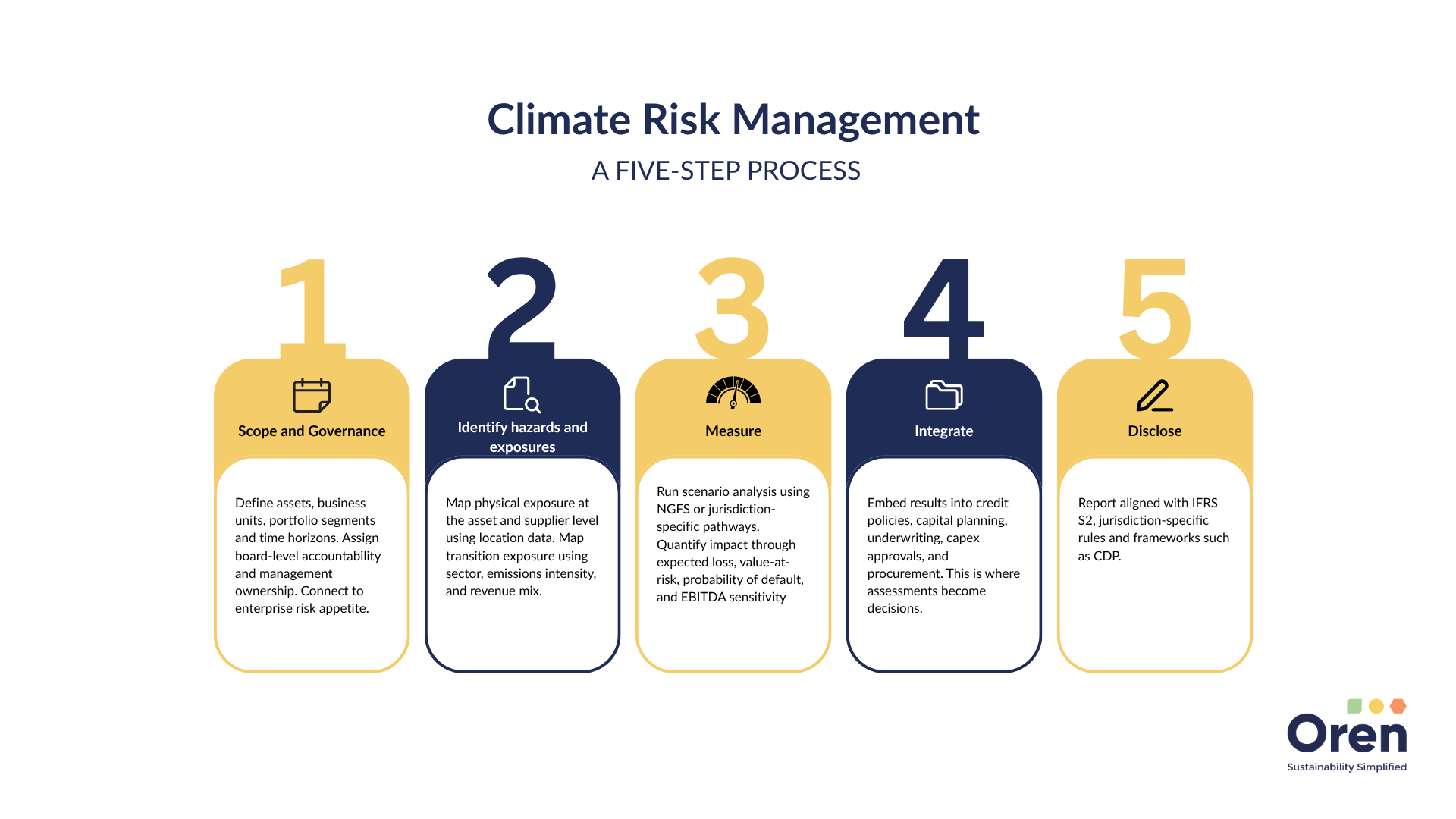
A robust materiality assessment is the most useful starting point; it identifies which climate-related topics are financially significant and where to focus measurement effort first.
Building the assessment that decisions can rest on
Climate risk has moved from a disclosure exercise to a balance-sheet one, with capital costs, insurance pricing and ISSB-aligned reporting all converging on the same expectation: quantified exposure. The organisations moving first are those whose assessments their boards trust, their auditors can sign off on, and their lenders and investors recognise because a well-built climate risk assessment connects hazard data to strategy.
Talk to an Oren ESG expert to scope a climate risk assessment that aligns with IFRS S2, supports stress testing where relevant, and gives your leadership team figures they can act on.
Frequently Asked Questions (FAQs)
Q1. What does climate risk mean in business terms?
In business terms, climate risk is the exposure an organisation carries to changing climate conditions and to the policy, technology and market shifts that accompany decarbonisation. It is expressed in financial terms: cash flow, asset value, cost of capital, insurability, rather than environmental terms. A climate risk assessment translates that exposure into figures that management can plan around.
Q2. Why is climate risk for banks now a supervisory priority?
Supervisors view climate as a driver of existing prudential risks - credit, market, operational and liquidity. The Basel Committee, the US federal banking agencies, the European Central Bank and OSFI have all issued guidance requiring large banks to integrate climate into their enterprise risk frameworks, stress testing and capital planning. Supervisors expect quantified evidence, not commitments.
Q3. What counts as climate financial risk under IFRS S2?
Under IFRS S2, climate financial risk covers climate-related risks and opportunities that could reasonably be expected to affect an entity's cash flows, access to finance or cost of capital over the short, medium or long term. It includes physical and transition risks, scenario analysis, financed emissions for financial institutions, and industry-specific metrics derived from SASB standards.
Q4. How is physical climate risk measured at the asset level?
Physical climate risk is measured by combining hazard, exposure, and vulnerability data for each asset. Hazard data comes from climate models that project variables such as temperature, precipitation, flood depth, and wind speed under specific warming scenarios. Exposure data identifies what is at risk. Vulnerability data converts hazard into expected financial impact. The output is typically expressed as expected annual loss or value-at-risk.
Q5. What is the difference between physical and transition risk?
Physical risk arises from the natural environment; acute events such as floods and wildfires, and chronic shifts such as rising temperatures and sea levels. Transition risk arises from the human response: policy, technology, market and reputational shifts as the economy moves toward lower emissions. Physical risk is largely location-driven. Transition risk is largely sector and emissions-driven. Both belong in every assessment.
Q6. How often should climate stress testing be performed?
Most supervisors and best-practice frameworks point to annual refresh cycles, with scenario updates whenever reference pathways such as NGFS are revised. Targeted exercises are also run ahead of significant capital decisions, such as large acquisitions, portfolio rebalancing, and major capex commitments. Climate stress testing is an ongoing capability, not a one-off project.
Q7. Is TCFD climate risk reporting still required in 2026?
The TCFD itself was disbanded in October 2023, with its responsibilities passed to the IFRS Foundation. Its four pillars: governance, strategy, risk management, metrics and targets, now sit inside IFRS S2. Many jurisdictions reference TCFD in transitional rules while phasing in IFRS S2 adoption. In practice, organisations should align with IFRS S2; doing so satisfies most TCFD-based regimes by design.

About the author
Olivia Paul
ESG & Sustainability Advisor
Olivia is an ESG & Sustainability Advisor at Oren, focused on ESG reporting and strategy, materiality assessments, GHG inventory, and net-zero roadmaps across manufacturing, financial services, and infrastructure.