Understanding ESG Maturity: A Guide to Evaluating Your Company's ESG Progress

As businesses evolve, ESG (Environmental, Social, and Governance) considerations are no longer optional but integral to sustainable success. ESG maturity reflects how well a company integrates ethical and sustainable practices into its operations and strategy. A company’s ESG maturity level signals its commitment to responsible business conduct and its ability to create long-term stakeholder value.
Assessing ESG maturity allows businesses to understand their current standing, identify strengths, address gaps, and develop a roadmap for continuous improvement. The ESG Maturity Assessment provides a structured approach to evaluating progress, benchmarking against industry standards, and refining sustainability strategies. This process helps companies proactively manage risks while leveraging opportunities to enhance resilience and drive long-term growth.
The ESG Maturity Assessment Framework
The ESG Maturity Assessment is a structured framework that enables companies to evaluate ESG performance, set strategic objectives, and drive meaningful improvements. By identifying their current ESG standing and outlining a pathway for progress, companies can evolve from compliance-driven approaches to industry-leading sustainability strategies.
Core Components of the ESG Maturity Assessment
1. Assessment and Evaluation
- Conduct a thorough review of current ESG policies, governance structures, and performance metrics.
- Focus on key areas such as carbon emissions, workplace diversity, supply chain transparency, and ethical corporate governance.
- Identify gaps and align ESG strategies with global regulations, sustainability frameworks, and stakeholder expectations.
2. ESG Maturity Levels
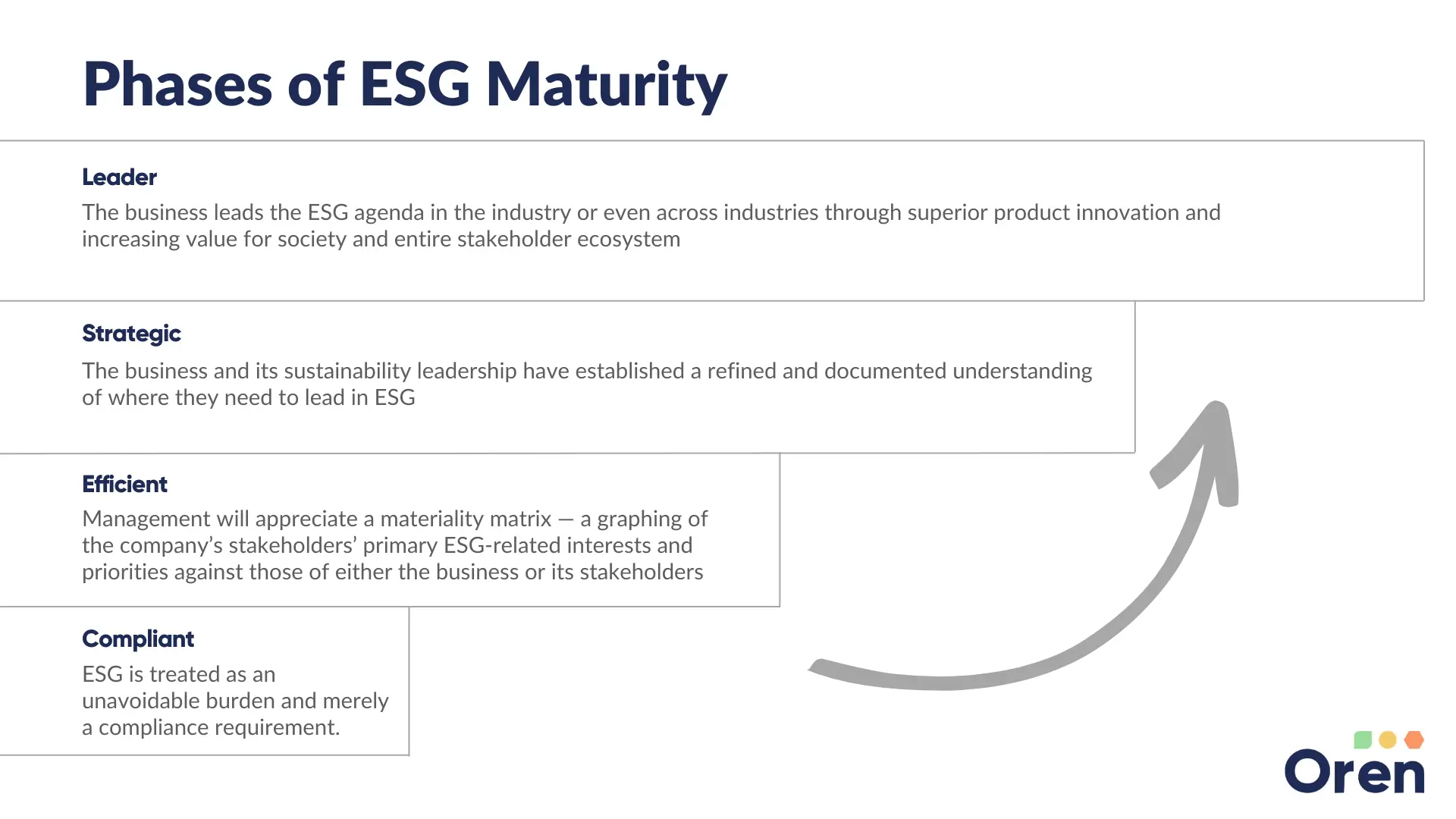
- Compliant: ESG is treated as a mandatory requirement rather than a strategic advantage.
- Efficient: ESG efforts are structured, with a materiality matrix to map stakeholder priorities.
- Strategic: The company has a well-defined ESG vision, with leadership driving sustainability goals.
- Leader: The company sets industry benchmarks, leveraging innovation to create value for society and stakeholders.
3. Benchmarking and Competitive Analysis
- Compare ESG performance against industry peers and best practices.
- Identify performance gaps to develop targeted improvements.
- Evaluate how ESG positioning influences investor confidence and corporate reputation.
Why ESG Maturity Matters
1. Strategic Initiative Planning
- An ESG maturity assessment helps companies prioritise ESG issues relevant to their operations and stakeholders.
- By assessing risks and opportunities, businesses can determine which initiatives require immediate attention and which can be developed over time.
2. Technology Alignment
- Companies in the early stages need foundational tools for data collection and reporting.
- Advanced companies can invest in AI-driven platforms for enhanced ESG performance tracking.
- Platforms like the Oren Sustainability Hub streamline ESG data management and reporting at all maturity levels.
3. Stakeholder Engagement
- A maturity assessment helps businesses identify key stakeholders, including employees, suppliers, investors, and regulators.
- Insights from the assessment guide targeted engagement strategies to enhance transparency and collaboration.
4. Budget Planning and Resource Allocation
- Companies can pinpoint priority areas and allocate financial resources efficiently.
- Aligning budgets with ESG goals ensures funds are directed toward high-impact initiatives while maintaining financial sustainability.
Implementing ESG Maturity in Your Company
1. Conduct an Internal ESG Assessment
- Evaluate existing ESG policies, metrics, and performance data.
- Identify industry-specific risks and opportunities.
- Establish a baseline ESG performance level for continuous improvement.
2. Determine ESG Maturity Level
- Assess where your company currently stands on the ESG maturity scale.
- Conduct peer benchmarking for industry insights.
- Engage ESG experts, such as Oren's team, for assessment and strategy development.
3. Define Realistic and Strategic ESG Goals
- Align ESG goals with corporate mission and stakeholder expectations.
- Prioritise material topics such as carbon emissions, labor rights, waste management, and corporate governance.
- Establish key performance indicators (KPIs) to track progress effectively.
4. Develop and Implement a Structured ESG Action Plan
- Define actionable steps for policy enhancements, operational efficiencies, and technology integrations.
- Allocate resources and assign responsibility to ensure execution.
- Integrate sustainability principles into governance and decision-making processes.
5. Strengthen ESG Reporting and Stakeholder Engagement
- Publish ESG performance reports aligned with recognised standards (e.g., BRSR, GRI, SASB, TCFD).
- Maintain transparency through regular ESG impact reports and disclosures.
- Utilise digital platforms like the Oren Sustainability Hub for improved data accuracy and reporting efficiency.
6. Foster a Culture of ESG Excellence
- Stay updated on evolving ESG regulations and best practices.
- Engage employees and supply chain partners in ESG initiatives.
- Establish an ESG governance committee to oversee continuous improvement and strategic alignment.
Conclusion
Advancing ESG maturity is an ongoing process requiring commitment, strategic planning, and regular evaluation. Companies that integrate ESG principles into their business strategy gain a competitive edge, enhance stakeholder relationships, and build resilience against emerging risks. The ESG Maturity Assessment framework empowers businesses to understand their current maturity level and establish a roadmap for continuous improvement.
As ESG regulations tighten and stakeholder expectations rise, companies can no longer afford to treat ESG as an optional initiative. Those that fully embrace ESG maturity will be better equipped to navigate challenges, enhance efficiency, and unlock new growth opportunities. The journey toward ESG excellence requires strong leadership, data-driven strategies, and agility to adapt to evolving sustainability demands.
Frequently Asked Questions (FAQs)
Q1. What is an ESG maturity assessment?
An ESG maturity assessment is a structured way for a company to figure out how developed its ESG practices actually are. It looks at where the company stands across environmental, social, and governance areas, identifies the gaps, and gives leadership a clear picture of how much further the company needs to go to meet its sustainability commitments.
Q2. What are the levels of ESG maturity?
Most ESG maturity models use 4 levels. The common version, also used in this guide, is Compliant (doing the bare minimum to meet regulations), Efficient (managing ESG actively to cut costs and risk), Strategic (treating ESG as a competitive advantage), and Leader (driving industry standards and shaping the broader ESG agenda). Each level has clear behaviours that define it.
Q3. Why does ESG maturity matter for a business?
It matters because ESG maturity directly shapes how well a company can plan strategic initiatives, align its technology investments, engage stakeholders, and allocate budget. A higher maturity level usually means lower regulatory risk, better access to capital, and stronger investor confidence. It also helps the company stay ahead of evolving disclosure requirements instead of catching up.
Q4. What's the difference between an ESG maturity model and an ESG maturity assessment?
Think of the model as the map and the assessment as the actual measurement. An ESG maturity model defines the stages and what each one looks like. An ESG maturity assessment is the exercise of evaluating a specific company against that model to identify where it currently sits and what it needs to move to the next stage.
Q5. How do you measure ESG maturity?
Measurement usually combines self-assessment with benchmarking. The company evaluates its policies, processes, data systems, governance structures, and reporting practices across each ESG area. Those findings get plotted against a maturity scale and benchmarked against industry peers. The result is a maturity score plus a clear view of which areas are leading and which are lagging.
Q6. What are the core components of an ESG maturity assessment?
A typical assessment covers three things: the assessment and evaluation of current ESG performance, placing the company on a maturity level scale (Compliant, Efficient, Strategic, Leader), and benchmarking against industry peers. Some assessments also include a competitive analysis to show how the company stacks up on specific ESG dimensions versus key competitors.
Q7. How long does an ESG maturity assessment take?
It depends on the size of the company and the depth of the assessment. A focused, board-level assessment can be done in 2-4 weeks. A full enterprise assessment covering multiple business units, geographies, and ESG dimensions usually runs 6-10 weeks. The biggest variable is how quickly internal teams can pull together the data the assessment needs.
Q8. Who should conduct an ESG maturity assessment?
Companies usually choose between an internal team, an external consultant, or a hybrid approach. Internal teams know the business best but may lack objectivity or peer benchmarking access. External consultants bring methodology, comparison data, and a neutral view but cost more. The hybrid model, where internal teams lead and consultants validate, tends to give the most balanced result.
Q9. How can a company improve its ESG maturity level?
Improvement usually follows a clear sequence: complete an honest assessment, agree the target maturity level, define specific goals for the next 12-18 months, build an action plan with owners and timelines, strengthen ESG reporting practices, and build internal culture around sustainability. Companies that move up levels treat ESG as core business rather than a side workstream.
Q10. What's the difference between ESG maturity and ESG performance?
ESG performance measures specific outcomes, like emissions reduced, water saved, or diversity hired. ESG maturity measures how well the underlying systems, governance, data, and processes are set up to deliver those outcomes over time. Strong maturity usually leads to strong performance, but a company can post good short-term numbers while having weak underlying maturity.

About the author
Olivia Paul
ESG & Sustainability Advisor
Olivia is an ESG & Sustainability Advisor at Oren, focused on ESG reporting and strategy, materiality assessments, GHG inventory, and net-zero roadmaps across manufacturing, financial services, and infrastructure.