Green Bonds: Meaning, How They Work, Types & Rules by Region
On 25 January 2023, the Reserve Bank of India auctioned the country's first sovereign green bonds: ₹8,000 crore of five-year and ten-year government paper. A second ₹8,000 crore auction followed on 9 February. With that, India joined a market that a handful of development banks started in 2007 and 2008.
Green bonds now fund solar parks, metro lines, efficient buildings and water systems in almost every major economy. They also come with obligations. Investors expect a published framework, an independent review, and reports every year on where the money went and what it achieved.
This guide explains what green bonds are, how they work, the standards behind them, and the rules in India, the EU, the UAE and Malaysia. It ends with what a company needs in place before its first green bond issuance.
What Are Green Bonds?
Green bonds are debt securities whose proceeds, or an equivalent amount, are applied exclusively to eligible green projects. Repayment, coupon and credit risk work exactly as they would on the issuer's conventional bonds.
The green bond meaning in one line
The money goes to eligible green projects, and the issuer proves it with evidence. A green bond from a bank carries that bank's own credit rating.
The rulebook most issuers follow
The Green Bond Principles (GBP) from the International Capital Market Association (ICMA) are voluntary guidelines. The June 2025 edition is current.
How Do Green Bonds Work?
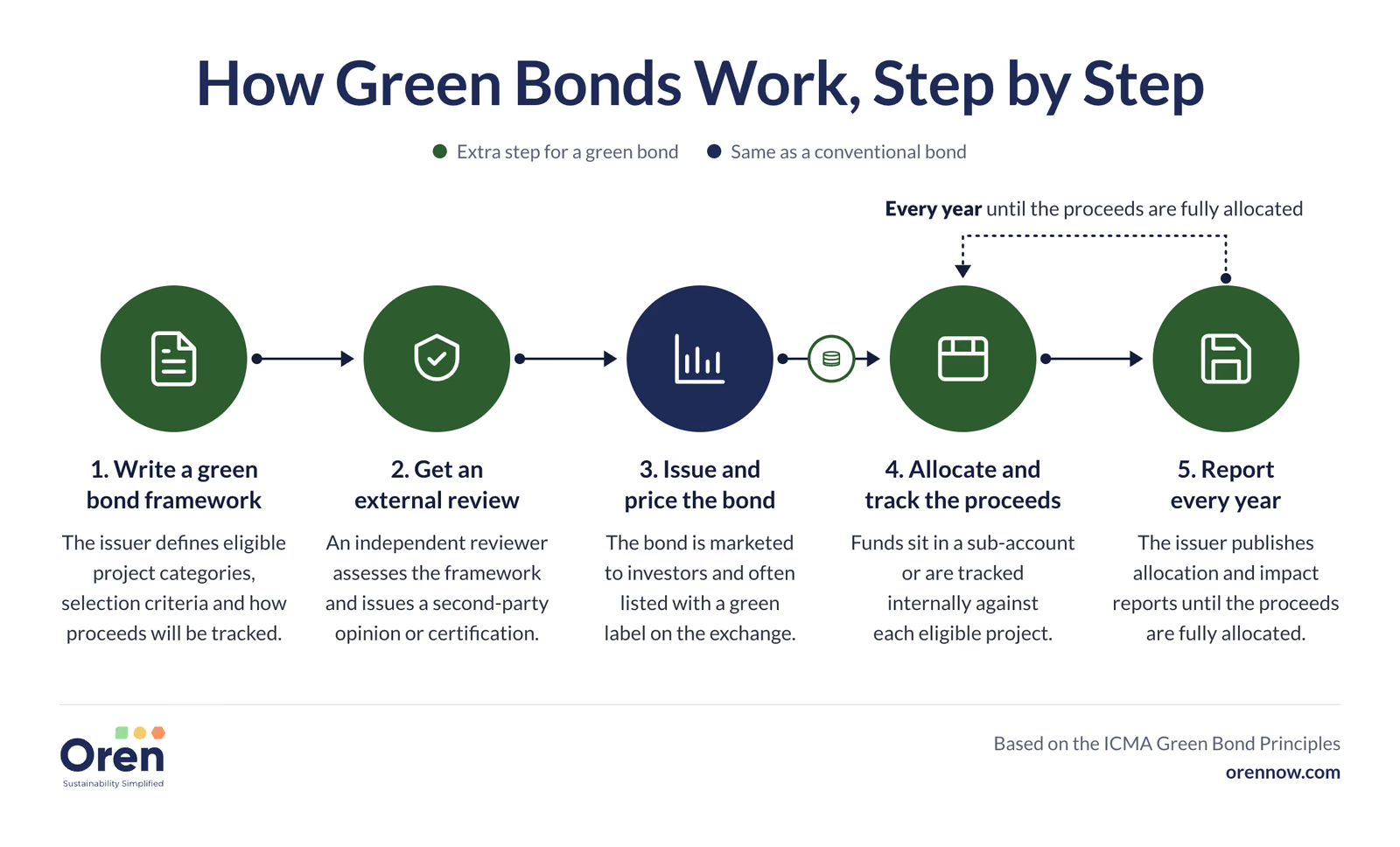
Green bonds follow the same issuance process as conventional bonds, with added steps for project selection, proceeds tracking and reporting. The sequence runs like this:
Write a green bond framework: The issuer defines eligible project categories, selection criteria and how proceeds will be tracked.
Get an external review: An independent reviewer assesses the framework and issues a second-party opinion, verification or certification.
Issue and price the bond: It is marketed to investors and often listed with a green label.
Allocate and track the proceeds: Funds sit in a sub-account or are tracked internally against each eligible project.
Report: ICMA asks for allocation reporting every year until proceeds are fully allocated, plus impact reporting. Many issuers keep reporting until maturity.
ICMA sets four core components: use of proceeds, project evaluation and selection, management of proceeds, and reporting. A framework and an external review are formally "key recommendations". In practice most issues have both: the Climate Bonds Initiative found that 86% of 2019 green bond volume carried an external review.
What Can Green Bonds Fund?
Green bonds can fund any project category that delivers a measurable environmental benefit. The ICMA Green Bond Principles list the categories most issuers use:
renewable energy, including generation, transmission and storage
energy efficiency in buildings, industry and grids
pollution prevention and control, including waste and emissions reduction
clean transportation, such as electric, rail and non-motorised transport
sustainable water and wastewater management
green buildings that meet recognised certification standards
climate change adaptation, such as flood defences and early warning systems
sustainable land use, forestry, biodiversity and circular economy products
The list is not exhaustive. Each issuer picks the categories that match its capital plan and names them in its framework. Investors then hold it to that list.
Types of Green Bonds
The ICMA Green Bond Principles recognise four types of green bonds. These differ in how investors are repaid and what they can claim on.
Type | How it works | Typical issuer |
Standard Green Use of Proceeds Bond | Unsecured debt with full recourse to the issuer | Banks, corporates, sovereigns |
Green Revenue Bond | No recourse to the issuer; credit exposure is to pledged revenues, fees or taxes; proceeds go to related or unrelated green projects | Municipalities, utilities |
Green Project Bond | Investors take direct exposure to the risk of one or more green projects, with or without recourse to the issuer | Project companies, infrastructure developers |
Secured Green Bond | Secured on assets, including covered bonds and securitisations; proceeds go exclusively to green projects | Banks, leasing and mortgage lenders |
The standard use of proceeds bond is by far the most common. It lets an established issuer borrow at its usual rating while committing the money to green assets.
Themed Sub-Labels
Some regulators add colour-coded labels. SEBI recognises blue bonds (water and marine), yellow bonds (solar) and transition bonds as sub-categories of green debt securities.
Who Issues Green Bonds?
Green bonds are issued by national governments, development banks, commercial banks, companies and cities. Each uses them for a slightly different purpose.
Sovereigns: Governments finance budget items such as rail, solar power and forestry. India, the UK and many EU member states issue sovereign green bonds.
Development banks: The European Investment Bank and the World Bank created the market and remain large, regular issuers.
Banks: They raise green funding and lend it on to renewable energy and green building projects.
Corporates: Utilities, real estate firms, manufacturers and transport operators finance specific capital projects.
Municipalities: Cities and public agencies fund metro lines, water treatment and efficient public buildings.
Green Bonds vs Other Sustainable Bonds
Green bonds belong to a wider family of sustainable bonds, often grouped together as ESG bonds. The labels differ on two points: what the money can fund, and whether the bond's terms change with the issuer's performance.
Bond type | Use of proceeds | What investors track | Main guidance |
Green bond | Environmental projects only | Allocation and environmental impact | ICMA Green Bond Principles |
Social bond | Social projects, such as affordable housing and healthcare | Allocation and social impact | ICMA Social Bond Principles |
Sustainability bond | A mix of green and social projects | Allocation and both types of impact | ICMA Sustainability Bond Guidelines |
Sustainability-linked bond | General corporate purposes | KPIs against targets; coupon usually steps up if targets are missed | ICMA Sustainability-Linked Bond Principles |
Transition bond | Decarbonisation in hard-to-abate sectors | Allocation plus a credible transition plan | ICMA Climate Transition Bond Guidelines (November 2025) |
Blue bond | Water and marine projects | Allocation and water or ocean impact | A green sub-label (for example, under SEBI) |
The Sustainability-Linked Outlier
Its proceeds are unrestricted. The issuer usually pays a higher coupon if it misses a target, such as a cut in Scope 1 and 2 emissions. Companies without a pipeline of green capex often prefer this route.
Where Transition Bonds Fit
Steel, cement and oil and gas companies use them for real decarbonisation projects that would fail a strict green test. Our guide on how ESG reporting helps companies qualify for green bonds and sustainability-linked loans compares the bond and loan routes.
Green Bond Standards and External Reviews
Three standards shape most green bond issuance worldwide: the ICMA Green Bond Principles, the European Green Bond Standard and the Climate Bonds Standard. They differ mainly in how strict they are and who checks compliance.
Standard | Who Sets It | Status | What It Requires |
Green Bond Principles | ICMA | Voluntary market baseline; June 2025 edition | Four core components; framework and external review recommended |
European Green Bond Standard (EuGB) | EU, Regulation (EU) 2023/2631 | Voluntary label, applicable from 21 December 2024 | At least 85% of proceeds to EU Taxonomy-aligned activities; ESMA-registered external reviewer; factsheet, allocation and impact reports |
Climate Bonds Standard | Climate Bonds Initiative | Voluntary certification | Sector criteria; verification by an approved verifier before and after issuance |
The EU Label in Practice
Only bonds that meet the taxonomy and review rules may use the "European Green Bond" or "EuGB" name. A2A issued the first EuGB, EUR 500 million, in January 2025. ESMA's transitional regime for reviewers ended on 21 June 2026, and seven external reviewers were registered by October 2026. Bonds marketed in the EU without the label can still follow ICMA, and can use the EU's voluntary disclosure templates under Delegated Regulation (EU) 2025/753.
What is a Second-Party Opinion?
A second-party opinion is an independent assessment of whether a green bond framework meets the ICMA Green Bond Principles, issued before the bond is sold. ICMA's External Review Guidelines also recognise verification, certification and scoring.
Some reviewers grade frameworks. India's sovereign green bond framework was rated "Medium Green" with a "Good" governance score by CICERO Shades of Green, as the Ministry of Finance announced in November 2022.
What is a Green Bond Framework?
A green bond framework is the public document that sets out how an issuer will select, fund, track and report on eligible green projects. It is what the external reviewer assesses and what investors check every annual report against. A framework aligned with the ICMA Green Bond Principles covers:
The issuer's sustainability strategy and the rationale for issuing
Eligible project categories, with technical criteria and exclusions
The internal committee and process for selecting projects
How proceeds are tracked, and how unallocated funds are held
The allocation and impact metrics the issuer will report, and how often
Most frameworks are written once and used for several issues. That makes the reporting commitments long-lived, so they should match data the company can produce every year.
Green Bond Market Size in 2026
Green bonds are the largest label in sustainable debt. According to the Climate Bonds Initiative (CBI), aligned green, social, sustainability and transition (GSS+) debt passed USD 7 trillion cumulatively in May 2026.
2025 issuance: aligned GSS+ volume topped USD 1 trillion for the third year running.
Green share: green bonds were 64% of 2025 aligned volume, or USD 653.5 billion.
Cumulative green: more than USD 4 trillion since 2007.
India: CBI counts USD 55.9 billion of aligned GSS+ debt from Indian issuers to December 2024, with green bonds and loans making up 83%.
Green Bond Rules by Region
Most markets build on the ICMA principles and add local listing and disclosure rules. The table below summarises the main regimes for issuers.
Region | Regulator and Rules | What Issuers Must Do |
India (corporate) | SEBI: NCS Regulations, 2021; definition widened February 2023; reviewer mandatory since 27 February 2026 | Use proceeds for defined green categories, disclose the framework, appoint an independent third-party reviewer, follow SEBI's greenwashing dos and don'ts |
India (sovereign) | Ministry of Finance Sovereign Green Bonds Framework (9 November 2022); RBI auctions | Government allocates proceeds to eligible public projects and publishes allocation and impact reports |
European Union | Regulation (EU) 2023/2631, applicable from 21 December 2024 | For the EuGB label: 85% Taxonomy alignment, ESMA-registered reviewer, standard reports |
UAE | SCA decision on green and sustainability-linked bonds and sukuk (2023); ADGM FSRA and DFSA regimes in the free zones | Issue under a defined framework; list onshore on ADX or DFM, or on Nasdaq Dubai |
Malaysia | Securities Commission Malaysia SRI Sukuk Framework (2014); ASEAN Green Bond Standards (2017) | Meet SRI eligibility and disclosure rules; optional ASEAN label |
US and UK | No statutory green bond label | Follow ICMA principles or seek Climate Bonds certification |
Green Bonds in India: SEBI Rules for Corporate Issuers
SEBI regulates corporate green bonds as "green debt securities" under the Issue and Listing of Non-Convertible Securities (NCS) Regulations, 2021.
The 2023 Amendment
Notified on 2 February 2023, it widened the definition to cover pollution prevention and control, circular economy projects and sectors under the India Cooling Action Plan. It also created blue bonds, yellow bonds and transition bonds as sub-categories.
Greenwashing and Disclosure Circulars
A SEBI circular of 3 February 2023 set dos and don'ts to curb greenwashing, effective immediately. A second circular, dated 6 February 2023, revised disclosure rules for issues launched from 1 April 2023.
Mandatory Independent Review
SEBI's framework for ESG debt securities, dated 5 June 2025, requires an independent third-party reviewer for social, sustainability and sustainability-linked bonds. A SEBI circular dated 27 February 2026 made the same appointment mandatory for green debt securities, with immediate effect. The reviewer must be independent and have ESG debt expertise; SEBI registration is not required.
Listed issuers will find much of the impact data overlaps with their Business Responsibility and Sustainability Report (BRSR).
What are Sovereign Green Bonds?
Sovereign green bonds are green bonds issued by a national government to fund eligible public projects. India's Ministry of Finance published its Sovereign Green Bonds Framework on 9 November 2022.
India's First Two Auctions
The RBI raised ₹16,000 crore across two auctions. On 25 January 2023 it sold ₹4,000 crore each of 2028 and 2033 securities, at cut-off yields of 7.10% and 7.29%.
Issuance Since Then
Auctions have shifted to 30-year paper. The RBI's October 2026 to March 2027 borrowing calendar schedules five tranches of ₹3,000 crore, down from ₹5,000 crore in earlier half-years.
Who Can Buy Them
Each auction reserves 5% for non-competitive retail bids through RBI Retail Direct. Since an RBI circular of 5 June 2026, all new sovereign green bonds are open to foreign investors under the Fully Accessible Route.
UAE and the GCC
The UAE Securities and Commodities Authority (SCA) adopted a decision in April 2023 allowing public joint-stock companies to issue green and sustainability-linked bonds and sukuk. SCA waived registration fees for green issues in 2023 and extended the waiver into 2024.
Free Zone Regimes
ADGM's Financial Services Regulatory Authority added green and sustainability-linked designations for bonds and sukuk in July 2023. The Dubai Financial Services Authority (DFSA) oversees listings on Nasdaq Dubai, which reported USD 30.08 billion of listed ESG debt at end-2025, including USD 18.38 billion of green bonds.
Green sukuk, the Shariah-compliant equivalent of a green bond, are common across the GCC. Our guide to green sukuk and Islamic sustainable finance explains how the structure differs. For the wider regulatory picture, see our GCC ESG regulations guide.
Malaysia
The Securities Commission Malaysia launched its Sustainable and Responsible Investment (SRI) Sukuk Framework in 2014. On 27 July 2017, Tadau Energy issued the world's first green sukuk under it, a programme of up to RM250 million for a large-scale solar project in Sabah. The ASEAN Green Bond Standards followed on 8 November 2017, launched by the ASEAN Capital Markets Forum. Issuers listed on Bursa Malaysia also face the disclosure rules in our ESG reporting in Malaysia guide.
United States and United Kingdom
The United States has no federal green bond label, so US issuers, including many municipalities, follow ICMA or seek Climate Bonds certification. The UK issued its first green gilt, £10 billion maturing in 2033, on 21 September 2021. Its Green Financing Framework was updated in November 2025.
Green bond examples
The European Investment Bank issued the first climate-themed bond in 2007. These green bond examples trace how the market grew:
2007, European Investment Bank: the EUR 600 million Climate Awareness Bond.
2008, World Bank: its first labelled green bond, SEK 2.325 billion over six years, arranged with SEB. T
2015, Yes Bank: India's first green infrastructure bonds, ₹1,000 crore over ten years.
2017, Tadau Energy: the world's first green sukuk, Malaysia.
2021, UK government: the first green gilt, £10 billion.
2021, Ghaziabad Nagar Nigam: ₹150 crore, which the Government of India calls India's first certified green municipal bond.
2023, Government of India: the first sovereign green bonds, ₹16,000 crore across two auctions.
2025, A2A: the first European Green Bond, EUR 500 million.
2026, CleanMax: ₹2,500 crore of privately placed green NCDs at coupons of 8.25% to 8.76%.
Benefits and Risks of Green Bonds for Issuers
Green bonds widen the investor base but add years of reporting and reputational exposure.
Benefits
Wider investor base: Many dedicated green funds limit their holdings to labelled bonds.
Pricing: Strong demand can lower the coupon slightly, a gap called the "greenium". Reuters estimated it at about 4 basis points on India's August 2026 sovereign green bond. It is never guaranteed.
Credibility: A framework turns a climate strategy into named, funded projects that investors can check.
Risks
Greenwashing claims: Proceeds used outside the framework invite regulatory action.
Reporting cost: Allocation and impact reports run every year, often to maturity.
Data conflicts: Impact figures that disagree with the company's other disclosures erode trust quickly.
Our guide to how ESG audits and assurance safeguard against greenwashing covers the controls regulators look for.
How to Issue a Green Bond: What Companies Need First
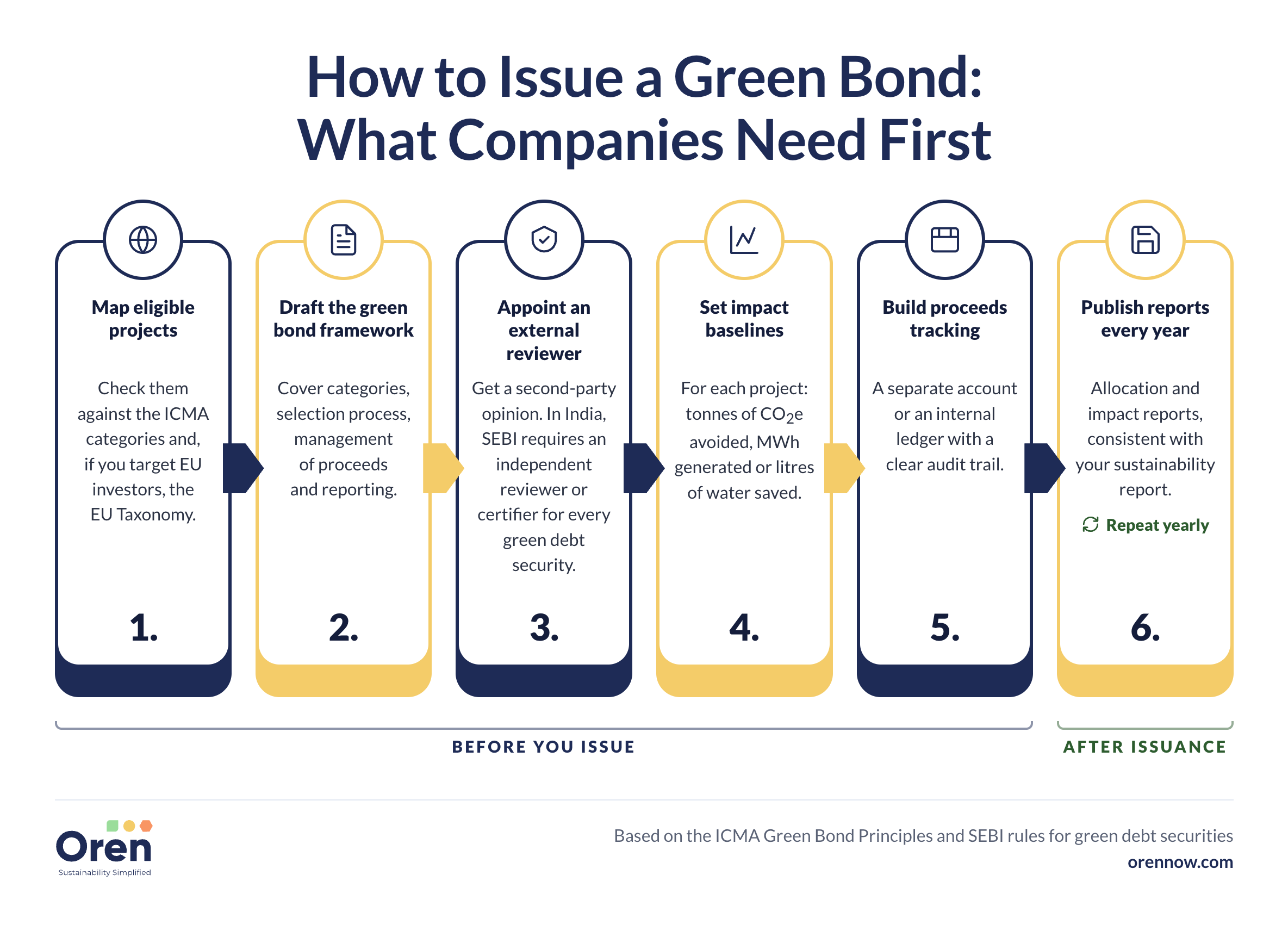
Before any green bond issuance, a company needs eligible projects, an accepted framework and data systems that can produce allocation and impact reports every year. A practical sequence:
Map eligible projects against the ICMA categories and, if you target EU investors, the EU Taxonomy.
Draft the green bond framework covering categories, selection, management of proceeds and reporting.
Appoint an external reviewer. In India, SEBI has required an independent third-party reviewer for every green debt security since 27 February 2026.
Set impact baselines for each project: tonnes of CO2e avoided, MWh generated or litres of water saved.
Build proceeds tracking through a separate account or an internal ledger with an audit trail.
Publish allocation and impact reports each year, consistent with your sustainability report.
Where First-Time Issuers Struggle
Impact reporting is where most first-time issuers struggle. Avoided emissions need a sound baseline, and the figures must match what the company discloses elsewhere. A complete GHG Inventory built to the GHG Protocol makes those numbers defensible in front of reviewers and investors.
How Oren Can Help
Oren supports issuers from the first project screen to the annual impact report. Our sustainable finance advisory team works with treasury and sustainability teams to:
Screen projects against ICMA categories, the EU Taxonomy and SEBI's green debt definitions
Draft the green bond framework and prepare for the external review
Set impact metrics and build the emissions baselines behind them on the Oren platform
Produce allocation and impact reports that stay consistent with your BRSR and other disclosures
Key Takeaways
Green bonds are ordinary debt with a binding promise on use of proceeds. The ICMA principles set the global baseline, while the EU Green Bond Standard and SEBI's rules add hard requirements for issuers in those markets.
Regulation is tightening in every major market, and investors now check impact claims against company-wide disclosures. Issuers that build the data foundation first will find each new green bond cheaper and faster to bring to market.
If you are weighing a first green bond or a sustainability-linked alternative, schedule a demo to see how Oren connects project data, emissions baselines and impact reporting in one place.
Frequently Asked Questions (FAQs)
Q1. What are green bonds?
Green bonds are debt securities whose proceeds finance or refinance projects with environmental benefits, such as renewable energy, clean transport or green buildings. The issuer repays investors like any other bond, and it reports each year on how the money was allocated and what environmental impact the projects achieved.
Q2. How is a green bond different from a regular bond?
The financial terms are usually the same: coupon, maturity and credit risk all sit with the issuer. The difference is the commitment on use of proceeds. A green bond ring-fences the money for eligible environmental projects, follows a published framework, and comes with external review and annual allocation and impact reporting.
Q3. Who issued the first green bond?
The European Investment Bank issued the first climate-themed bond, its Climate Awareness Bond, in 2007. The World Bank followed in November 2008 with the first bond labelled a green bond, a SEK 2.325 billion issue arranged with SEB for Scandinavian institutional investors.
Q4. Who are the issuers of green bonds?
Green bonds are issued by national governments, development banks such as the World Bank and European Investment Bank, commercial banks, companies and municipalities. All of them follow the same core rules on use of proceeds, external review and annual reporting.
Q5. What are sovereign green bonds and how do they work?
Sovereign green bonds are green bonds issued by a national government. The government publishes a framework listing eligible public projects, raises money through regular bond auctions, and reports on allocation and impact. India's first sovereign green bonds raised ₹16,000 crore through two RBI auctions in January and February 2023.
Q6. Which bank issued the first green bond in India?
Yes Bank issued India's first green infrastructure bonds in February 2015. The issue raised ₹1,000 crore with a ten-year tenor, double its base size of ₹500 crore, and the proceeds were earmarked for solar, wind, biomass and small hydro projects.
Q7. What is the difference between a green bond and a sustainability-linked bond?
A green bond restricts its proceeds to eligible environmental projects. A sustainability-linked bond can fund general corporate purposes, and its terms change, usually through a higher coupon, if the issuer misses pre-set sustainability targets such as an emissions cut. One is project-based; the other is performance-based.
Q8. How do regulators prevent greenwashing in green bonds?
Regulators set definitions, disclosure rules and review requirements. In India, SEBI defines eligible green debt securities and issued a list of dos and don'ts for issuers in February 2023. The EU Green Bond Standard requires 85% Taxonomy alignment and an external reviewer registered with ESMA.

About the author
Kushagra
Senior ESG & Sustainability Advisor
Kushagra is a Senior ESG & Sustainability Advisor at Oren with 8+ years across CSR and sustainability consulting, specialising in GHG accounting, ESG strategy, and regulatory reporting across India, the UAE, and the Middle East.